Three plans: El Resumen Esencial for free, Premium with the full analysis and Intelligence with data and alerts to decide, in English, Spanish or Portuguese.
Full speech · Institutional
Casa Rosada15 min read

One topic in one place: the official text, the video, what happened on X, how each outlet told it and the full speech.
AI estimate · 90% confidence
Main framing
Right 90%
Right · estimated by AI · 90% confidence
The estimate comes from analyzing the story's text: which sources it quotes, which facts it highlights and what language it uses.
An AI model reads the story and estimates how much of its framing leans left, center or toward a libertarian view. The three percentages add up to 100.
This is an AI-generated estimate, not an objective judgment.
Generated on · 1 min read
AI summaries may contain errors.
Milei's speech is direct and openly defends the Argentine government's stance, mentioning the defense of national sovereignty and severely criticizing organizations like the UN. He uses language promoting military action and cooperation with the West, aligning with a right-wing perspective.

Institutional · Casa Rosada

Institutional · Casa Rosada
Source: Casa Rosada (CC BY 2.5 AR). Translation by MileiHoy
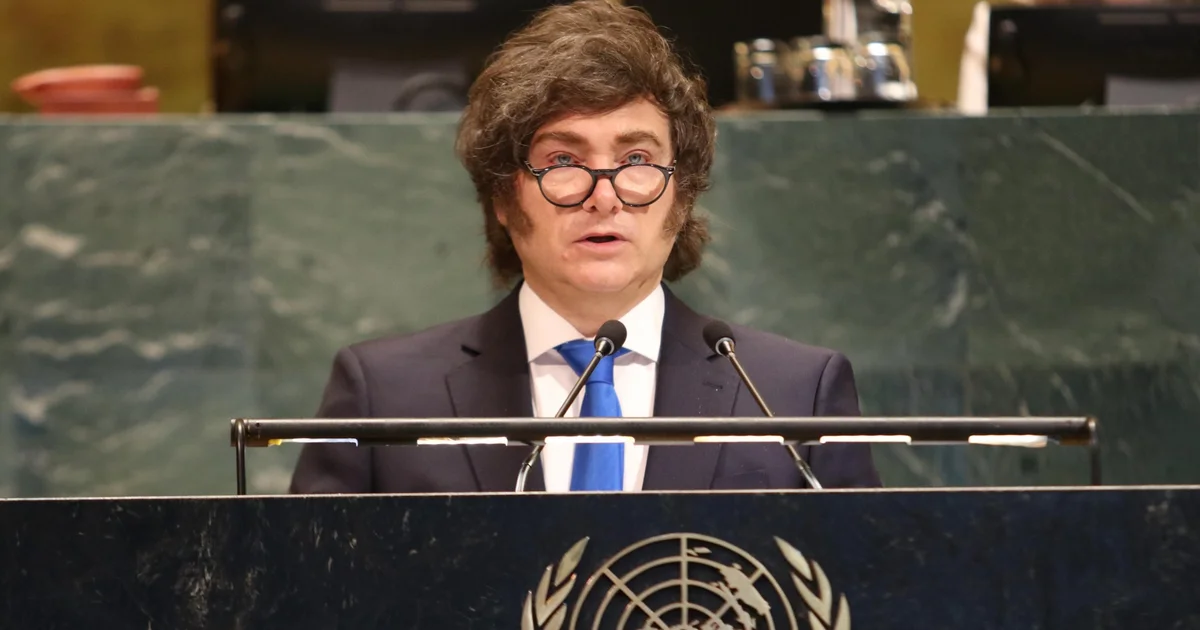
Speech by President Javier Milei at the 81st session of the United Nations General Assembly in New York.
Mr. President, Heads of State, representatives of the peoples of the world: today I address you for the third time as President of all Argentinians. When we assumed the government of a country in ruins, on the brink of the worst crisis in its history, we were clear from the start: our problems had to be faced with absolute sincerity. Lying to ourselves to feel better would lead us nowhere. It is always preferable to tell an uncomfortable truth rather than a comfortable lie.
Therefore, believe me when I say I know what I am talking about when I constructively point out the problems this organization has, which aims to guide and arbitrate between states.
In this regard, today I want to talk to you about three issues. First, what this body should have done but did not do. Second, what it should not have done, and did anyway. And third, its position regarding the advent of artificial intelligence.
Seventy-eight years ago, this house declared that all human beings are born free and equal in dignity and rights. Noble words whose spirit I fully share. And, to this end, it committed to respecting international law, defending the sovereignty of nations, and providing a forum where conflicts would be resolved through cooperation rather than immediately by arms. That was the original purpose, the contract we all signed. But today, unfortunately, it is time to recognize that this sacred pact has, in fact, been broken.
That is: it has turned into a useless organization that only serves to feed a caste of parasites, fatally arrogant, disguised as well-intentioned bureaucrats. To which I remind you what Mises said: 'good people do not think about controlling the lives of their fellow men.' Those who should guarantee collective security and human rights have failed in their task and, instead, allowed chaos, violence, and international terrorism to prevail.
The supposed defenders of Human Rights shielded bloody dictatorships and regimes that stone women in the streets. They voted systematically against Israel while remaining silent in the face of Islamic terrorism and the genocides of Christians in Africa.
And as if that weren't enough, an organization that set out to defend the territorial sovereignty of its members decided to look the other way regarding the situation of the Malvinas Islands, South Georgia, South Sandwich Islands, and the surrounding maritime spaces.
The Malvinas is a national cause for us. I repeat: the Malvinas is a national cause for us. And it is also a test of the distance that can exist between the words of international institutions and the reality they aim to act upon.
Fifty years ago, this same assembly approved resolution 3149, which urges the parties to refrain from making unilateral changes while the dispute remains open. Fifty years later, the situation has not changed, but unilateral changes continue.
Today, the Sea Lion project is moving forward with oil extraction in the Argentine continental shelf, corresponding to the Northern Falkland Basin, through British licenses that Argentina rejects as illegal and illegitimate.
Any action in this regard not authorized by the Argentine Republic constitutes an unlawful act, both in light of international law, including the United Nations Convention on the Law of the Sea, and Argentine domestic law.
For this reason, I want to pose a question: what is the use of a resolution if for decades the counterpart can act in the opposite direction while that resolution remains intact in the files, but powerless against reality?
There are no shortcomings in words or resolutions; what is lacking is consequences because an institution that fails to ensure its word weighs on facts loses what is most important: it loses its authority.
Under this reality, those who follow the rules receive no reward for doing so, while those who do not comply face no repercussions. Therefore, the Malvinas is not just an issue between Argentina and the United Kingdom. It also raises a question about this organization’s ability to uphold its own resolutions.
Argentina has taken note of that reality, and in the face of unauthorized exploitation of our resources in the disputed area, we acted, presented letters of discouragement, resorted to the legal tools available, sanctioned the companies involved and their suppliers, and sent to Congress a Law for the Defense of National Sovereignty. For too long, Argentine governments opted for a discursive defense. We chose a peaceful, practical, and effective defense. I repeat: we chose a peaceful, practical, and effective defense.
I also want to reiterate the situation of the population of the islands. As this same assembly has determined in numerous resolutions, the principle of self-determination does not apply in this case since it involves a population implanted by the occupying power over territory whose sovereignty is in dispute. That principle exists to liberate colonized peoples, not to enshrine situations derived from colonization. If the United Kingdom maintains a selective interpretation of the principle of self-determination regarding the Malvinas Islands, it must also explain how it reconciles that criterion with the existing self-determination debates within its own territory.
To the United Kingdom, we reiterate once again our call to resume negotiations to find a peaceful solution to the sovereignty dispute, as required by international law, and also our invitation to proceed without delay to exchange views with a view to resolving the issue related to the controversy over the exploitation of our natural resources.
And to the global energy sector, I want to say something more: Vaca Muerta is a historic opportunity, with the potential to be one of the major energy players of the coming decades. Come. Invest. Develop it. Do it with us. But this invitation has a limit. We will not be indifferent to those who exploit resources under illegal external occupation. The Argentine position is taken.
Today I come to tell you that Argentina will not sit and wait for the UN and the international community to rise to their own mandate; it will take action.
For too long Argentina managed its decline; we managed poverty, we managed isolation, we managed irrelevance. We became used to discussing how to divide what was left, instead of asking ourselves how to grow again, how to rebuild what we had lost. That has come to an end. We have lost too much already. We do not want to lose again.
Therefore, we embrace free enterprise capitalism. We are opening our economy to trade and investment. We are advancing in the development of our strategic resources. We embrace the technological revolution and are rebuilding our military instrument after decades of neglect.
We also made a geopolitical choice: we aligned ourselves unambiguously with the West. We did so with the United States and Israel, countries with which we share a profound affinity of values and a strategic complementarity.
That is why we repudiate the attacks of the Iranian regime against the State of Israel. We declare the Iranian Revolutionary Guard a terrorist organization, while we continue to seek justice for the two attacks we suffered on our Argentine soil in 1992 and 1994.
We have decided to cooperate with the world, but to do so standing tall, understanding that only a politically relevant nation, economically influential, and militarily respectable can truly own its destiny.
Mr. President, just as I showed you how the UN failed to fulfill what it was supposed to do, I now want to tell you how it excelled in doing what nobody asked of it and that it never should have done, because in parallel to this failure they have mounted a bureaucratic leviathan, devoted to deciding how the peoples of the world and their citizens must live.
This constitutes a curious mix of anarchy and tyranny, impotence among those who break the most basic rules like bloody dictatorships and terrorist organizations, and Orwellian control and imposition against those liberal democracies that do comply with the norms. We saw it with the New Millennium agenda. We saw it with the 2030 Agenda, with economic regulation, gender agendas, extremism and environmentalism, and uncontrolled immigration.
And, each time they have failed, instead of reviewing the model or apologizing, they doubled down, as they are doing now with the 2045 Agenda, which I dare say will fail.
But the gravest example, the one that should shame this organization forever, is another: it is the management of the pandemic. During the pandemic, agencies that depend on this house put themselves ahead of scientific evidence and the sovereignty of nations and promoted policies of forced lockdowns worldwide that destroyed jobs, ruined the education of an entire generation of children, and cost the lives of millions of people who died alone, without basic medical care.
Where some claim a mistake in health policy, we see a global experiment in social control disguised as science. And when a state with health blinders takes away its population's right to work, to educate themselves, to mourn their dead, and that translates into millions of avoidable deaths, there is a word to name it: genocide.
That occurred in many countries, including Argentina, which boasted of being the chosen pupil of the World Health Organization, which is why we decided to leave it. To this is added something more subtle, but equally harmful: the psychological terror installed by the State. For years, citizens of the world were told they had to be afraid, afraid of their neighbors, of the air they breathed, of leaving their homes. That fear was not a side effect; it was the chosen tool of governance. The problem is that then..., emergencies pass, fear passes, generations pass, and the institutions and powers created at the expense of those supposed emergencies remain.
And, if for any moment, we were led to believe that the lesson was learned after so many failures, the arrival of Artificial Intelligence proves otherwise. The printing press, the steam engine, electricity, the internet, every great technological revolution was accompanied by fears about what it would destroy, particularly employment.
Undoubtedly, one of the most effective ways to sow terror in human beings, given the role that work plays as a mechanism of sustenance. As an example, let us take the Industrial Revolution. At the time of its arrival, the world was home to about 800 million human beings. Moreover, if in line with the Luddites and the usual pessimists, like this house, in the best case scenario employment would have remained constant since today the population has multiplied more than 10 times, then according to these absurd hypotheses the unemployment rate in the world would be 90%. Ridiculous, something that seems to have been little thought out, except for those of us who have the passion for reading Jorge Luis Borges and love his vision of validating an idea by taking it to its limits.
Ultimately, these technological improvements have not only not led to any of the catastrophes with which they have tried to instill terror, but also, each of them has ended up expanding what the human being is capable of doing. Now man has built machines capable of performing tasks that until recently seemed reserved for his own intelligence.
And there, where many see a threat, we see a frontier. Artificial intelligence or superintelligence, as President Donald Trump calls it, can multiply our productivity by orders of magnitude that we still do not fully understand.
Bringing in Adam Smith: artificial intelligence will be the pin factory of the 21st century, and much more. It can transform our economies, our medicine, our education, and even our way of governing. Does that require caution? Yes. But caution does not mean fear, and, moreover, fear should in no case automatically turn into obedience.
In fact, the dystopian scenarios that are often alluded to in order to instill fear and promote state control make no sense from an economic point of view. The answer is in Adam Smith: artificial intelligence, just as the division of labor in the case of the pin factory, is an accelerator for productivity growth. However, Smith noted that the division of labor is limited by the size of the market. Therefore, growth will be extended with its counterpart of genuine demand, without the need for fiscal deficits or spurious money issuance.
But not only that, but also these projects have to be financed and that is done with the resources of human beings. This is the initial endowments and the level of wealth that is the counterpart of the size of the market. Moreover: producing more aims at a higher level of consumption. However, the satisfaction it generates itself grows at a decreasing rate while the loss of satisfaction of giving up leisure for greater production grows disproportionately.
Thus, that point where what is gained from increased consumption equals the loss of leisure leads the system to a position of equilibrium, leaving no room for dystopian terror. That is why, when we hear that the state must control artificial intelligence, it is worth remembering something elementary: the state is not an abstract creature, but rather men, officials, and bureaucrats, and granting it control over innovation is granting some, in the best and most naive of cases, the power to limit what others can create.
History provides us with reasons to carefully examine such power. For centuries, fear of tomorrow has been used as an argument to restrict freedoms in the present, with the same promise: give us a part of your freedom and we will protect you from this new threat.
We will apply a different principle: in the face of uncertainty, we propose determination; in the face of fear, courage; in the face of decay, ambition; and in the face of resignation, we propose optimism.
That is why I tell you: in the face of artificial intelligence, Argentina will position itself at the forefront of freedom. We have the critical minerals, energy, talent, and the capacity to compete in every link of that value chain, and we want to be the most competitive place in the world to develop it, with a cutting-edge legal framework, the commitment not to regulate preventively, limited liability for companies that operate with AI agents, and tax benefits.
Because artificial intelligence is not a geopolitically neutral issue. It is necessary for the West to lead the development of the technology to ensure that it aligns with our fundamental libertarian values, such as respect for life, freedom, private property, and the notion of human dignity. In this, we fully share President Trump's vision.
Mr. President, we live in one of those strange moments in history where a world begins to disappear before the next one has finished being born. These are dangerous moments, but they are also extraordinary because during long periods of stability, nations manage the world they have inherited, while in periods of transformation, some have the opportunity to build the world to come. Argentina wants to be one of them.
We will continue to be part of multilateral forums, in good faith, because there are problems that require joint work. But we do not confuse cooperation with subordination. We believe in alliances and, above all, in nations. Argentina speaks about this with the experience of someone who knows its own mistakes; we know the cost of isolation, we know the cost of destroying a currency, we know the cost of turning the state into a permanent obstacle to human initiative.
For a century we experimented with almost all forms of impeding our own greatness and we survived, not unscathed, but we survived. And perhaps that is why today we understand something that other nations may forget: decay is not a destiny, but the result of repeated decisions, and if that course can be chosen, it can also be changed. That is what Argentina is trying to do.
We have the energy that the world will need. We have food, we have critical minerals, we have human talent, we have the South Atlantic, and we are a natural gateway to Antarctica. And we have something that we have lacked for far too long: the will to transform our possibilities into national power.
We want a prosperous, influential, and powerful Argentina. Not to subjugate others, but to be free. Not to conquer others, but for our destiny to be decided by Argentines.
That is why, to the free men and women of the world, to scientists, entrepreneurs, creators, to those who dreamed of a land where they could start anew, I say: look to the south. You will find a vast land of fertile fields, of oil, of minerals, and of human talent. A land that welcomed millions who crossed oceans in the hope that their children would live better than they did and built one of the most prosperous nations on earth.
We have the responsibility to rise to this occasion. We do not know exactly what the world that is being born will look like, but we do know what kind of nation we want to be when it arrives. A free nation. A prosperous nation. A sovereign nation. A nation capable of defending its own and open to the world. A nation that is not afraid to once again pronounce the word that for too long seemed prohibited: greatness.
No nation is guaranteed a place in history; it is built generation after generation, with work, with freedom, and with the will of a people that refuses to accept that their best days are behind them.
We believe that Argentina still has a great history ahead. And we have decided to go and seek it. May God bless all the peoples of the world. May God bless the Argentine Republic. May the forces of heaven accompany us and ¡viva la libertad, carajo!
Discurso del Presidente Javier Milei ante la 81.ª sesión de la Asamblea General de la ONU en Nueva York
Señor Presidente, Jefes de Estado, representantes de los pueblos del mundo: hoy me dirijo ante ustedes por tercera vez como Presidente de todos los argentinos. Cuando asumimos el gobierno de un país en ruinas, al borde de la peor crisis de su historia, tuvimos algo claro desde el principio: nuestros problemas debían enfrentarse con absoluta sinceridad. Mentirnos a nosotros mismos para sentirnos mejor no nos iba a llevar a ninguna parte. Siempre es preferible decir una verdad incómoda por sobre una mentira confortable.
Por eso, créanme que sé de lo que hablo cuando señalo con ánimo constructivo los problemas que tiene esta organización, que pretende orientar y arbitrar entre los Estados.
En este sentido, hoy quiero hablarles de tres cuestiones. Primero, aquello que este organismo debió hacer y no hizo. Segundo, aquello que no debió hacer e hizo de todas formas. Y tercero, su posición ante el advenimiento de la inteligencia artificial.
Hace 78 años esta casa declaró que todos los seres humanos nacen libres e iguales, en dignidad y derechos. Palabras nobles cuyo espíritu comparto plenamente. Y, para este fin, se comprometió a hacer respetar el derecho internacional, a defender la soberanía de las naciones y a ofrecer un foro donde los conflictos se resolvieran por la cooperación en vez de resolverse instantáneamente por las armas. Ese era el propósito original, el contrato que todos firmamos. Pero hoy, lamentablemente, es momento de reconocer que ese pacto sagrado en los hechos se rompió.
Esto es: se convirtió en una organización inútil que sólo sirve para alimentar una casta de parásitos, fatalmente arrogantes, disfrazados de burócratas bien intencionados. A lo que les recuerdo lo que decía Mises: “las buenas personas no piensan en controlar la vida de sus semejantes”. Quienes deberían garantizar la seguridad colectiva y los derechos humanos fracasaron en la tarea y en su lugar permitieron el caos, la violencia y el terrorismo internacional.
Los supuestos defensores de los Derechos Humanos apañaron a dictaduras sanguinarias y regímenes que lapidan mujeres en la calle. Votaron sistemáticamente en contra de Israel, mientras hacían silencio frente al terrorismo islámico y ante genocidios de cristianos en el África.
Y como si fuera poco, una organización que se propuso defender la soberanía territorial de sus miembros decidió mirar para el otro lado respecto a la situación de las Islas Malvinas, Georgias del Sur, Sándwich del Sur y los espacios marítimos circundantes.
Malvinas es para nosotros una causa nacional. Repito: Malvinas es para nosotros una causa nacional. Y es también una prueba de la distancia que puede existir entre las palabras de las instituciones internacionales y la realidad sobre la que pretenden actuar.
Hace 50 años, esta misma asamblea aprobó la resolución 3149, que insta a las partes a abstenerse de introducir modificaciones unilaterales mientras la disputa permaneciera abierta. 50 años después, la situación no ha cambiado, pero las modificaciones unilaterales continúan.
Hoy, el proyecto Sea Lion avanza hacia la extracción de petróleo en la plataforma continental argentina, correspondiente a la Cuenca Malvinas Norte, mediante licencias británicas que la Argentina rechaza por ilegales e ilegítimas.
Toda actuación en este sentido no autorizada por la República Argentina, constituye un acto ilícito, tanto a la luz del derecho internacional, incluida la Convención de las Naciones Unidas sobre el derecho del mar como del derecho interno argentino.
Por eso, quiero plantear una pregunta: ¿de qué sirve una resolución si durante décadas la contraparte puede actuar en sentido contrario y esa resolución queda intacta en los archivos, pero impotente frente a la realidad?
No faltan palabras ni resoluciones, lo que falta es que tengan consecuencias porque una institución que no logra que su palabra pese sobre los hechos, pierde lo más importante: pierde su autoridad.
Bajo esta realidad, quienes siguen las reglas no tienen recompensa alguna por hacerlo, mientras que los que incumplen no reciben la menor represalia. Por eso, Malvinas no es solamente una cuestión entre la Argentina y el Reino Unido. También plantea una pregunta acerca de la capacidad de esta organización para hacer valer sus propias resoluciones.
La Argentina tomó nota de esa realidad, y frente a la explotación no autorizada de nuestros recursos en el área en disputa, actuamos, presentamos notas de desaliento, acudimos a las herramientas jurídicas disponibles, sancionamos a las empresas involucradas y a sus proveedores y enviamos al Congreso una Ley de Defensa de la Soberanía Nacional. Durante demasiado tiempo, los gobiernos argentinos optaron por una defensa discursiva. Nosotros elegimos una defensa pacífica, práctica y efectiva. Repito: nosotros elegimos una defensa pacífica, práctica y efectiva.
Quiero reiterar también la situación de la población de las islas. Como esta misma asamblea ha determinado en numerosas resoluciones, el principio de libre determinación no aplica en este caso ya que se trata de una población implantada por la potencia ocupante sobre un territorio cuya soberanía se encuentra en disputa. Ese principio existe para liberar a los pueblos colonizados, no para consagrar situaciones derivadas de la colonización. Si el Reino Unido sostiene una interpretación selectiva al principio de libre determinación respecto de las Islas Malvinas, deberá explicar también cómo concilia ese criterio con los debates sobre autodeterminación existentes dentro de su propio territorio.
Al Reino Unido le reiteramos, una vez más, nuestro llamado a reanudar las negociaciones para encontrar una solución pacífica a la disputa de soberanía, como lo requiere el derecho internacional, y también nuestra invitación a proceder sin demora a intercambiar opiniones con miras a resolver la cuestión relativa a la controversia referida sobre explotación de nuestros recursos naturales.
Y al sector energético mundial quiero decirle algo más: Vaca Muerta es una oportunidad histórica, con potencial para ser una de las grandes protagonistas energéticas de las próximas décadas. Vengan. Inviertan. Desarróllenla. Háganlo con nosotros. Pero esta invitación tiene un límite. No seremos indiferentes frente a quienes exploten recursos bajo ocupación externa ilegal. La posición argentina está tomada.
Hoy vengo a decirles que la Argentina no se va a sentar a esperar a que la ONU y la comunidad internacional estén a la altura de su propio mandato; va a tomar cartas en el asunto.
Durante demasiado tiempo la Argentina administró su decadencia, administramos la pobreza, administramos el aislamiento, administramos la irrelevancia. Nos acostumbramos a discutir cómo repartir lo que quedaba, en lugar de preguntarnos cómo volver a crecer, cómo reconstruir aquello que habíamos perdido. Eso terminó. Ya perdimos demasiado. No queremos volver a perder.
Por eso, abrazamos el capitalismo de libre empresa. Estamos abriendo nuestra economía al comercio y a la inversión. Avanzamos en el desarrollo de nuestros recursos estratégicos. Abrazamos la revolución tecnológica y estamos reconstruyendo nuestro instrumento militar después de décadas de abandono.
También hicimos una elección geopolítica: nos alineamos sin ambigüedades con Occidente. Lo hicimos con los Estados Unidos y con Israel, países con los que compartimos una profunda afinidad de valores y una complementariedad estratégica.
Por eso, repudiamos los ataques del régimen iraní al Estado de Israel. Declaramos organización terrorista a la Guardia Revolucionaria Iraní, así como seguimos buscando justicia por los dos atentados que sufrimos en nuestro suelo argentino en 1992 y 1994.
Hemos decidido cooperar con el mundo, pero hacerlo de pie, entendiendo que solo una nación políticamente relevante, económicamente influyente y militarmente respetable puede ser verdaderamente dueña de su destino.
Señor Presidente, así como les mostré cómo la ONU fracasó en cumplir con lo que debía hacer, ahora quiero contarles cómo sobresalió haciendo lo que nadie le pidió y que nunca debió hacer, porque en paralelo a este fracaso han montado un leviatán burocrático, abocado a decidir cómo deben vivir los pueblos del mundo y sus ciudadanos.
Esto constituye una mezcla curiosa de anarquía y tiranía, impotencia entre quienes rompen las reglas más básicas como dictaduras sangrientas y organizaciones terroristas, y un control e imposición orwellianas ante las democracias liberales que sí cumplen las normas. Lo vimos con la agenda del Nuevo Milenio. Lo vimos con la Agenda 2030, con la regulación económica, las agendas de género, el extremismo y ambiental, y la inmigración descontrolada.
Y, cada vez que fracasaron, en lugar de revisar el modelo o pedir disculpas, redoblaron la apuesta, como ya están haciendo ahora con la Agenda 2045, la cual, adelanto que va a fracasar.
Pero el ejemplo más grave, el que debería avergonzar a esta organización para siempre, es otro: es el manejo de la pandemia. Durante la pandemia, organismos que dependen de esta casa se antepusieron a la evidencia científica y a la soberanía de las naciones y promovieron en todo el mundo políticas de encierro forzado que destruyeron empleos, arruinaron la educación de una generación entera de niños y le costaron la vida a millones de personas que murieron solas, sin atención médica básica.
Donde algunos aducen un error de política sanitaria, nosotros vemos un experimento global de control social disfrazado de ciencia. Y cuando un Estado con anteojeras sanitaria le quita su población el derecho a trabajar, a educarse, a despedir a sus muertos y eso se traduce en millones de muertes evitables, hay una palabra para nombrarlo: genocidio.
Eso sucedió en muchos países, entre ellos la Argentina, que se jactaba de ser el alumno predilecto de la Organización Mundial de la Salud, y motivo por el cual decidimos abandonarla. A eso se le suma algo más sutil, pero igual de dañino: el terror psicológico instalado desde el Estado. Durante años a los ciudadanos del mundo se les dijo que tenían que tener miedo, miedo al vecino, al aire que respiraban, a salir de sus casas. Ese miedo no fue un efecto secundario, fue la herramienta de gobierno elegida. El problema es que ello luego…, las emergencias pasan, el miedo pasa, las generaciones pasan, y las instituciones y los poderes creados a cuenta de esas supuestas emergencias permanecen.
Y, si por algún momento, nos ilusionamos con que la lección estuviera aprendida tras tantos fracasos, la llegada de la Inteligencia artificial nos demuestra lo contrario. La imprenta, la máquina a vapor, la electricidad, Internet, cada gran revolución tecnológica estuvo acompañada por temores acerca de aquello que destruía, en especial, el empleo.
Sin dudas, una de la forma más efectivas para sembrar el terror en los seres humanos, dado el rol que tiene el trabajo como mecanismo de sustentación. A modo de ejemplo, tomemos la Revolución Industrial. Al momento de su llegada, en el mundo habitaban unos 800 millones de seres humanos. A su vez si en línea con los luditas y pesimistas de siempre, como esta casa, en el mejor de los casos el empleo se hubiera mantenido constante dado que hoy la población se ha multiplicado por más de 10 veces, entonces según estas hipótesis disparatadas la tasa de desempleo en el mundo sería de un 90%. Una ridiculez, algo que parece que poco se pusieron a meditar, salvo aquellos que tenemos la pasión de leer a Jorge Luis Borges y amamos su visión de convalidar una idea llevándola a su límite.
En definitiva, estas mejoras tecnológicas no sólo no han derivado en ninguna de las catástrofes con las que nos han intentado sembrar el terror, sino que, además, cada una de ellas terminó ampliando también aquello que el ser humano era capaz de hacer. Ahora el hombre ha construido máquinas capaces de realizar tareas que hasta hace muy poco parecían reservadas a su propia inteligencia.
Y, allí, donde muchos ven una amenaza, nosotros vemos una frontera. La Inteligencia artificial o superinteligencia, como dice el Presidente Donald Trump, puede multiplicar nuestra productividad en órdenes de magnitud, que todavía no comprendemos.
Trayendo a Adam Smith: la inteligencia artificial será la fábrica de alfileres del siglo XXI, y mucho más. Puede transformar nuestras economías, nuestra medicina, nuestra educación e incluso nuestra forma de gobernar. ¿Eso exige prudencia? Sí. Pero prudencia no significa miedo, y, es más, el miedo bajo ningún punto de vista debería convertirse automáticamente en obediencia.
De hecho, los escenarios distópicos a los que se suele aludir para infundir el miedo y propiciar el control del Estado, carecen de sentido desde el punto de vista económico. La respuesta está en Adam Smith: la inteligencia artificial, tal como la división del trabajo en el caso de la fábrica de alfileres, es un acelerador para el crecimiento de la productividad. Sin embargo, Smith señaló que la división del trabajo está limitada por el tamaño del mercado. Por ende, el crecimiento será extendido con su contrapartida de demanda genuina, sin necesidad de déficits fiscales ni emisión espuria de dinero.
Pero no solo eso, sino que además esos proyectos tienen que ser financiados y eso se hace con los recursos de los seres humanos. Esto es las dotaciones iniciales y el nivel de riqueza que es la contraparte del tamaño del mercado. Es más: producir más tiene por objeto mayor nivel de consumo. Sin embargo, la satisfacción que él mismo genera crece decrecientemente mientras que la pérdida de satisfacción de entregar ocio por una mayor producción crece desproporcionadamente.
Por ende, aquel punto donde lo que se gana por una mayor cantidad de consumo se equipara con la pérdida de ocio, lleva al sistema a una posición de equilibrio, sin lugar para el terror distópico. Por eso, cuando escuchamos que el Estado debe controlar la inteligencia artificial, conviene recordar algo elemental: el Estado no es una criatura abstracta, sino hombres, funcionarios y burócratas, y concederle el control sobre la innovación es conceder a algunos, en el mejor y más ingenuo de los casos, la facultad de limitar lo que los demás pueden crear.
La historia nos ofrece razones para examinar cuidadosamente semejante poder. Durante siglos, el miedo al mañana fue argumento para restringir libertades en el presente, con la misma promesa: entréguennos una parte de su libertad y los protegeremos de esta nueva amenaza.
Nosotros aplicaremos un principio diferente: ante la incertidumbre, proponemos determinación; ante el miedo, coraje; ante la decadencia, ambición y ante la resignación, proponemos optimismo.
Por eso les digo: ante la Inteligencia artificial, la Argentina se ubicará en la vanguardia de la libertad. Tenemos los minerales críticos, la energía, el talento y la capacidad para competir en cada eslabón de esa cadena de valor y queremos ser el lugar más competitivo al mundo para desarrollarla, con un marco jurídico de vanguardia, el compromiso de no regular de manera preventiva, el compromiso de no regular de manera preventiva, responsabilidad limitada para las empresas que operen con agentes de IA y beneficios fiscales.
Porque la inteligencia artificial no es un asunto geopolíticamente neutral. Es necesario que sea Occidente quien lidere el desarrollo de la tecnología para asegurarnos que sea acorde a nuestros valores fundamentales libertarios, como son el respeto a la vida, la libertad y la propiedad privada, y la noción de dignidad humana. En eso compartimos plenamente la visión del Presidente Trump.
Señor Presidente, vivimos uno de esos extraños momentos de la historia en los que un mundo comienza a desaparecer antes que el siguiente haya terminado de nacer. Son momentos peligrosos, pero también son momentos extraordinarios porque durante los largos periodos de estabilidad, las Naciones administran el mundo que heredaron, en los periodos de transformación, algunos tienen la oportunidad de construir el mundo que vendrá. La Argentina quiere ser una de ellas.
Seguiremos formando parte de los foros multilaterales, de buena fe, porque hay problemas que requieren trabajo conjunto. Pero no confundimos cooperación con subordinación. Creemos en las alianzas y, antes que nada, en las naciones. La Argentina habla de esto con la experiencia de quien conoce sus propios errores, conocemos el costo del aislamiento, conocemos el costo de destruir una moneda, conocemos el costo de convertir al Estado en un obstáculo permanente para la iniciativa humana.
Durante un siglo ensayamos casi todas las formas de impedir nuestra propia grandeza y sobrevivimos no intactos, pero sobrevivimos. Y quizás por eso hoy comprendemos algo que otras naciones pueden olvidar: la decadencia no es un destino sino el resultado de decisiones repetidas y si ese rumbo puede elegirse también puede cambiarse. Eso intenta hacer la Argentina.
Tenemos la energía que el mundo necesitará. Tenemos alimentos, tenemos minerales críticos, tenemos talento humano, tenemos el Atlántico Sur y somos una puerta natural hacia la Antártida. Y tenemos algo que durante demasiado tiempo nos faltó: la voluntad de transformar nuestras posibilidades en poder nacional.
Queremos una Argentina próspera, influyente y poderosa. No para someter a otras, sino para ser libres. No para conquistar a otros, sino para que nuestro destino sea decidido por los argentinos.
Por eso, a los hombres y mujeres libres del mundo, a los científicos, a los emprendedores, a los creadores, a quienes soñaron con una tierra donde comenzar de nuevo, les digo: miren al sur. Van a encontrar una tierra inmensa de campos fértiles, de petróleo, de minerales y de talento humano. Una tierra que recibió a millones que cruzaron océanos con la esperanza de que sus hijos vivieran mejor que ellos y construyeron una de las naciones más prósperas de la tierra.
Tenemos la responsabilidad de estar a la altura de esto. No sabemos cómo será exactamente el mundo que están naciendo, pero sí sabemos qué clase de nación queremos ser cuando llegue. Una nación libre. Una nación próspera. Una nación soberana. Una nación capaz de defender los suyos y abierta al mundo. Una nación que no teme volver a pronunciar la palabra que durante demasiado tiempo pareció prohibida: grandeza.
Ninguna nación tiene garantizado un lugar en la historia, se construye generación tras generación, con trabajo, con libertad y con la voluntad de un pueblo que se niega a aceptar que sus mejores días quedaron atrás.
Nosotros creemos que la Argentina aún tiene una historia grande por delante. Y hemos decidido ir a buscarla. Que Dios bendiga a todos los pueblos del mundo. Que Dios bendiga la República Argentina. Que las fuerzas del cielo nos acompañen y ¡viva la libertad, carajo!
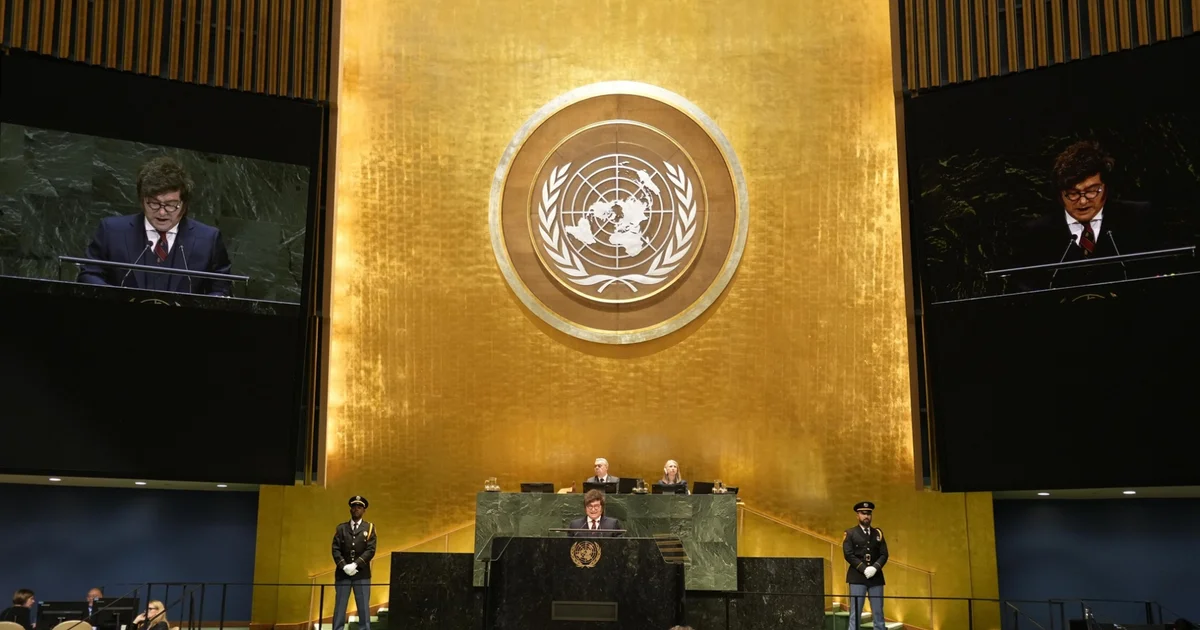
Full original text in Spanish, published by Casa Rosada.
Copied verbatim from the official speech; translation by MileiHoy.
“Today I come to tell you that Argentina will not sit back and wait for the UN and the international community to rise to their own mandate; we will take action.”
— Javier Milei · See it in the speech
“For too long, Argentina managed its decay, we managed poverty, we managed isolation, we managed irrelevance.”
— Javier Milei · See it in the speech
“We will apply a different principle: in the face of uncertainty, we propose determination; in the face of fear, courage; in the face of decay, ambition; and in the face of resignation, we propose optimism.”
— Javier Milei · See it in the speech
“We have decided to cooperate with the world, but to do so standing tall, understanding that only a politically relevant, economically influential, and militarily respectable nation can truly own its destiny.”
— Javier Milei · See it in the speech
“And perhaps that is why today we understand something that other nations may forget: decay is not a destiny but the result of repeated decisions, and if that path can be chosen, it can also be changed.”
— Javier Milei · See it in the speech