Three plans: El Resumen Esencial for free, Premium with the full analysis and Intelligence with data and alerts to decide, in English, Spanish or Portuguese.
Three plans: El Resumen Esencial for free, Premium with the full analysis and Intelligence with data and alerts to decide, in English, Spanish or Portuguese.
Three plans: El Resumen Esencial for free, Premium with the full analysis and Intelligence with data and alerts to decide, in English, Spanish or Portuguese.
One topic in one place: the official text, the video, what happened on X, how each outlet told it and the full speech.
Full speech · Institutional
Casa Rosada13 min read
AI estimate · 80% confidence
Main framing
Right 90%
Right · estimated by AI · 80% confidence
The estimate comes from analyzing the story's text: which sources it quotes, which facts it highlights and what language it uses.
An AI model reads the story and estimates how much of its framing leans left, center or toward a libertarian view. The three percentages add up to 100.
This is an AI-generated estimate, not an objective judgment.
Generated on · 1 min read
AI summaries may contain errors.
The speech criticizes the current UN approach to rights and bureaucracy, advocating a return to principles of freedom; it portrays Milei as a leader making tough choices, thus aligning more with a neutral perspective. The criticism of bureaucracy and the defense of freedom suggest a more balanced framework leaning towards centrist views.
Institutional · Casa Rosada
Institutional · Casa Rosada
Source: Casa Rosada (CC BY 2.5 AR). Translation by MileiHoy
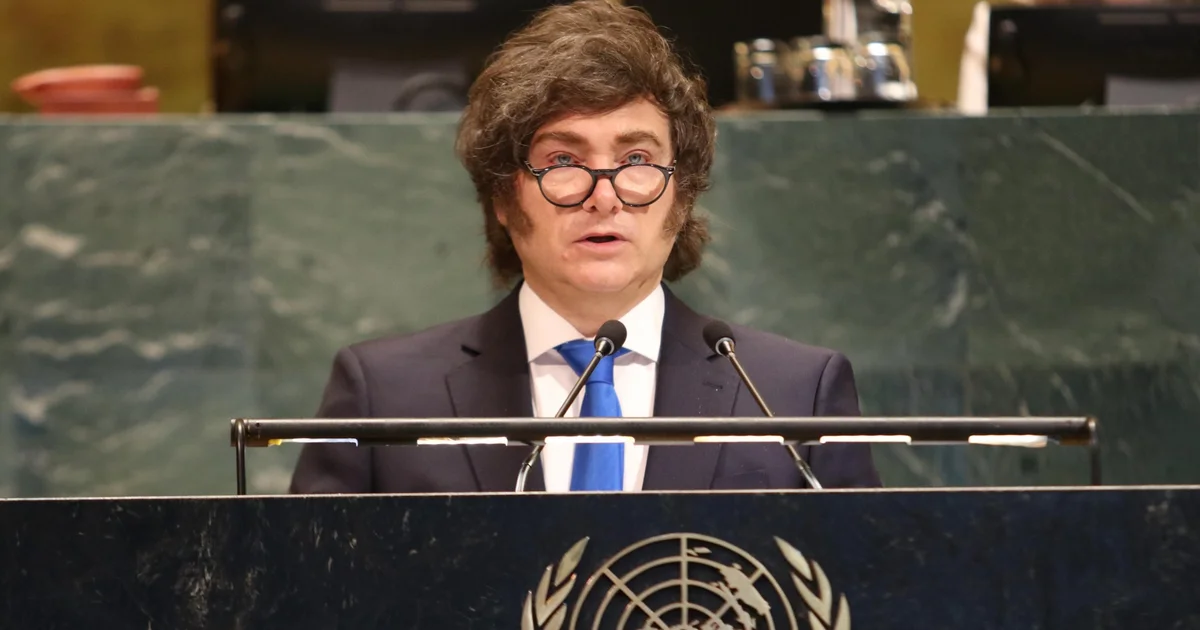
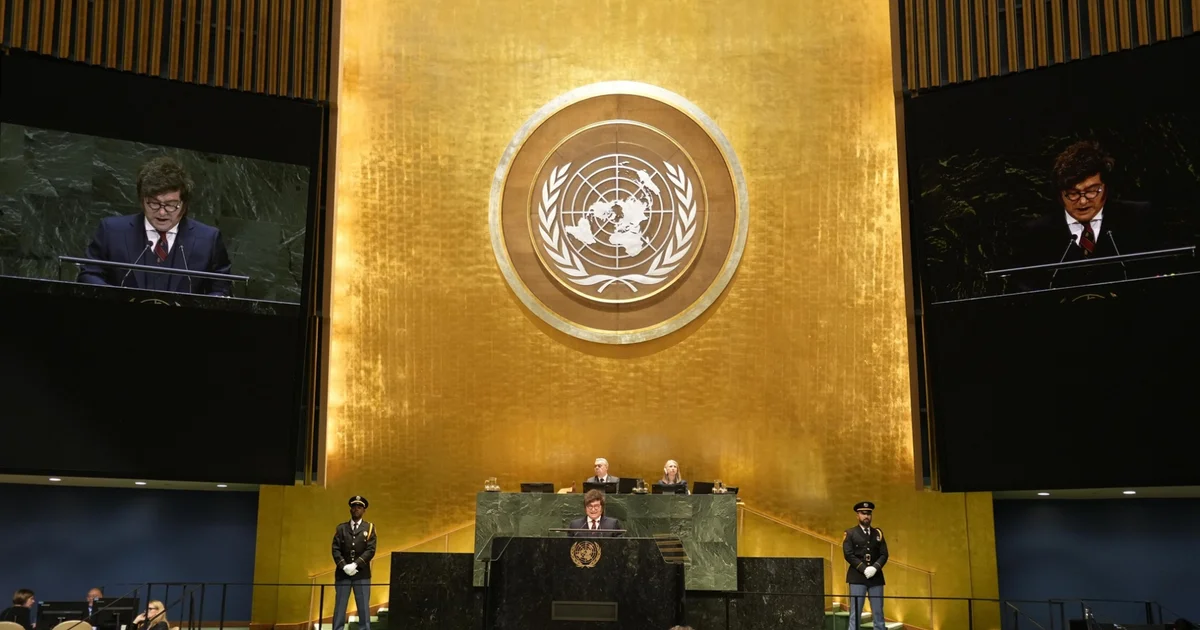
Speech by the President of the Nation, Javier Milei, at the 80th session of the UN General Assembly, New York
To the authorities of the United Nations, to the representatives of the member countries, and to all the citizens of the world who are attentively following this summit, good morning.
Last year, I stood before you in this same assembly and presented a new direction in foreign policy for Argentina. We argued that a return to the ideas of freedom was imperative, to the immortal principles that uphold the dignity of life, the freedom, and the property of all individuals under the law, and the need for international cooperation to specifically ensure these principles.
However, I noted that the UN has departed from its course over the last few decades. The successful United Nations model that spoke of the need for peace without victory and was based on the cooperation of nation-states has been replaced by a supranational model of international bureaucrats seeking to impose a determined way of life on the citizens of the world. Thus, we have moved from an organization aimed at mediating peace among peers to one that aims to decide not only what each State or Nation should do but also what each individual in different latitudes of the planet should do.
We believe in the original purpose of this organization. We believe that there are global problems that require dialogue and international cooperation to be resolved. But for that, we must reject these overreaches that often accompany noble agendas; as we stated last year, we will never support the curtailment of individual freedoms, commercial rights, nor the violation of the natural rights of the citizens of member States; and, during the last year and a half, we have voted accordingly. I say this knowing that many do not share my words because —as I have always said— it is preferable to tell an uncomfortable truth than a comfortable lie.
In this line, today I want to speak to you about a specific problem that modern countries face. Currently, a contradiction is arising worldwide between the present and the future, a problem of political, economic, and philosophical nature, in which the fate of all humanity hangs in the balance. If we frame it in the terms of comfort and discomfort that I have raised, the entire world seems to be stuck in the comfort of the present, ignoring the consequences that this may bring in the future. Because discomfort diminishes votes and power for those who assume it, leaders prefer to do everything in their power to maintain the inherited status quo, even at the cost of future consequences, burning the future to keep the present warm.
Thus, contemporary States have entered a very complex dynamic in reversal where the incentives, both of the population and politicians, point to prioritizing the distribution of today's wealth over generating tomorrow's wealth. At all times, decision-makers face the choice to either preserve the legacy that was entrusted to them or to destroy it. This legacy can be accumulated wealth, productive capacity, laws, or anything that benefits the common good. Generally, if they incinerate their legacy, if they opt for comfort, they will have great present benefits, but they will suffer even greater future costs. If I have savings today, I lose them for tomorrow; if they preserve them, on the other hand, they ensure growth and prosperity for themselves as well as for future generations.
That is to say, it is necessary to find a balance so that today’s bread does not mean hunger for tomorrow, thus ensuring a sustained increase in well-being, something that economists call economic growth. This growth can sometimes feel slow and may sometimes appear momentarily halted because progress is never linear.
But it is precisely its long-term consistency that has systematically revolutionized the world and lifted billions out of poverty. The difference between growing 0% and growing 2% in the long term is the difference between stagnation and prosperity. Argentines know a lot about this, being the only country in the region that has not grown in the last fifteen years. Legally, the condition for growth is the sanctity of property and the free market, which is nothing other than the voluntary cooperation between peers. Because without property rights, there is no savings; without savings or the capacity to exchange it freely, there is no investment; and without investment, no growth is possible.
However, it is not in the individual interest of politicians to respect these principles because it is precisely in the enlargement of the state, at the cost of the liberties of citizens, where politicians gain power. Thus, for politicians, it will always be profitable to sacrifice the future on the altar of the present because consuming accumulated capital generates momentary well-being and that momentary well-being generates votes. But in return, they are sacrificing a future of greater growth, making the accumulated wealth increasingly lesser over time.
The greatest manifestation of this is those countries that show an orgy of increased public expenditure since the State does not create wealth; rather, it robs it and destroys it. In this scheme, politicians gain power in a double way, they are democratically legitimized and obtain more resources to spend. That is to say, politicians have a double incentive to promote this intergenerational betrayal because, while in the future everyone loses, in the present they gain more than anyone else.
In this sense, a great man is one who plants trees whose shade he knows he will never enjoy; the one who cuts down trees that others planted to build his seat of power is a miserable man. In short, he is a despicable man.
This is the great evil and the great trap to which nearly all nations are gradually succumbing because when this process is carried out, growth stagnates, and when growth stagnates, the demand for redistribution intensifies. Then, the populist politician shouts even louder, appealing to envy and resentment. The end of this process is to see helpless youth, suffocated by the weight of a State that they know is only there to exploit them.
Unfortunately, the measures of fiscal expansion, monetary expansion, and the expansion of state power over that of individuals constitute a pattern that is being repeated in all countries, especially in those that make up the free world.
But the problem is not only economic policy; we see it also when the equality before the law is disregarded or when indiscriminate doors to immigration are opened for political reasons. Contrary to what immigration is, in this case, it would be an invasion. And the international cooperation organizations, of which this organization is part, are not immune to this problem.
Over the years, this organization has acquired functions that are alien to its founding spirit. It has created layers upon layers of organizations, agencies, and programs until it has reached an overgrowth of administrations that are ineffective when it comes to solving the problems for which they were created. Thus, the responsibilities of the UN swell, the contributions received from member nations swell, and the tangible results that this organization had to offer the world have diminished.
To this cocktail of cross-incentives, we add the fact that, unlike national leaders, international organizations do not truly hold anyone accountable for failing to resolve a problem. This contradiction between grand objectives and meager results has generated an erosion of the prestige of this house and others. Not to mention, the poor results of the 2030 Agenda testify to what I am describing. What persists in practice is a cycle of structures that recycle, resources that multiply, and goals that are reprogrammed. For this reason, Argentina decided at that time to withdraw from this process because we saw in this agenda a waste of scarce resources, with objectives we did not share, and the effect of distracting attention from the real difficulties of a world headed toward stagnation.
It is my duty to warn against this evil because in Argentina we experienced its natural consequences. We have reached the end of the comfortable path that leads to disregarding the future, meaning we come from a future that for you has not yet finished arriving. And I want to tell you that you are in time to avoid it. Because no society can survive if it burns the future to warm the present.
In my country, we have learned the hard way a very valuable lesson: for decades future flows were mortgaged in order to distribute stock in the present. In 2023, we finally reached the long term of one hundred consecutive years of doing things wrong, passing the bill hand in hand until there was no one left to pay it. And all that —combined with what I told you previously— ended up breaking our State.
As a result of that implosion, during the last year and a half, we faced the gigantic task of managing extreme scarcity. And today we are, for the first time in decades, doing what needs to be done to ensure that the future is better. The only formula for this is to do the opposite of what was done in the past. This is contrasted with the rest of the policy, which demands that we do the same things they did and which also dragged us into decadence: mortgaging the future to satisfy present demands.
They want us to apply what they did a thousand times and which brought us here, but I want to make it clear that Argentina today has a government that has decided to embark on the right path, even if it is the most difficult; because the prosperity and progress of our people cannot be postponed any longer.
However, we are not the only ones making the difficult decisions that this historical moment demands. President Trump, in the United States, also understands that it is time to reverse a dynamic that was leading the United States to catastrophe, and we know that a catastrophe in the United States is a global catastrophe. His firm and successful policy in terms of putting a stop to illegal immigration makes this more than clear.
He understands that he must do what is necessary, even if many do not like it, before it is too late. In other countries, for example, it is already too late for this decision. Not only that, but he is also carrying out an unprecedented restructuring of the terms of international trade. A titanic task that goes to the heart of the global economic system, because this system was preying on the industrial heart of his country and plunging it into an unparalleled debt crisis; furthermore, he is undertaking a cleaning of the institutional capture of the American state because factions of the left had infiltrated it, undermining any reform program no matter how necessary it was.
These types of challenges that both President Trump and I are addressing share a common denominator that all countries in the world and even supranational organizations must face: They must find a way to regain interest in the future and not succumb to the temptation to only address the present. This is something that the great nations of the West practiced for a long time, and we need to reclaim it.
It is necessary to return to the basics; we must reclaim a notion of what is priority, accompanied by recovering the notion of doing what is difficult and correct over what is easy and comfortable. As I said earlier: this is also true for the various international organizations that have gradually incorporated this action into their ecosystem. I believe I speak for everyone when I say that we would like the UN to lead this paradigm shift, returning to the foundations that made it the great organization it once was in the past.
Therefore, I would humbly like to offer this Assembly four principles that we believe can be useful for pursuing this goal: 1. Principle of essential mandate. The central mission of the UN is to preserve international peace and security; everything else should be conceived as complementary to that end. The strategic management and resources of this institution therefore require adherence to those priorities, not others.
2. Principle of international subsidiarity. The UN should intervene on an issue only when it is evident that the problem demonstrably exceeds the capacities for national action; in all other cases, it is appropriate to return the initiative to the States that possess democratic legitimacy and are accountable to their peoples.
3. Principle of institutional diligence. Just as Argentina has initiated a process of optimizing the State by eliminating redundant structures and returning resources to taxpayers, we understand that the UN needs a similar path. This implies the realization of reliable audits, the closure of ineffective programs, the consolidation of unique agencies, and funding conditioned on verifiable results.
4. Principle of simplification and normative rationalization. Peace is not merely the absence of conflict; it requires prosperous societies. International cooperation should not become an obstacle to economic growth and the generation of opportunities. Therefore, we should only support initiatives that do not restrict the capacity of States to unleash their productive forces, attract investment, and promote trade, which are the most successful ways to reduce poverty.
We believe that these four principles would be great values for rechanneling this organization so that it can endure and bring tangible results over time.
Finally, I want to remind you of four sensitive and vital issues for the Republic of Argentina. First, I want to reiterate our legitimate and non-negotiable claim over the sovereignty of the Malvinas, South Georgia, South Sandwich Islands, and the surrounding maritime spaces that remain illegally occupied. Despite the eighty years that have passed since the creation of this organization, colonial situations like these remain unresolved. Therefore, we invite the United Kingdom to resume bilateral negotiations in accordance with Resolution 2065 of this very General Assembly along with all the subsequent resolutions that accompany it.
Second, I want to express once again my condemnation of the expressions of fundamentalist violence that still exist and spread across the world. In Argentina, we have already suffered this horror with the attacks on the Israeli Embassy and the AMIA in 1992 and 1994, respectively. Therefore, we urge the international community to strengthen legal cooperation to ensure that Interpol's red notices are respected and that those responsible for such atrocities can be brought to justice, helping us to heal this painful wound in the history of our country.
Third, we are witnessing an inadmissible escalation of political violence by the left on a global scale. Violence that we know very well in Argentina. It is unacceptable to resort to force where reason fails. Therefore, we emphatically repudiate these actions that violate the basic norms of democratic coexistence.
Fourth, the situation of Argentine citizen Nahuel Gallo, who has been arbitrarily kidnapped and detained in Venezuela without charges, without legal or consular assistance, in simple words: a forced disappearance. We demand the immediate release of the Venezuelan Government and call on the international community to support this legitimate demand, in defense of the most basic principles of international law and human dignity.
Finally, we reiterate our demand for the immediate release of the hostages who remain captive in Gaza. Finally: may God bless the free world, may the strength of Heaven be with us. Thank you very much to all.
Discurso del Presidente de la Nación, Javier Milei, en la 80° sesión de la Asamblea General de la ONU, Nueva York
A las autoridades de las Naciones Unidas, a los representantes de los países miembros y a todos los ciudadanos del mundo que siguen atentamente esta cumbre, buenos días.
El año pasado me paré ante ustedes en esta misma asamblea y presenté una nueva orientación en política exterior para la Argentina. Sostuvimos que era imperativo un retorno a las ideas de la libertad, a los principios inmortales que sostienen la dignidad de la vida, la libertad y la propiedad de todos los individuos bajo la ley, y la necesidad de que la cooperación internacional tenga como fin, precisamente, asegurarlas.
Sin embargo, advertí que la ONU se había alejado de su norte en las últimas décadas. El exitoso modelo de Naciones Unidas que hablaba de la necesidad de paz sin victoria y que se fundaba en la cooperación de los Estados-Nación se vio reemplazado por un modelo de gobierno supranacional de burócratas internacionales que buscan imponerles a los ciudadanos del mundo un modo de vivir determinado. Así es como pasamos de una organización que pretendía mediar la paz entre pares a una organización que pretende decidir no solo qué debe hacer cada Estado o Nación, sino también cada uno de los individuos en las distintas latitudes del planeta.
Nosotros creemos en el fin original de este organismo. Creemos que existen problemas globales que requieren del diálogo y la cooperación internacional para ser resueltos. Pero para eso debemos rechazar estas extralimitaciones que a menudo acompañan a las agendas nobles, como sostuvimos el año pasado, no acompañaremos nunca el cercenamiento de libertades individuales, comerciales, ni la violación de los derechos naturales de los ciudadanos de los Estados miembros; y, durante el último año y medio, hemos votado en consecuencia. Esto lo digo a sabiendas de que muchos no comparten mis palabras porque —como siempre dije— es preferible decir una verdad incómoda, que una mentira confortable.
En esta línea, hoy quiero hablarles acerca de un problema específico que enfrentan todos los países modernos. Actualmente, en todo el mundo se está planteando una contradicción entre el presente y el futuro, un problema de índole política, económica y filosófica, en cuya respuesta se juega el destino de la humanidad toda. Si lo llevamos a los términos de comodidad e incomodidad que he planteado, el mundo entero parece estar estancado en el confort del presente, haciendo caso omiso a las consecuencias que esto pueda traer en el futuro. Como la incomodidad le resta voto y poder a quien lo asume, los dirigentes prefieren hacer todo lo que está a su alcance para mantener el statu quo heredado, aunque sea a costa de las consecuencias futuras, incendian el futuro para mantener caliente el presente.
Así, los Estados contemporáneos han entrado en una dinámica muy compleja de revertir en la que los incentivos, tanto de la población como de los políticos, apuntan a privilegiar el repartir la riqueza de hoy por sobre generar la riqueza de mañana. En todo momento, los tomadores de decisiones tienen frente así la decisión de: o bien preservar el legado que les fue encomendado o bien destruirlo. Este legado puede ser riqueza acumulada, capacidad productiva, leyes o cualquier cosa que haga el bien común. Por lo general, si incineran su legado, si optan por la comodidad tendrán grandes beneficios presentes, pero sufriendo costos futuros aún mayores. Si yo dispongo de un ahorro hoy, lo pierdo para mañana; si lo mantienen, por el otro lado, preservan el crecimiento y la prosperidad tanto de sí mismo como de las generaciones futuras.
Es decir, es necesario encontrar un equilibrio para que el pan de hoy no signifique hambre para mañana, y así poder garantizar un incremento sostenido del bienestar, algo que los economistas llamamos crecimiento económico. Dicho crecimiento a veces se podrá sentir lento y a veces podrá verse frenado momentáneamente porque el progreso nunca es lineal.
Pero es precisamente su consistencia a largo plazo lo que ha revolucionado sistemáticamente el mundo y ha sacado a miles de millones de la pobreza. La diferencia entre crecer 0% y crecer 2% a largo plazo es la diferencia entre el estancamiento y la prosperidad. Los argentinos sabemos mucho del tema, siendo el único país de la región que no creció en los últimos quince años. En el plano legal, la condición del crecimiento es la sacralidad de la propiedad y del libre mercado, que no es otra cosa que la libre cooperación entre pares. Porque sin derecho de propiedad, no hay ahorro; sin ahorro ni capacidad de intercambiarlo libremente, no hay inversión; y sin inversión, no hay crecimiento posible.
Pero no está en el interés individual del político respetar estos principios porque es precisamente en el agrandamiento del Estado, a costa de las libertades de los ciudadanos, donde el político gana poder. Es así que para el político siempre será redituable sacrificar el futuro en el altar del presente porque consumir el capital acumulado genera bienestar momentáneo y ese bienestar momentáneo genera votos. Pero a cambio, está sacrificando un futuro de mayor crecimiento, haciendo que la riqueza acumulada sea cada vez menor en el tiempo.
La mayor manifestación de eso es aquellos países que muestran una orgía de aumento de gasto público ya que el Estado no crea riqueza, sino que la roba, sino que la destruye. En este esquema, el político gana poder por vía doble, se legitima democráticamente y obtiene más recursos para gastar. Es decir, el político tiene un doble incentivo para fomentar esta traición intergeneracional porque, aunque en el futuro todos pierden en el presente él más que nadie gana.
En este sentido, un hombre grande es aquel que siembra árboles cuya sombra sabe que nunca disfrutará; aquel que tala los árboles que otros sembraron para así construir su silla de poder, es un hombre miserable. En definitiva, es un hombre despreciable.
Este es el gran mal y la gran trampa a la que casi todas las naciones están de a poco sucumbiendo, porque cuando este proceso se lleva adelante, el crecimiento se estanca, y cuando el crecimiento se estanca, la demanda de redistribución se recrudece. Entonces, el político populista grita con más fuerza, apelando a la envidia y al resentimiento. El final de este proceso es ver jóvenes desamparados, sofocados por el peso de un Estado que saben que solo está allí para explotarlos.
Lamentablemente, las medidas de expansión fiscal, de expansión monetaria y la expansión del poder estatal por sobre el de los individuos, conforman un patrón que se está repitiendo en todos los países, sobre todo en aquellos que componen el mundo libre.
Pero el problema no es solo de política económica, lo vemos también cuando se vio la igualdad ante la ley o se abren las puertas de forma indiscriminada a la inmigración por razones políticas. Contrariamente a lo que es la inmigración, en este caso, se trataría de invasión. Y los organismos de cooperación internacional, de los cuales esta organización forma parte, tampoco son ajenos a este problema.
Con el correr de los años esta organización ha ido adquiriendo funciones ajenas a su espíritu fundacional. Ha ido creando capas sobre capa de organismos, agencias y programas hasta alcanzar una hipertrofia de administraciones que son poco efectivas a la hora de resolver los problemas para los cuales fueron creadas. Así se engrosan las responsabilidades de la ONU, se engrosan los aportes recibidos por parte de las Naciones miembro y se redujeron los resultados palpables que esta organización tenía para ofrecerle al mundo.
A este cóctel de incentivos cruzados se le suma que, a diferencia de los primeros mandatarios nacionales, las organizaciones internacionales nadie rinde verdaderamente cuentas por fallar en la resolución de un problema. Está contradicción entre grandes objetivos y resultados magros ha generado una erosión del prestigio de esta casa y de otras. Sin ir más lejos, los malos resultados de la Agenda 2030 dan testimonio de esto que describo. Lo que persiste la práctica es un ciclo de estructuras que se reciclan, recursos que se multiplican y metas que se reprograman. Por esta razón, la Argentina decidió en su momento apartarse de este proceso porque veíamos en esta agenda un mal gasto de recursos escasos, con fines que no compartíamos y con el efecto de distraer la atención de las dificultades reales de un mundo encaminado al estancamiento.
Es mi deber advertir contra este mal porque en Argentina lo vivimos hasta sus consecuencias natural. Llegamos al fin del cómodo camino al que conduce desentenderse del futuro, o sea que venimos de un futuro que para ustedes aún no ha terminado de llegar. Y quiero decirles que están a tiempo de evitarlo. Porque ninguna sociedad puede sobrevivir si incendia el futuro para calentar el presente.
En mi país, hemos aprendido por las malas una lección muy valiosa: durante décadas se hipotecaron flujos futuros en función de repartir stock en el presente. En 2023, llegamos finalmente al largo plazo de cien años consecutivos de hacer las cosas mal, de pasar la cuenta de mano en mano hasta que no quedó quien la pague. Y todo eso —sumado a lo que les conté previamente— terminó quebrando nuestro Estado.
Producto de esa implosión durante el último año y medio tuvimos la gigante tarea de administrar la escasez extrema. Y hoy estamos por primera vez en décadas haciendo lo que hay que hacer para que el futuro sea mejor. Para lo cual la única fórmula es hacer lo contrario a lo que se hizo en el pasado. A esto se le contrapone el resto de la política, que nos demanda hacer lo mismo que hacían ellos y que también nos arrastró hacia la decadencia: hipotecar el futuro para satisfacer demandas presentes.
Ellos quieren que apliquemos lo que hicieron mil veces y nos trajo hasta aquí, pero quiero dejarles en claro que Argentina hoy tiene un Gobierno que decidió emprender el camino correcto, aunque sea el más difícil; porque la prosperidad y el progreso de nuestro pueblo no puede postergarse más.
No somos, sin embargo, los únicos que estamos tomando las decisiones difíciles que este momento histórico demanda. El Presidente Trump, en Estados Unidos, también entiende que es el momento de revertir una dinámica que estaba llevando a Estados Unidos a una catástrofe, y sabemos que una catástrofe en Estados Unidos es una catástrofe global. Su férrea y exitosa política en términos de ponerle un freno a la inmigración ilegal lo deja más que claro.
Entiende que debe hacer lo necesario, aunque a muchos no les guste, antes de que sea demasiado tarde. En otros países, por ejemplo, ya es demasiado tarde para esta decisión. No solo eso, sino que también está llevando adelante una reestructuración, sin precedentes, de los términos del comercio internacional. Una tarea de magnitudes titánicas que hacen al corazón del sistema económico global, porque este sistema estaba depredando el corazón industrial de su país y sumiéndolo en una crisis de deuda sin parangón; más aún, está llevando adelante una limpieza de la captura institucional del Estado americano porque en el mismo se habían infiltrado facciones de izquierda que atentaban contra cualquier programa de reforma por más necesario que fuera.
Este tipo de desafíos que tanto el Presidente Trump como yo estamos abordando tienen un denominador común que todos los países del mundo e incluso las organizaciones supranacionales deben enfrentar: Deben encontrar la manera de recuperar un interés por el futuro y no sucumbir a la tentación de solo atender el presente. Esto es algo que las grandes naciones de Occidente durante mucho tiempo practicaron y necesitamos recuperar.
Hace falta volver a las bases, debemos recuperar una noción de lo prioritario, acompañado por recuperar una noción de hacer lo difícil y correcto por sobre lo fácil y cómodo. Tal como dije anteriormente: esto también es cierto para los distintos organismos internacionales que han ido incorporando gradualmente este accionar en su ecosistema. Creo que hablo por todos al decir que nos gustaría que la ONU lidere este cambio de paradigma, regresando a las bases que la han convertido en la gran organización que supo ser en el pasado.
Por eso quisiera humildemente poner a disposición de esta Asamblea cuatro principios que creemos pueden ser útiles para seguir en pos de este objetivo:1. Principio del mandato esencial. La misión central de la ONU es preservar la paz y la seguridad internacional, todo lo demás debe concebirse como complementario a ese fin. La gestión estratégica, los recursos de esta institución requiere, por lo tanto, apegarse a esas prioridades, no a otras.
2. Principio de subsidiariedad internacional. La ONU debería intervenir sobre un tema únicamente cuando sea evidente que el problema excede de manera demostrable las capacidades de acción nacional, en todos los demás casos corresponde devolver la iniciativa a los Estados que son quienes poseen legitimidad democrática y responden ante sus pueblos.
3. Principio de diligencia institucional. Así como la Argentina ha iniciado un proceso de optimización del Estado eliminando estructuras redundantes y devolviendo recursos a los contribuyentes, entendemos que la ONU necesita un camino similar. Eso implica la realización de auditorías confiables, el cierre de programas ineficaces, la consolidación de agencias únicas y un financiamiento condicionado a resultados verificables.
4. Principio de simplificación y racionalización normativa. La paz no es solo ausencia de conflicto, requiere sociedades prósperas. La cooperación internacional no debe transformarse en un obstáculo para el crecimiento económico y la generación de oportunidades. Por ello, solo debemos apoyar iniciativas que no restrinjan la capacidad de los Estados de liberar sus fuerzas productivas, atraer inversión y fomentar el comercio, que son el camino más exitoso para reducir la pobreza.
Creemos que estos cuatro principios serían grandes valores para reencauzar esta organización, para que así pueda perdurar y traer resultados palpables en el tiempo.
Para finalizar, quiero recordar cuatro cuestiones sensibles y de vital importancia para la República Argentina. En primer lugar, quiero reiterar nuestro reclamo legítimo e irrenunciable sobre la soberanía de las Islas Malvinas, Georgias del Sur, Sándwich del Sur y los espacios marítimos circundantes que permanecen ocupados ilegalmente. A pesar de los ochenta años que pasaron desde la creación de esta organización, situaciones coloniales como estas siguen sin ser resueltas. Por lo que invitamos al Reino Unido a reanudar las negociaciones bilaterales de conformidad con la Resolución 2065 de esta misma Asamblea General junto con todas las resoluciones posteriores que la acompañan.
En segundo lugar, quiero manifestar nuevamente mi repudio a las expresiones de violencia fundamentalistas que aún existen y se propagan por el mundo. En Argentina ya sufrimos este horror con los ataques de la Embajada Israel y la AMIA en los años 1992 y 1994 respectivamente. Por eso, instamos a la comunidad internacional a fortalecer la cooperación jurídica para garantizar que las circulares rojas de Interpol sean respetadas y que los responsables de dichas atrocidades puedan comparecer ante la Justicia, ayudándonos a terminar de cicatrizar esta dolorosa herida en la historia de nuestro país.
Tercero, estamos asistiendo a una escalada inadmisible la violencia política por parte de la izquierda a nivel global. Violencia que en Argentina conocemos muy bien. Es inadmisible recurrir a la fuerza allí donde las razones fallan. Por eso, repudiamos enfáticamente estos procedimientos que atentan contra las normas básicas de convivencia democrática.
Cuarto, la situación del ciudadano argentino Nahuel Gallo secuestrado y detenido de manera arbitraria en Venezuela, sin imputación, sin asistencia legal ni consular, en palabras simple: una desaparición forzosa. Exigimos al Gobierno de Venezuela su inmediata liberación y hacemos un llamado a la comunidad internacional para que acompañe este reclamo legítimo, en defensa de los principios más básicos del derecho internacional y de la dignidad humana.
Finalmente, reiteramos nuestra exigencia de liberación inmediata de los rehenes que aún permanecen cautivos en Gaza. Finalmente: que Dios bendiga al mundo libre, que la fuerza del cielo nos acompañe. Muchas gracias a todos.
Full original text in Spanish, published by Casa Rosada.
Copied verbatim from the official speech; translation by MileiHoy.
“We maintained that it was imperative to return to the ideas of freedom, to the immortal principles that uphold the dignity of life, freedom, and property of all individuals under the law.”
— Javier Milei · See it in the speech
“Thus, it will always be profitable for the politician to sacrifice the future on the altar of the present because consuming accumulated capital generates momentary well-being, and that momentary well-being generates votes.”
— Javier Milei · See it in the speech
“Because no society can survive if it sets fire to the future to warm the present.”
— Javier Milei · See it in the speech
“In 2023, we finally reached the long term of one hundred consecutive years of doing things wrong, passing the bill from hand to hand until there was no one left to pay it.”
— Javier Milei · See it in the speech
“The UN should only intervene on an issue when it is evident that the problem demonstrably exceeds national action capabilities.”
— Javier Milei · See it in the speech