Three plans: El Resumen Esencial for free, Premium with the full analysis and Intelligence with data and alerts to decide, in English, Spanish or Portuguese.
Three plans: El Resumen Esencial for free, Premium with the full analysis and Intelligence with data and alerts to decide, in English, Spanish or Portuguese.
Three plans: El Resumen Esencial for free, Premium with the full analysis and Intelligence with data and alerts to decide, in English, Spanish or Portuguese.
One topic in one place: the official text, the video, what happened on X, how each outlet told it and the full speech.
Full speech · Institutional
Casa Rosada51 min read
AI estimate · 85% confidence
Main framing
Right 90%
Right · estimated by AI · 85% confidence
The estimate comes from analyzing the story's text: which sources it quotes, which facts it highlights and what language it uses.
An AI model reads the story and estimates how much of its framing leans left, center or toward a libertarian view. The three percentages add up to 100.
This is an AI-generated estimate, not an objective judgment.
Generated on · 1 min read
AI summaries may contain errors.
The speech frames the government's policies positively and includes strong criticisms of opponents, highlighting the failures of previous administrations. Phrases like 'social justice is theft' and attacks on the opposition suggest a right-wing focus.
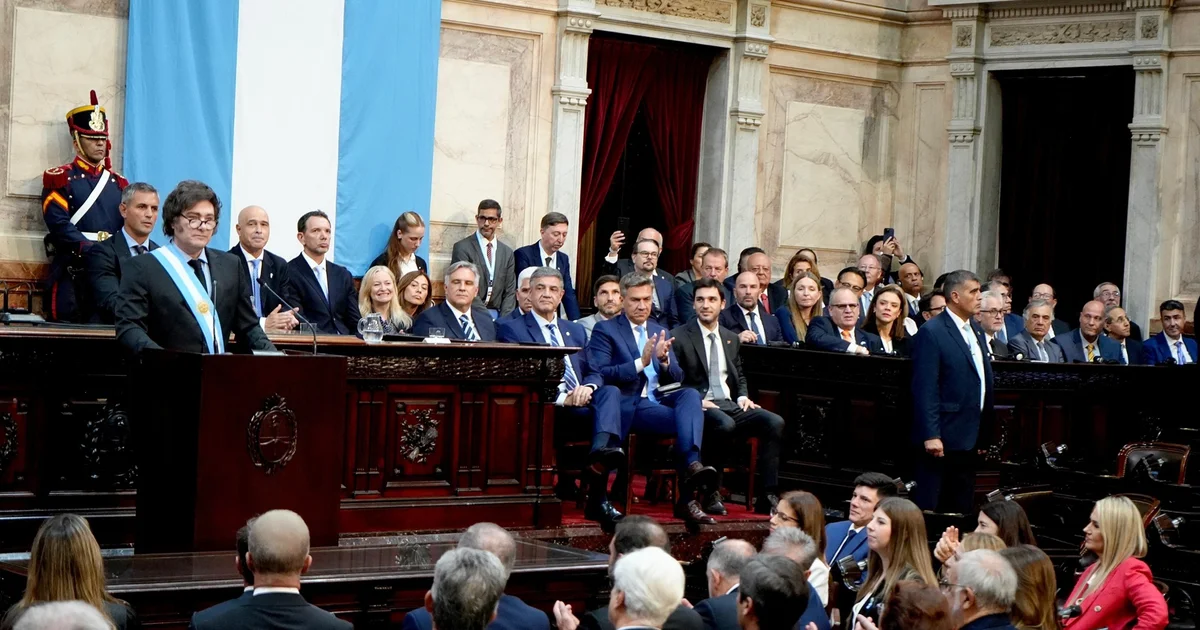
Institutional · Casa Rosada
Source: Casa Rosada (CC BY 2.5 AR). Translation by MileiHoy
Speech by the President of the Nation, Javier Milei, at the opening of the 144th Ordinary Session of the National Congress
Members of the National Congress, governors, ministers of the Supreme Court, ambassadors, esteemed members of the national Cabinet, and to all Argentinians listening to us from home, good evening.
Furthermore, I want to give a very special greeting because today, in this house, we are honored by the presence of the foremost representative of the history of Argentine liberalism, Doctor Alberto Benegas Lynch (h). Thank you, professor, thank you.
Today we are gathered here in compliance with Article 99 of the National Constitution, to account for the state of the Nation and to begin a new period of ordinary sessions of this Honorable National Congress. Being the third inauguration of ordinary sessions of our mandate, I would like to invite all of you to remember where we came from in order to understand where we are going and why this year in Congress will be so important.
Just two years ago, Argentina was in a terminal crisis; the very continuity of our Union as a country was at stake. The legacy showed us the combination of the three worst crises in Argentine history: a monetary imbalance that was twice that of the pre-Rodrigazo period of 1975, during Isabel Perón's government; a Central Bank in bankruptcy, in even worse condition than that of Raúl Alfonsín before the hyperinflation of 1989; and, if all this were not enough, social indicators worse than those of 2001. A combination that would have turned us into Venezuela.
That is to say, two years ago we were trapped with no way out, in an eternal present that destroyed our faith and that of our children. Two years ago, we were resigned to always repeating the same mistakes due to the greed, incompetence, and cowardice of our perennial politicians. Those who always have the formula to eradicate all evils and who always failed. However, today we look to the future with hope again. Today we know there is a way forward and we know it is possible to take it.
Today we are doing things that have been pending for decades. Today we not only stopped feeling like losers, but we also know that we can make Argentina great again.
Today, in just a few weeks, in what has been one of the most productive extraordinary sessions in our history and fulfilling all campaign promises made in 2025, we can say: one, we have approved the first budget without fiscal deficit, free of default in 100 years. This means: the immoral indebtedness that burdened future generations for our celebrations has ended, with no possibility for them to defend themselves with their vote.
We ended the monetary issuance that was used to finance the fiscal chaos, which resulted in rising inflation that hit the most vulnerable. And all this we accomplished not only without raising taxes, but we also lowered them by the equivalent of two and a half percentage points of GDP, and we did this because we not only believe that taxes are theft, but also because the adjustment had to be made by politics.
You could also shout, because I am your President, even if you don't like it.
Two. We sanctioned the law of fiscal innocence. No, you cannot applaud because your hands slip into other people's pockets.
Come on, keep up with the operations, and later, I will come to get you when you fall in the Justice system for liars. Come on. Two: we sanctioned the Law of Fiscal Innocence, where after years of looting by politics, where taxpayers were guilty until proven otherwise, today we have reversed that atrocity and Argentinians are innocent until proven guilty again.
Three: we reformed the Juvenile Penal Law, thus modifying an obsolete penal regime that was already 45 years old because, as we said before being in government and carried out in practice with Doctor Patricia Bullrich, former Minister of Security and now senator: those who commit the crime, pay the price.
This is so because without order and without justice, there is no possible future. No one can think of building their future if the law, freedom, and property are not respected.
Let's see, let's see, ignorant ones: social justice is theft, it implies unequal treatment before the law and is preceded by theft, bunch of thieves. Criminals. That's why yours is in jail.
Additionally, four: we approved the law… Yes, keep up with the operations, because the people know, let’s say they know you are liars. They know the audios are false, they know the one who testified has already said it was a lie, but keep lying to the people. Keep lying to the people with situations that additionally have no evidence, come on, keep lying. Bunch of thieves, bunch of crooks, that’s why your leader is in jail. And she'll remain in jail for the notebooks case, she'll remain in jail for the Iran Memo, she'll remain in jail for what she did with Vialidad, because she is a crook, because they were the biggest crooks in history.
Four: we approved the Labor Modernization Law, a law that comes to sweep away a delusion sanctioned 50 years ago, inspired by cave-like ideas from 80 years ago, which left half of the workers in the informal market. This is to say, the champions of workers' rights left half of the workers without any rights.
And that, apart from the fact that they left their last government with a situation in which 30% of formal workers were poor. Furthermore, this law will allow the labor market to align with an economy that is witnessing the greatest transformation in history.
What an allergy you have to data. Unemployment has decreased. Focus on reciting poems and talking about data no, because you know nothing about that.
How interesting that in Congress I find part of my rock band, the presidential band. What is it? Stop looking at yourself in the mirror, Martínez, the crooks are you.
Hey, so a failure reached the Presidency… How interesting!
Finally, this week we became the first country in the region to ratify the Mercosur-European Union agreement. Behind this advance lies our conviction that trade, due to its effect on competition, leads to an elevation in quality of life, as it allows us to access better-quality goods at a better price.
Moreover, we achieved a trade agreement with the United States after 21 years of that famous self-sabotage that has tragically been celebrated by our leadership. The voice of Hugo Chávez still resonates in our minds saying: 'ALCA, ALCA, al carajo,' and then they want to convince us they are not taking us to Cuba, on the way to becoming Venezuela.
That is why, after lost decades and generations who have seen their children live increasingly worse, we have come to conclude that this decadent misery has ended. From now on, and by the will of the Argentinians who expressed this at the polls, we have the strength to begin a new chapter in Argentine history.
A change of era that can be summarized in a central concept, which is the one that guides our conduct and which is the conceptual core of what I want to talk to you about today, in this opening of a new period of ordinary sessions of our National Congress: morality as a State policy.
I want to be clear on this: in our vision, there is a clear order of merit. Come on, fascists are socialists who understood that the way was not through violence. At least be less ignorant and go study.
Moreover, in a book called The Doctrine of Fascism, these sinister characters said: 'Nothing outside the State, everything within the State, and nothing against the State.' What does that have to do with me? It has to do with you, who were inspired by a fascist. First, grab the books, then tell me anything you want.
I want to be clear on this: in our vision, there is a clear order of merit. First, there is ethics and morality based on Western values. That is, Greek philosophy, Roman law, the rectitude of the Stoics, and the Judeo-Christian values.
So that each of our actions is, above all, just in the sense of Ulpian. This is: justice is the constant and persistent will to give each person their right; that is, the intention to give each one what is theirs, what corresponds under the precepts of law, which are to live honestly, without causing harm to anyone.
In second place, we position economic efficiency. In second place, we position economic efficiency. And, lastly, in third place, political utilitarianism. In this sense, when a policy is just, these three elements will be aligned; while when they are in tension, that will be a sign that said policy is unjust.
But this radical change does not occur in a vacuum. We did not take the reins of the country under normal conditions, but we had to face the stabilization of a society on the verge of destruction. Our national currency had been wrecked by the reckless issuance of money and an extended history of sovereign defaults. The lack of investment, due to instability and legal insecurity, destroyed companies and jobs every year.
No, again, learn, go look at the numbers. I understand that you have difficulty adding, but today go and look at the numbers.
I tell you that the unemployment rate fell despite the increase in the offer; this means that job positions increased more than the offer did.
But again, it would be fun to debate with you if you knew something. But what can I expect from you? That in the last government you emitted 28 points of GDP; three in the last year to win an election.
At the same time, poverty and the Eugenio Zaffaroni doctrine, promoted by Kirchnerism, turned our streets into a bloodbath, and poverty kept growing, even though it was attempted to disguise it with social plans and public employment, which only worsened the problem. That is: we received a failed State in all areas.
Crime and homicides were on the rise and the streets were no man's land in the neighborhoods and of the picketers in the cities. To worsen the situation, these pickets were financed with social assistance money that should have been allocated to the most needy.
Our borders were a sieve, which served as perfect breeding ground for drug trafficking to invade our society, as happened in Rosario. As a country, we did not know who was coming in or out, and that is why the worst came in and our youth left.
In terms of Human Capital, we had a camouflaged poverty with price controls of 57%, with seven out of ten kids poor, and a large majority of school leavers who could neither read nor write, nor do simple math, in a world where Artificial Intelligence advances daily by leaps and bounds.
The State and state-owned enterprises were used as shelters for militants whose sole purpose was to camouflage the inability to create genuine jobs, due to high tax pressure and an anachronistic labor law.
As a result, the vast majority of state-owned companies were deficit-ridden and had to be supported with taxes and monetary issuance. The State was also taken over by an inscrutable web of regulations that suffocated the free market; and behind each of them, there was someone robbing Argentinians with markups, forced services, or ridiculous fines. Some cases are so blatant as the import license system, through which friends of the powerful could have a profitable business importing at the official exchange rate and selling at the parallel.
That is why it is not surprising that there are sinister people, some of them coup plotters, who, in the name of defending national industry, under the guise of a flimsy nationalism, advocate for protectionism and capital controls, with their consequent exchange rate gap. That is, they embrace the Argentine flag with the sole intention of robbing good Argentines.
We had a judiciary stagnant due to excessive politicization, with vacancies in a huge number of federal judgeships and cases sleeping for years. Politics, unconcerned with all this, continued to spend as if there were no tomorrow to secure positions for their friends. This reached a peak of madness with the 18 ministries that the previous government had when they left, as they had previously had 23. Truly communist.
And in international matters, this entire political structure served no purpose in establishing any commercial relationship that would open markets to Argentines. We were isolated, alone, and fearful of the rest of the world; and that is why our economy was poor and fragile. And as if all this were not enough, the tax authorities persecuted each and every good Argentine as if they were drug traffickers, for making a transfer or wanting to buy dollars, which today they can buy freely.
And the truth is that I could spend until next year's inauguration enumerating the critical sectors left by the previous administration, but I prefer to focus on what we have done to solve it and what we still have to do.
There was only one way to cut the Gordian knot that this inherited disaster represented, and that was by stabilizing the economy. The most urgent aspect was the inflationary mess that had us on the brink of hyperinflation, and the root of inflation is the monetary emission that stemmed from the fiscal deficit. That is why, in our first month, we eliminated a fiscal deficit of 5% of GDP in one fell swoop. Many thanks to the best Minister of Economy in the world, twice in a row, Toto Caputo. Thank you.
Moreover, we did not achieve this by raising taxes, as populists always suggest, but by cutting spending. During 2024, we reduced national government primary spending in real terms by 30%. From the standpoint of the Central Bank, we focused on restoring its financial situation so that the pesos of Argentines have support. Along this line, we managed to eliminate in just 6 months the quasi-fiscal deficit, which amounted to 10% of GDP, and began the process of rebuilding reserves, despite having to pay debt in cash dollars all year due to lack of access to international credit markets. Thank you Santiago Bausili, for saving us from hyperinflation. Thank you Pablo Quirno, for such institutional design, with which we stabilized the economy without expropriating, without doing the Bonex Plan, without price controls, without repression; all in a free market.
It seems that... could you step out of... or are you still reciting or saying things that make sense? Because you left a gap of 300%. That is not devaluation; you devalued. We acknowledged the disaster you left behind.
This part is also not going to please you: here come your merits, Doctor. In Security, after an unrelenting action by Dr. Bullrich, we have promoted legislative reforms such as the Antimafia Law, the Genetic Data Registry and the Law of Recidivism and Repetition and unification of sentences to cut this scourge, along with the implementation of the Flag Plan and the Antipiquete Protocol.
Later we will pass you the cartoon version, so that you can understand.
Thanks to this, we have managed to reduce the national homicide rate by 17%, reduce homicides in Rosario by 65%, and just in 2025, we achieved a 20% reduction in robberies, the lowest value in recent history, not counting the lockdown period due to quarantine.
In the same way, we are bringing order to the border, where drug traffickers came and went at will, and as we promised during the campaign, we have put an end to the blockades once and for all, which went from nine thousand a year to zero.
This last achievement was done in conjunction with Minister Pettovello and the entire Human Capital Ministry. Thanks to that, we eliminated discretionary transfers, to take the business of social aid intermediation away from politics; and we increased automatic transfers, so that the most vulnerable receive those resources fully. Without a doubt, there is hardly an example that better illustrates what Bastiat called 'the porous hand of politicians.'
Stealing is wrong, but robbing the bread from the mouths of the most vulnerable, making them slaves in order to amass power, exceeds any adjective that can be found in the dictionary.
Thus, thanks to the reassignment of funds, the AUH increased by 492.9% compared to the inherited value in 2023. We incorporated 600,000 kids into the AUH. We increased the Alimentar benefit by 137.5%. We increased the First Childhood scholarships by more than 500% and the First Thousand Days benefit by more than 1,100%.
However... (shouting) Let's see, you who used social programs to rob people through intermediation, that is, and condemned them to poverty and turned them into slaves, what are you talking about if you don't even know how to add? But of course, you hid behind just causes a bunch of criminals so that then they wouldn’t touch the thefts, a bunch of criminals.
Kukas, I'm going to let you in on something. Kukas, you know what? I love breaking you down. I love making you cry. And the vast majority love to see you cry. And, if you are right.
However, we understand that social programs are not a long-term solution, but a transition. That is why we are also reforming early and primary education to ensure the basic skills of reading comprehension that were lost in recent decades. We renewed the educational curriculum, strengthening fundamental competencies, expanding the Aprender tests in primary and secondary. No, of course, I understand: for you, education was washing kids' brains with 'The Reason of My Life.'
You are very funny for debate: you have all the past ahead of you.
It seems that the oligarch disguised as a beggar got offended.
Yes, I may be a beggar, but I wiped the floor with you in a runoff.
Restoring the economy, security, and the streets has allowed us to move forward with other changes that the country was crying out for. The state companies that were previously in deficit have come to balance, resulting in savings for all Argentines. I take, for example, the emblematic case of Aerolíneas Argentinas, which from 2008 to our arrival cost all Argentines 8 billion dollars, and this year generated profits of 100 million dollars. Go find the angle, kuka.
It seems that the accounting statements say otherwise. Again: you don't know how to read, you don't know how to look at a number. Thank you for confirming that: go read the balance sheets, ma'am.
In this same vein, we have advanced with the first privatizations contemplated in the Bases Law and we are working on the requirements to privatize the remaining ones. Thanks to the work of the entire government, but particularly to our Minister of Deregulation, the colossus Federico Sturzenegger. Thanks to his Herculean task. Oh, I don’t know if they'll understand who Cyclops was. Well, thanks to Federico's enormous work, we have made over 14,500 deregulations across countless areas that reflect the level of corporate cooptation that the State had, because behind every regulation there was a privilege, or, rather, a scam, a trick.
Among other things, these deregulations have allowed us to set records in the commercial air passenger market; enabled Argentine producers to access better productive machinery than what was locally available; and normalized and enhanced the rental market. This last one, after repealing the nefarious Rent Law, has seen a strong increase in the supply of rental housing and a 30% reduction in real terms.
Let me tell you, Kuka, because since you are so ignorant: in real terms is net of inflation.
At the same time, we have dismantled the sinister licensing system for imports thanks to the elimination of IRAs, the expansion of courier services, and the reduction of tariffs.
And all these great achievements seem small compared to the achievement of the RIGI. Through this system of incentives for investment, we have approved projects worth 25 billion dollars that are already underway; and we are evaluating additional requests for 45 billion dollars. The 32 projects presented are distributed across 11 provinces and will require more than 60,000 direct and indirect jobs.
And this is just in one year of validity. Imagine if we sustain this policy over time, especially considering that a good part of the current investments are developing the critical infrastructure that will make even more future investments viable. Already for its present results, we are facing the most effective development policy of the century, and it is the vocation of this administration to transform the RIGI not into an exception, but into a state policy that will make us the most attractive country in the region for investment.
That is, the goal is not for the RIGI to converge with the rest of the economy, but for the rest of the economy to eventually have the same treatment as the RIGI. In parallel, we have managed to reduce the state workforce by 20%; we have reduced senior positions in the Public Administration by nearly 40%, saving society 2 billion dollars a year, without affecting the quality of a single service or competition. We have also returned most state companies to equilibrium.
At the same time, please change places. But of course, you add with difficulty, you don’t know what it is to move a ravioli inside an organogram.
At the same time, this has allowed us to advance with the elimination of taxes, such as the PAIS tax, withholdings on regional economies and various productive chains. We also reduced VAT and income tax perceptions on imports of basic goods, tariffs on clothing, fabrics, appliances, tires, motorcycles, industrial inputs, fertilizers, herbicides, and electronic products.
We lowered internal taxes on cars and motorcycles, tariffs for hybrid and electric cars, tariffs on cell phones and internal taxes on electronic products and the internal tax on insurance. Now all that’s left is for the provinces and municipalities to do their part, for which we have facilitated a tool to report excessive fees, checking it on a page.
At the same time, we have just approved the RIMI, for partial investments, which will enhance the expansion of a large part of the SMEs in the country, allowing them to quickly amortize the purchase of capital goods. This measure was approved as part of the labor reform, which will modernize for the first time in over 50 years labor regulation in our country, in line with the dynamics of the present.
In terms of Justice, we have enacted the Reincidence and Repetition Law, the Absentee Trial Law, and in recent weeks we have sent the project for the new Juvenile Penal Regime back to Congress. At the same time, we have managed to implement the accusatory system in 65% of the country and we are on the way to implement it throughout the territory. All of this has been done with the aim of recovering the rule of law and improving the timeliness of Justice, given that a Justice that takes years is not just at all.
In short, all of this was a coordinated effort among multiple areas to avoid catastrophe. And it was thanks to eliminating the fiscal deficit and monetary emission that we managed to go from an inflation rate that closed in 2023 at over 200% and was traveling at an annualized speed of 17,000%, to an inflation that ended in 2025 around 30%.
And all of this without sending the economy into a mega-recession, but instead returning to the path of economic growth. Thus, in 2024, and I clarify well so you can see which indicator I am using, economic activity, measured by the seasonally adjusted monthly EMAE, grew by 6.6% from the previous year, that is, from December 2024 to December 2023. Meanwhile, during 2025, the growth was 3.3%, which means that the economy has been growing for two consecutive years, accumulating an improvement of over 10%.
That is, we are coming out of the hole. And what is more important, we achieved all of this without expropriations, or default, or hyperinflation, which would have driven 90% of Argentinians into poverty. All of this was merely the result of addressing the management of the State seriously and maturely, respecting property rights and restoring freedom to Argentinians.
Del Caño, if you were the representation of the workers, you know that we would have a very serious problem, because you are no more than 5%.
What’s wrong with you, Chilindrina troska? What’s the matter with the Chilindrina troska? Because I can’t hear you. Keep crying, Chilindrina, go on.
That said, we cannot make a true description of the state of the Nation without first addressing the anxieties generated by a sector of politics - you - your business and media partners who resist change and who throughout the last year did everything possible to overthrow this Government. And it went wrong for them.
By having managed to emerge from the storm in the first year, with enormous sacrifices made by Argentine society, the conditions were in place for an economy where our country could grow strongly, given that at the beginning of the year, the economy was expanding at a rate of 6% and accelerating towards 8%. However, the opposition was willing to do anything to regain power, while the Executive Branch, for the first time in history, entered an election year by tightening fiscal policy and monetary policy. The opposition decided to use all sorts of resources to destroy the economic plan.
The first attack occurred in March, prior to the agreement with the IMF, which triggered an initial spike in uncertainty that translated into a rise in Country Risk, an increase in interest rates, a surge in inflation, and a stagnation of investment. However, we overcame the onslaught and the inflation rate for the month of May fell to 1.5%.
However, in that month, after our victory in the City elections, an unprecedented attack in Argentine history began to unfold, reaching its peak after the elections in September in the province of Buenos Aires; something that, for both opponents and allies, let’s say, made them dream of embracing the Rivadavia chair.
This coordinated attack among the Congress of the Nation, sanctioning irresponsible laws; some media, with operations and deceits of all kinds to confuse the electorate; and some business sectors betting on a devaluation to benefit at the expense of the poor, generated a level of uncertainty in society rarely seen, akin only to the panic over the return to Kirchnerism in August 2019 and the crisis of 2001, where politics had no qualms about throwing either one or all necessary dead bodies into the street to regain power.
Not far from the truth, this was made clear in statements made in recent days by Governor Quintela and Senator María Florencia López from La Rioja, who are your people, coup plotters. They have not only been denounced by Prosecutor Stornelli, but he has also reopened the case regarding the events that occurred in 2001. We hope that Justice moves forward not only on possible acts of sedition but also on those who could be their direct and indirect beneficiaries of such actions.
In this context of political uncertainty, Country Risk skyrocketed, aptly nicknamed kuka risk, which led to a fall in demand for assets denominated in pesos, as the peso was attacked by the equivalent of 50% of M2, that is, about 41 billion dollars. Interest rates were soaring, activity came to a screeching halt, and the decline in transactional demand for pesos caused the inflation rate to accelerate. It is clear that this coup adventure was not without cost. According to our estimates, we lost two and a half points of growth, meaning the kuka risk also cost us 25 billion dollars in terms of GDP.
In this coup context. Yes, coup context, we had, thanks to our great success in foreign policy, a key ally. For the first time in history, and as a result of the special relationship that now characterizes the bond between the United States and Argentina, the government of Donald Trump came to our country's aid. And that help was not for economic reasons, but to defend us against the destabilizing assault of representatives of the old regime. In other words, you, the usual coup plotters.
However, it is not that I have no problem accepting the facts as they are; I do not fight with the data like you do.
However, it was impossible to immediately remedy all the damage caused. Damage inflicted not on the government but on the Argentine people, who had to endure once again the harmful consequences of politicians' power ambitions. And, what’s more, even despite the attacks, we managed to maintain and deepen the reduction of poverty, going from a inherited level of 57%, after clarifying the prices that the previous government suppressed, to a rate around 30% during our tenure. Thank you, Minister Pettovello.
Although we are still far from the target in terms of poverty, this data fills us with pride and hope. But I want to tell you that this interval of suffering has ended: the suffering has ended. Society inoculated itself on October 26 of last year.
Today, as evidenced by this period of extraordinary sessions that concluded a few days ago, in which we approved some of the most important reforms of the last decades, we have the most reformist Congress in history, and the strength to face any political blow that the agents of the old changes want to carry out.
Moreover, before continuing with the logic of the speech, I want to thank the Chamber of Deputies and the Chamber of Senators for the enormous work they did, both those who accompanied us and those who sabotaged and wanted to sink the country, because I am President for the 47.5 million Argentinians.
On the other hand, we are now on the brink of a great economic resurgence. But growing requires a set of fundamental prerequisites that we must secure. The first, and fundamental requirement, is to guarantee basic macroeconomic conditions, which has been the great task of our first two years in office. For this, nothing is more important than continuing to defend fiscal balance tooth and nail and a restrictive monetary policy, which allows us to put an end once and for all to the scourge of inflation.
The first will allow for the continued reduction of Country Risk, hence the rate in dollars; while the second will make it possible for the nominal interest rate in pesos to decrease, while also reducing the distortion of relative prices caused by inflation. Note that this results in a better allocation of resources and an endogenous decrease in the interest rate, which leads to greater capital accumulation, higher productivity, higher wages, and lower levels of poverty and indigence.
Furthermore, the reduction in spending that allowed for the reduction of both explicit and implicit taxes leads to greater economic freedom and thus greater levels of prosperity.
Second: we have long-term growth drivers supported by three simultaneous pillars. The first pillar is the deregulation of the economy. This policy of exterminating regulations is not only a way to restore the right to property, but also releases increasing returns, which are the basis of economic growth. If we do not assimilate this point, everything else will be in vain.
The second pillar is human capital. The productivity of a nation and its future projection rests on the shoulders of a well-nourished, educated, and protected citizenry. Without food, there can be no proper cognitive development, education, and active participation in the economy. Therefore, children are an absolute priority for this Government.
How paradoxical. How paradoxical that those of us who put children first are us, when their original leader said that 'the privileged will be the children.' And all they did was put seven out of ten under the poverty line.
The process of discovery and coordination that leads to economic growth is uncertain. Today we do not know for certain what the industries of the future will be in 10, 20, or 50 years. Therefore, we must have a citizenry capable of deciding for itself how to arrange its physical and mental capabilities, and we must also provide the tools to make these decisions.
Finally, the third pillar of growth comes hand-in-hand with trade openness. For almost a century, Argentina has been trapped in the industrialist fetichism trap. They told us that the only way to generate employment was to maintain a heavily subsidized industrial scheme. They told us that we could only grow if we lived on what we had. To maintain this narrative, the development of agriculture and regional economies was actively impeded with taxes, while trade was limited with all kinds of restrictions on imports, which raised the cost of all local industrial inputs.
And as if all this were not enough, we must not forget about an astronomical tax burden that has made almost all kinds of investment impossible. However, after decades of protection, we obtained a small, expensive, subsidy-dependent industry, with meager dollar wages.
First the data, poet, first the data. We have tripled the salary in dollars, poet. What a party Milton Friedman would throw with these cavemen, for God's sake.
No, that’s what you do, paying militants.
In light of the debate that took place over the last few weeks. I want to take a few minutes to make it clear what the Government's position is and what the idea of morality as a State policy means.
In this sense, I have not hesitated to call a group of local businesses thieves, as a result of their commercial actions. That is, if a law, as happened in Sodom, allows stealing, the fact that it is legal does not make it legitimate. Thus, when a legal framework attacks natural rights, that is, the right to life, freedom, and property, where the State becomes the main violator of the principle of non-aggression and of free exchanges, we are faced with an illegitimate legal framework. Obviously, the privileged businessmen cannot buy privileges that corrupt politicians, like you, do not put up for sale. That is, both are complicit in corruption, and the greater responsibility falls on the politicians.
However, the question is very simple: does anyone want to continue with a impoverishing model where only corrupt politicians and businesspeople who are friends of those in power profit at the expense of good Argentines? I understand that for a handful of corrupt individuals the answer is yes. It goes without saying that for this Government the answer is no.
If we were to think in terms of political utilitarianism, the answer is clear, since benefiting a handful of people while harming almost 48 million Argentines should be a clear calculation. That is why the fiery defense of the populists in favor of protecting the subsidized national industry is surprising, which clearly indicates that they are complicit in robbing Argentines. Many politicians, when publicly insulting some industrialists, did so to negotiate a higher bribe, not to reject it.
Or do you find it normal to pay $4,000 per ton of steel tube when it costs $1,400, and that if this whim is not indulged, there's a threat to accelerate the payment of dividends in an attempt to put the foreign exchange market in check? No, you are corrupt politicians who sell favors to corrupt businesspeople, and you benefited, you and the corrupt businessmen, at the expense of all Argentines.
Or do you think it is acceptable to pay three or four times more for tires, under the extortion of laying off 920 workers, while negotiating protection for the aluminum sector?
Or do you think it is right to pay $50 for a basic t-shirt when the imported one costs $5?
Obviously, the sectorial response is not so crude. They talk about indiscriminate opening, while when you look at the openness coefficient of foreign trade, Argentina is by far the most closed country in the world for its level of GDP. You can see it in what is the Council of May. Not only that: in the World Bank's ranking of openness, Argentina is in 178th place out of 179 countries. What indiscriminate opening are they talking about? They are speaking about defending the privileges of the zoo hunters.
Now let's move on to the analysis of economic efficiency. One of the great lies that have been instilled in us is that opening the economy will lose jobs. In the Argentine case, despite what the professionals of lies repeat, during our management not only did unemployment not rise, but this happened in a context where the number of people looking for work increased.
The analysis is very simple: when one opens the economy, it allows consumers access to better quality goods at lower prices. Obviously, if the local company cannot compete, it goes bankrupt and lays off people. However, that's only part of the story. The other part is that now the consumer saves money by purchasing the imported good, and that money will be used to buy other goods, thereby generating jobs in another sector of the economy, which is more productive and, therefore, can pay higher wages.
In short, wages rise and prices are lower, consumption increases, and welfare grows. 48 million Argentines win, and a few lose: the businessmen who are inefficient and the corrupt politicians. Except for this power group, everyone else wins.
Finally, there is the most important dimension, which is the moral dimension. The problem with protection, with privilege, and state corruption is that it is wrong. Restricting freedom and stealing is wrong. Restricting trade is to cut the freedom to manage the money that a person has earned with the sweat of their brow. Furthermore, trade restriction allows one to pay a much higher price than market price unjustly; and since this is possible due to violent action by the State, it constitutes theft. Moreover, the fact that it is legal does not make it legitimate; it makes the politician a traitor to the homeland. Moreover, if the politician receives bribes for granting that privilege, this implies a case of corruption. If not, go and review the cases involving the head of the gang.
Therefore, our proposal for trade opening is based on a moral foundation that states that curtailing freedom is wrong, stealing is wrong, and corruption is wrong. Furthermore, our policy promotes efficiency, which implies higher wages and lower prices, more consumption both now and in the future, and therefore greater welfare. Finally, as if all this were not enough, the living conditions of almost 48 million human beings improve and only the inefficient and the criminals lose. Thus, this not only demonstrates the superiority of our policies but also reveals, through the principle of revelation, who the enemies of Argentines are.
Now, applying this moral heuristic, which guides our actions, and being clear about the three requirements an economy needs to grow, we have a truly historic opportunity before us in the year 2026, which brings a change of perspective for those of us who govern.
The success of a stabilization plan is measured in months and even years, but the state policies that Argentina needs are measured in decades. That is the horizon we need to look at today. It is time to embrace morality as state policy again, for it is what made us great at the end of the 19th century and will make us great again.
The mandate that society has given us could not be clearer. Never has the Congress of the Nation had such a reformist composition as it does now. For 100 years our country has been burdened with false consensuses and formulas that have led us from being a prosperous country to a poor one, leaving us in December 2023 on the brink of the worst crisis in our history. We will dedicate this year to examining the legal and institutional organization that has brought us here and to building a new architecture; the architecture that will shape the Argentine State for the next 50 years, with Western morality as state policy.
It is the hour of vision, it is the hour to think as a Nation and not just as a Government. It is time to embrace state policies for the first time in a century so that these policies return to ordinary Argentines the ability to dream of a better future for themselves and their children. This is our true task and our true mandate.
Past governments have destroyed respect for private property in our country. But property is the cornerstone of all economy, and therefore, we will deepen the necessary reforms to safeguard it. Thus, we will fight against this anomie with the reform of the Civil and Commercial Code, the Code of Civil and Commercial Procedure, and a package of laws aimed at protecting the fundamental rights of Argentines from those who only know how to live off others; including the codification that establishes the defense of consumers and competition.
Moreover, we will send to Congress projects that will sweep away a mountain of regulatory chains and unleash investment in industries that are currently dormant so that they can produce, innovate, and generate employment.
But that is not enough. We also need to reform our tax scheme. As we have said so many times, we need lower taxes because the tax system must serve growth; not the collector of the moment. To galvanize all these reforms, we will continue to deepen our approach to economic opening and commercial agreements. We will ratify the agreement with the United States, just as we did with the European Union. We will reform the Customs Code to adapt it to our new challenges. And we will also integrate into the necessary international treaties because we must sit at the table of international trade, until we are so relevant that our interests cannot be ignored.
And this relevance comes from taking advantage of our resources. Thus, we will seek to remove the legal barriers that stand between society and its wealth. We will build a robust legal framework that allows for primary development for the benefit of all Argentines, with precautions, but free of absurd environmental prejudices. I am referring to all resources: critical minerals like copper and lithium, fishing and agriculture, conventional and unconventional hydrocarbons, regional economies, and the agricultural sector.
As politics and institutions are the backbone of growth, we must reform them to support the weight of this future. For too long, politics has been used to weave a kind of mafia, united by a predatory solidarity with the common purpose of living off the producer. That is what you do. It is called social justice, living off the labor of others.
This includes everything from the media to public officials, through businesses and even soccer. Politics, for us, must be put back to the service of society. That is why we need to comprehensively reform our electoral system so that representatives are accountable to their constituents. And this also implies reforming how political parties are financed, to provide transparency to the relationships between business and politics.
This is the path to eliminating the influence of mafias and drug trafficking in state affairs. And this also applies to the historical promiscuity between politics and justice. Justice is hindered because it has been captured by political disputes unrelated to its original purpose. Therefore, we will present projects that will make the Judiciary once again a democratic, republican, agile, swift, effective tool, and above all, just.
Ultimately, the only infallible way to avoid the main costs of promiscuity, nepotism, and corruption in the State is to reduce it. The present State, which intends to take charge of all areas of life, has failed. That is why we need an agile State, focused on a few essential functions, summarized in the defense of life, liberty, and private property, without neglecting elements of the current structure, relying on what we define, as Ayn Rand said, the ethics of emergency.
And to defend these values, we must deepen security reforms; we must move forward without scruples in modifying the Penal Code, introducing harsher penalties and expanding effective imprisonment coverage. Ultimately, to be able to advance in our slogan: those who commit crimes must pay.
Regarding Justice, it must also be transformed. We have already implemented the accusatory system in 65% of the country, increasing the agility of federal cases. Trials that used to take years are now resolved in days; and by the end of the year, it will be implemented in the vast majority of the country. Now, we need to promote jury trials in Federal Justice, a healthy practice that several provinces have already adopted. It is healthy because, as Tocqueville said, participating in a jury is a practical school of civic responsibility and respect for the law. It is also a way to subject judges to public scrutiny and the standard that that implies.
In terms of human capital, we need to reform early, primary, and secondary education. We all know how low the quality of our educational system has fallen; the statistics are overwhelming. That is why, during our Government, the school will serve its original purpose: to give our children the tools to secure a better future, not to indoctrinate them.
We cannot be a defenseless country against external threats in a world that increasingly demands more preparation. Therefore, we will continue to strengthen our Armed Forces and elevate our defense capabilities to the standards that the geopolitical context requires.
In this sense, we have already started a sustained and responsible process of recovery and modernization of the military instrument. After decades of neglect, we have undergone a historic modernization of military equipment, through the incorporation of 24 F-16 aircraft, mountain helicopters, and Striker vehicles, among others. A defense system that aligns with the present threat is the shield needed for the prosperity we will build as a nation. Thank you very much today, Deputy Petri.
These radical reforms of the State are not optional. A new world order is being configured today, and the way we insert ourselves into it will determine the fate of our country. Go on and defend Cuba, North Korea, and all the murderous communists who killed 150 million human beings. Go ahead.
The era of global cooperation without a moral compass has ended. We enter a new era of great nations competing to secure vertical value chains. And in this world, the waters will increasingly part between free nations and subjugated nations.
Times of change require a correct diagnosis, a calibrated moral compass, and the courage to act. Without morality, you end up making common cause with dictatorships; without expertise, you end up going against the tide of history. This cannot happen to us again.
In this new world, the two most important capitals a nation can have are its resources and its location. Argentina has both. But our advantage is not only in resources. It is in coupling. When I speak of human capital, I speak of the people. You cannot be so, so ignorant. Your ignorance hurts. No, I have never heard this before. Sorry, Gary Becker, sorry if you heard what this lady said.
We have the critical minerals that the West needs, we have energy: gas, oil, nuclear energy, and renewable energy to supply large-scale production chains. We have land, water, and agro-industrial capacity to guarantee the food security of the hemisphere. And we have the location: the southern tip of the continent, with access to both oceans and a presence in Antarctica. We are a natural link in the strategic value chain of the West.
No, of course. You who surrendered to Venezuela and who surrendered to the terrorists of Iran, who planted two bombs. Go ahead. Where the corrupt one also signed a Memorandum. And come explain to me what happened with Nisman. Go ahead. A bunch of murderers and thieves.
As a government, we have had a great success: we were the first in the region to plant the flag. Argentina has already missed the train of history twice. In World War II, our neutrality cost us decades of marginality; with the no to ALCA, we were left out of the largest economic expansion cycle in human history. Meanwhile, we implemented the most anti-export regime on the planet. Today we have 30% of foreign trade over GDP, when we should have one that is triple, close to 93%. These are numbers of shame, and this cannot happen to us again.
This also applies to defense. The South Atlantic is the strategic battleground of the coming decades: trade routes, natural resources, maritime sovereignty, and the growing presence of actors who do not share our values. Whoever controls it will control a key part of global work. Argentina must be that actor. The F-16s already guard our airspace, and we will send a package of laws to strengthen coordination between security forces and intelligence.
But all of this requires a lasting strategic alliance. And that is what we are building with the United States of America. This is not just an agreement between President Trump and President Milei. It has to do with the cultural affinity and strategic objectives between the two countries and the entire region. It is what allowed us to renegotiate with the International Monetary Fund, save a currency crisis, increase our foreign trade, and boost the largest wave of foreign investment in our history.
It is time to make this a state policy. We have to create the century of the Americas: Make Americas Great Again, from Alaska to Tierra del Fuego. Let’s make Argentina and America great again.
And as greatness takes time to materialize, I want to give you a glimpse of what the country we are heading towards will look like. Argentina is experiencing several virtuous processes. The first is energy. Last year we exported 80 billion dollars in total. In 5 years. That they paid three times for and took the difference, a bunch of corrupts.
That's why they defend Piedrita so much, right? That's why they defend Chatarrín of the expensive tubes so much, right? If you hadn’t been breaking everything, we would be a great country, which we reached at the end of the 19th century.
Thus, in five years, the energy complex alone will be exporting around 50 billion dollars. This is not a hope; it is already a reality. The Great Neuquén will, in a few years, be another of Argentina's metropolises. And I want to tell you that many other cities already have the same potential. Mining will expand throughout the Andes, generating hundreds of thousands of jobs.
In fact, if it weren’t for cavemen like you, and we did things not as a great feat but as Chile does, the Andes would give us 1,000,000 real jobs; not things invented in the public sector to cover up the atrocities in unemployment.
I want Argentines producing, not Argentine parasites.
But this boom is not just good news for the energy sector. It is the basis for an unprecedented realization. Cheap energy is the transversal input that changes the equation of industrial localization. Where there is abundant and cheap energy, heavy industry is established. We will see the growth of petrochemical, steel, aluminum— but not that sham—hydrogen production, lithium processing, and critical minerals. And we will see data centers and computing capacity installed in Patagonia, where the natural cold and energy involve and create unique conditions for Artificial Intelligence infrastructure. I say, apart from the huge human capital we have to meet that demand.
Many fear that in the Argentina of tomorrow there will be a lack of jobs, but we do not. All these new industries will far surpass the job demand withdrawn by the old industries, and with much better wages.
If you only reviewed the work of Adam Smith, you would know that the division of labor is determined by the size of the market. The budget constraint is internalized once and for all: they will understand that there is a financial limit to investment. And if, just in case, a delusional person believes that money can be financed by issuing it, they would collide with the physical constraint that human beings only have 24 hours a day, which renders apocalyptic scenarios meaningless.
You don’t like Smith, you don’t like the argument about hatred of the machine by Henry Hasting, which is in economics, in a lesson that destroys the ludite fallacy that you greet and adore.
Do you hate Bastian? Don’t worry: look at the numbers and realize that if general technical progress generated unemployment, that logic, after the Industrial Revolution, would imply that unemployment in the world would be 90%. Look at the data and you will see that there is no apocalypse.
I will explain it easily: since the Industrial Revolution, the population has multiplied by 10 on the planet. If what the ignorant beasts are saying here were true, not a single job would have been created. So, you would have stayed at jobs, at most, for that 10% of the population; therefore, there would be 90% unemployment and you would be doubling the votes in the representation you aspire to.
And all this would be accompanied by the privatization of our cargo railway system. In a year, we will have the entire network undergoing its largest modernization in over a century. The agricultural sector will also have its revolution. We are in a position to produce 300 million tons of grain, doubling current production. For this, we will grant a rights regime for innovators in seeds; we will continue the path of lowering tariffs responsibly and only to the extent that the fiscal surplus allows.
And the incentives regime for medium investments will catalyze a torrent of capital goods and irrigation systems. We cannot accept that our yields in Chaco are 600 kilos of cotton per hectare when in Brazil they are 1,400. Nor can we allow Brazil to triple its soybean production using seeds with Argentine technology, made by Argentine companies, that cannot be sold in Argentina.
Driven by these sectors, the financial sector will expand, aided by the Tax Innocence Law, beginning to embark on the path to quintuple its size. As a result of all these virtuous processes, a new sense of national pride will be generated, grounded in what Argentines can do; not in what politicians say the State should do.
(shouts) ¡Qué paciencia que tenés! ¿Con qué creés que van a funcionar los data centers? No puede ser que sean tan brutos.
This country is already being built, despite the ruckus from that part of the political sphere that seeks to stop it. That is why what will determine our parliamentary agenda is how fast we go and how far we go. We have the strength and the ideas to change the country definitively, and the conviction and tenacity to make it happen. We have the support of a people whom this chamber has done nothing but fail, and in every election, they show that they do not want to try any of your antiquated ideas. But at the same time, we also have a dishonest adversary—I’m talking about you—a foe who will break all the rules he has created, in order to stop this change of era.
I also want to tell you that each of the ministries has prepared 10 packages of structural reforms, so every month we will present a package of projects to be discussed by this Congress, corresponding to the verticals of change that we have explained today. This will constitute the calendar year of reform: nine uninterrupted months of structural reforms that will redesign the institutional architecture of the New Argentina.
Some will say that 90 packages of structural reforms in a year are excessive, dictatorial, or whatever. In the face of this, I want to point out the following: our reformist ambition cannot be understood as an attempt to accumulate power. It is not, nor will it ever be, a 'let’s go for everything.'
Because precisely the recipe that Argentina needs to prosper is reducing the size of the State, which means a reduction of the political power, whoever the politician may be. We have always said it, and it is worth repeating now: we do not ask for people's votes to give us power, but to return power to them. It is time for us to become a mature nation.
I would like now to read some words that were sent to me yesterday by one of the greatest economists on the planet, Professor Jesús Huerta de Soto: "There are moments in history when a nation must choose its future. We have been told that the state is our protector, that the bureaucrat is our savior, and that the politician knows more than the free man; that we should obey, that we should depend. But the truth is different: the world only has two types of people. Those who live off what others produce, that is, the parasites — that is, you — and those who produce everything that makes modern life possible. While you draft regulations, we create wealth; while you promise equality, we generate prosperity; while you distribute poverty, we multiply abundance."
The true battle of our time is cultural, philosophical, and moral. It is about choosing the system that lifted millions out of poverty. It is about stopping being an immature nation that squanders the future to distribute benefits in the present; and becoming a mature nation that plans the rules of the game so that there is a present and future; and so that each citizen can freely choose their own destiny. Not one that an ignorant, fatally arrogant bureaucrat wants to determine. To govern with responsibility is to govern for the Argentines of today, but also to govern for the Argentines of tomorrow.
It is time to create the institutional and legal architecture for the next 50 years, these new rules of the game that will leave in the past, once and for all, the forgettable process that has been our last century of history. Our country is coming out of adolescence and entering adulthood, and that is why we proclaim this year as the Year of Argentine Greatness.
This is the proposal for this Congress: to legislate at the height of Argentine greatness. We will do our part, and you must do yours. As our beloved Minister of Economy says, “there are moments in history when history changes.” This is that moment. We, who are seated here today, are the protagonists of this moment.
I invite you to think of your names engraved in stone, like that generation that changed the destiny of our homeland. With these words, I declare the opening of the 144th ordinary session of the Honorable Congress of the Nation.
Thank you very much to all. May God bless the Argentines, may the strength of heaven be with us, and ¡viva la libertad, carajo! (long live freedom, damn it!) ¡Viva la libertad, carajo! (long live freedom, damn it!) ¡Viva la libertad, carajo! (long live freedom, damn it!) Let us make Argentina great again. Thank you very much.
Discurso del Presidente de la Nación, Javier Milei, en la apertura del 144° período de Sesiones Ordinarias del Congreso de la Nación
Diputados y senadores del Congreso de la Nación, gobernadores, ministros de la Corte Suprema de Justicia, embajadores, estimados miembros del Gabinete nacional, y a todos los argentinos que nos están escuchando desde su hogar, buenas noches.
Además, quiero hacer un saludo muy especial porque hoy, en esta casa, nos honra el máximo representante de la historia del liberalismo argentino, el Doctor Alberto Benegas Lynch (h). Gracias, profe, gracias.
Hoy estamos aquí reunidos en cumplimiento del artículo 99 de la Constitución Nacional, para dar cuenta del estado de la Nación e iniciar un nuevo periodo de sesiones ordinarias de este Honorable Congreso Nacional. Siendo la tercera inauguración de sesiones ordinarias de nuestro mandato, me gustaría invitarlos a todos a hacer memoria de dónde venimos y así poder entender a dónde vamos y por qué este año en el Congreso será tan importante.
Hace tan solo dos años, la Argentina estaba en una situación de crisis terminal; la continuidad misma de nuestra Unión como país estaba en juego. La herencia nos mostraba la combinación de las tres peores crisis de la historia argentina: un desequilibrio monetario que duplicaba el de la previa al Rodrigazo de 1975, durante el gobierno de Isabel Perón; un Banco Central en quiebra, aún en peor estado que el que tenía Raúl Alfonsín previo a la hiperinflación de 1989; y, como si todo esto fuera poco, indicadores sociales peores a los de 2001. Un combo que nos hubiera convertido en Venezuela.
Esto es, hace dos años estábamos atrapados sin salida, en un eterno presente que destruía nuestra fe y la de nuestros hijos. Hace dos años estábamos resignados a repetir siempre los mismos errores por la codicia, la impericia y cobardía de nuestros políticos de siempre. Esos que siempre tienen la fórmula para erradicar todos los males y que siempre fracasaron. Sin embargo, hoy volvemos a mirar al futuro con esperanza. Hoy sabemos que hay un camino hacia adelante y sabemos que es posible tomarlo.
Hoy estamos haciendo cosas que llevaban décadas pendientes. Hoy no solo hemos dejado de sentirnos como unos perdedores, sino que además sabemos que podemos hacer a la Argentina grande nuevamente.
Hoy, tan solo en unas pocas semanas, en lo que ha sido uno de los períodos de sesiones extraordinarias más productivos de nuestra historia y cumpliendo con todas las promesas de campañas hechas en 2025, podemos decir: uno, hemos aprobado el primer presupuesto sin déficit fiscal, libre de default en 100 años. Esto es: se terminó con el endeudamiento inmoral que le pasaba la cuenta de nuestras fiestas a generaciones futuras sin posibilidad de que se defiendan con el voto.
Terminamos con la emisión monetaria que se usaba para financiar el descalabro fiscal y cuyo resultado era una inflación creciente que golpeaba sobre los más vulnerables. Y todo esto no solo lo hicimos sin subir impuestos, sino que además los bajamos por el equivalente de dos puntos y medio del PBI, y esto lo hicimos así porque no solo creemos que los impuestos son un robo, sino porque además el ajuste tenía que hacerlo la política.
Ustedes también podrían gritar, porque soy Presidente de ustedes, aunque no les guste.
Dos. Sancionamos la ley de inocencia fiscal. No, ustedes no pueden aplaudir porque se les escapan las manos los bolsillos ajenos.
Dale, sigan con las operaciones que después los voy a ir a buscar cuando se caigan en la Justicia por mentirosos. Dale. Dos: sancionamos la Ley de Inocencia Fiscal, donde después de años de saqueo de la política, donde el pagador de impuestos era culpable hasta que se demostrara lo contrario, hoy hemos revertido esa atrocidad y los argentinos han vuelto a ser inocentes hasta que se demuestre lo contrario.
Tres: reformamos la Ley Penal Juvenil, modificando así un régimen penal obsoleto que tenía ya 45 años de antigüedad, porque, tal como lo hemos dicho antes de ser gobierno y lo hemos llevado a cabo en los hechos con la Doctora Patricia Bullrich, antes Ministra de Seguridad y ahora senadora: el que las hace, las paga.
Esto es así porque sin orden y sin justicia no hay futuro posible. Nadie puede pensar en edificar su futuro si no se respeta la ley, la libertad y la propiedad.
A ver, a ver, ignorantes: la justicia social es un robo, implica un trato desigual frente a la ley y está precedido de un robo, manga de ladrones. Delincuentes. Por eso tienen a la suya presa.
Además, cuatro: aprobamos la ley… Sí, sigan con las operetas, que la gente sabe, digamos saben que son unos mentirosos. Saben que los audios son falsos, saben que el que declaró ya dijo que era mentira, pero sigan así ustedes, mintiendo a la gente. Sigan mintiendo a la gente con situaciones que no tienen además los crudos, vamos, sigan mintiendo. Manga de ladrones, manga de chorros, por eso tienen a su líder presa. Y va a seguir presa por la causa de los cuadernos, va a seguir presa por el Memorándum de Irán, va a seguir presa por lo que hizo con Vialidad, porque es una chorra, porque fueron los más chorros de la historia.
Cuatro: aprobamos la Ley de Modernización Laboral, una ley que viene a barrer con un delirio sancionado hace 50 años, inspirado en ideas cavernícolas de hace 80 años, y que dejó a la mitad de los trabajadores en el mercado informal. Esto es, los campeones de los derechos de los trabajadores dejaron sin ningún tipo de derecho a la mitad de los trabajadores.
Y eso, al margen de que se fueron de su último gobierno con una situación en la que el 30 % de los trabajadores formales eran pobres. Además, esta ley permitirá que el mercado de trabajo pueda estar en línea con una economía que está siendo testigo de la mayor transformación de la historia.
Qué alergia le tienen a los datos. El desempleo bajó. Dedícate a recitar poemas y a hablar de los datos no, porque de eso no sabes nada.
Qué interesante que en el Congreso me encuentre con parte de mi banda de rock, la banda presidencial. ¿Cómo es? Deja de mirarte al espejo, Martínez, los chorros son ustedes.
Che, así que un fracasado llegó a Presidente… ¡Qué interesante!
Por último, esta semana nos convertimos en el primer país de la región en promulgar el acuerdo Mercosur–Unión Europea. Detrás de este avance se encuentra nuestra convicción de que el comercio, por su efecto en la competencia, deriva en una elevación de la calidad de vida, ya que es lo que nos permite acceder a bienes de mayor calidad a un mejor precio.
Además, logramos un acuerdo comercial con Estados Unidos luego de 21 años de aquel famoso autosabotaje que trágicamente ha sido festejado por nuestra dirigencia. Aún resuena en nuestras mentes la voz de Hugo Chávez diciendo: “ALCA, ALCA, al carajo”, y después nos quieren convencer de que no nos llevan a Cuba, camino a ser Venezuela, también en el medio.
Por eso, luego de décadas perdidas y generaciones que han visto cómo sus hijos vivían cada vez peor, hemos venido a determinar que esta miseria decadente se terminó. A partir de ahora y por voluntad de los argentinos que así lo expresaron en las urnas, tenemos la fuerza para empezar un nuevo capítulo de la historia argentina.
Un cambio de época que puede resumirse en un concepto central, que es el que guía nuestra conducta y que es el núcleo conceptual de lo que quiero hablarles hoy aquí, en esta apertura de un nuevo período de sesiones ordinarias de nuestro Congreso Nacional: la moral como política de Estado.
Quiero ser claro en esto: en nuestra visión existe un claro orden de mérito. Dale, los fascistas son socialistas que entendieron que el camino no era la violencia. Por lo menos sé menos bruto y andá a estudiar.
Es más, en un libro que se llama La doctrina del Fascismo, estos personajes siniestros decían: “Nada fuera del Estado, todo dentro del Estado y nada contra el Estado”. ¿Qué tiene que ver eso conmigo? Tiene que ver con ustedes, que estaban inspirados en un fascista. Primero, agarrá los libros, después decime todo lo que quieras.
Quiero ser claro en esto: en nuestra visión existe un claro orden de mérito. En primer lugar, están la ética y la moral en base a los valores de Occidente. Esto es, la filosofía griega, el derecho romano, la rectitud de los estoicos y los valores judeocristianos.
De modo tal que cada una de nuestras acciones sea, sobre todo, justa en el sentido de Ulpiano. Esto es: la justicia es la constante y persistente voluntad de otorgar a cada cual su derecho; esto es, la intención de dar a cada uno lo que es suyo, lo que corresponde bajo los preceptos del derecho, que son el de vivir honestamente, sin causar daño a nadie.
En segundo lugar, ubicamos la eficiencia económica. En segundo lugar, ubicamos la eficiencia económica. Y, por último, en tercer lugar, el utilitarismo político. En este sentido, cuando una política es justa, estos tres elementos estarán alineados; mientras que cuando estén en tensión, eso será una muestra de que dicha política es injusta.
Pero este cambio radical no ocurre en el vacío. No tomamos las riendas del país en condiciones normales, sino que tuvimos que encarar la estabilización de una sociedad al borde de la destrucción. Nuestra moneda nacional había sido destrozada por la emisión desenfrenada de dinero y un extenso historial de defaults soberanos. La falta de inversión, producto de la inestabilidad y la inseguridad jurídica, destruía empresas y puestos de trabajo todos los años.
No, de vuelta, aprendan, vayan, miren los números. Yo entiendo que ustedes suman con dificultad, pero hoy vayan y miren los números.
Les cuento que la tasa de desempleo cayó a pesar de que aumentó la oferta; quiere decir que aumentaron los puestos de trabajo más de lo que aumentó la oferta.
Pero, de vuelta, sería divertido poder debatir con ustedes, si supieran algo. Pero ¿qué puedo esperar de ustedes? que en el último gobierno emitieron 28 puntos del PBI; tres en el último año para ganar una elección.
A su vez, la pobreza y la doctrina Eugenio Zaffaroni, impulsada por el Kirchnerismo, hicieron de nuestras calles un baño de sangre, y la pobreza no paraba de crecer, aunque se la intentara maquillar con planes sociales y empleo público, que nos hacía más empeorar el problema. Esto es: recibimos un Estado fallido en todos los ámbitos.
El crimen y los homicidios venían aumentando y las calles eran tierra de nadie en los barrios y de los piqueteros en las ciudades. Para agravar la situación, estos piquetes eran financiados con dinero de asistencia social que debía destinarse a los más necesitados.
Nuestras fronteras eran un colador, lo que servía como caldo de cultivo perfecto para que el narcotráfico irrumpiera en nuestra sociedad, tal como sucedió en Rosario. Como país, no sabíamos quién entraba, no sabíamos quién salía, y por eso entraban los peores y se iban nuestros jóvenes.
En materia de Capital Humano, teníamos una pobreza camuflada con controles de precios del 57%, con siete de cada diez chicos pobres, y una gran mayoría de egresados escolares que no sabían leer o escribir, ni hacer cuentas matemáticas simples, en el mundo en el que avanza todos los días a pasos agigantados la Inteligencia Artificial.
El Estado y las empresas estatales eran utilizados como aguantaderos de militantes cuya finalidad no era otra que la de camuflar la incapacidad de crear puestos de trabajo genuinos, producto de la alta presión tributaria y una ley laboral anacrónica.
Fruto de esto, la gran mayoría de empresas estatales eran deficitarias y debían ser sostenidas con impuestos y emisión monetaria. También el Estado estaba tomado por una telaraña inescrutable de regulaciones, que sofocaban el libre mercado; y detrás de cada una de ellas, había alguien robándole al argentino con sobrecostos, servicios forzados o multas irrisorias. Algunos casos tan alevosos como el sistema de licencias para importación, a través del cual los amigos del poder podían tener un negocio rentable importando al tipo de cambio oficial y vendiendo al paralelo.
Es por eso que no sorprende que haya personas siniestras, y algunos de ellos golpistas, que, en nombre de la defensa de la industria nacional, bajo la pátina de un nacionalismo de pacotilla, defiendan el proteccionismo y el control de capitales, con su consecuente brecha cambiaria. Esto es, abrazar la bandera argentina con la única intención de robar a los argentinos de bien.
Teníamos una justicia estancada por su excesiva politización, con vacantes en una enorme cantidad de juzgados federales y causas dormidas desde hace años. La política, desentendida de todo esto, seguía gastando como si no hubiera mañana para asegurarle cargos a sus amigos. Esto llegó al pico de la locura con los 18 ministerios con los que contaba el gobierno anterior, cuando se fueron, porque antes habían tenido 23. Bien de comunista.
Y en materia internacional, toda esta estructura política no sirvió para tener relación comercial alguna que le abra mercados a los argentinos. Estábamos aislados, solos y temerosos del resto del mundo; y por eso nuestra economía era pobre y frágil. Y como si todo esto no fuera suficiente, el fisco perseguía a todos y cada uno de los argentinos de bien, como si fueran narcotraficantes, por hacer una transferencia o por querer comprar dólares, que hoy compran libremente.
Y la verdad es que podría quedarme hasta la inauguración del año que viene enumerando los sectores críticos que dejó la administración anterior, pero prefiero centrarme en lo que hemos hecho para solucionarlo y en lo que nos queda por hacer.
Había solo una forma de cortar el nudo gordiano que significaba este desastre heredado, y era estabilizando la economía. El aspecto más urgente era el descalabro inflacionario que nos tenía a las puertas de una hiperinflación, y la raíz de la inflación es la emisión monetaria que derivaba del déficit fiscal. Por eso, en nuestro primer mes eliminamos un déficit fiscal del 5 % del PBI de una sola tajada. Muchísimas gracias al mejor Ministro de Economía del mundo, dos veces seguidas, Toto Caputo. Gracias.
Además, esto no lo hicimos aumentando impuestos, como siempre sugieren los populistas, sino recortando el gasto. Durante 2024 redujimos en un 30% el gasto primario del Estado Nacional en términos reales. Desde el lado del Banco Central, nos concentramos en recomponer su situación patrimonial, para que los pesos de los argentinos tengan respaldo. En esta línea, logramos eliminar en tan solo 6 meses el déficit cuasifiscal, que ascendía al 10% del PBI, y comenzamos el proceso de recomposición de reservas, a pesar de tener que pagar todo el año deuda en dólares cash por la falta de acceso a los mercados internacionales de crédito. Gracias Santiago Bausili, por salvarnos de la hiperinflación. Gracias Pablo Quirno, por semejante diseño institucional, que estabilizamos la economía sin expropiar, sin hacer Plan Bonex, sin controles de precio, sin represión; todo a libre mercado.
Parece que… ¿podrías salir de… o seguís recitando o decís cosas con sentido? Porque llegaron a dejar brecha del 300 %. Eso no es devaluar, devaluaron ustedes. Nosotros sinceramos el desastre que ustedes dejaron.
Esta parte tampoco les va a gustar: vienen los méritos suyos, Doctora. En Seguridad, tras un accionar implacable de la doctora Bullrich, hemos impulsado reformas legislativas como la Ley Antimafia, el Registro de Datos Genéticos y la Ley de Reincidencia y Reiterancia y unificación de condenas para cortar con este flagelo, junto con la puesta en acción del Plan Bandera y el Protocolo Antipiquetes.
Después les pasamos la versión en dibujito, para que ustedes entiendan.
Gracias a esto, hemos conseguido bajar la tasa de homicidios en un 17 % a nivel nacional, reducir en un 65 % los homicidios en Rosario y, tan solo en 2025, conseguimos una reducción del 20 % de los robos, el valor más bajo de la historia reciente, sin contar el período de encierro por la cuarentena.
De la misma forma, estamos poniendo orden en la frontera, donde los narcos entraban y salían a su antojo, y tal como prometimos en campaña, hemos terminado con los piquetes de una vez por todas, los cuales pasaron de nueve mil por año a cero.
Esto último se hizo de forma conjunta con la Ministra Pettovello y todo el Ministerio de Capital Humano. Gracias a eso, eliminamos las transferencias discrecionales, para sacarle a la política el negocio la intermediación de la ayuda social; y aumentamos las transferencias automáticas, para que los más vulnerables reciban esos recursos de manera plena. Sin lugar a dudas, difícilmente hay un ejemplo que muestre de mejor manera lo que Bastiat llamaba “la porosa mano de los políticos”.
Robar está mal, pero robarle el pan de la boca a los más vulnerables, haciéndolos esclavos para amasar poder, excede a cualquier adjetivo que se pueda encontrar en el diccionario.
Así, gracias a la reasignación de partidas, la AUH aumentó en un 492,9% respecto al valor heredado en 2023. Incorporamos a 600.000 chicos a la AUH. Incrementamos en 137,5% la prestación Alimentar. Aumentamos más de 500% las becas Primera Infancia y más de 1.100% la prestación Primeros Mil Días.
Sin embargo… (gritos) A ver, ustedes que usaron los planes sociales para robar a la gente con la intermediación, o sea, y los condenaban a la pobreza y los convertían en esclavos, ¿de qué hablan si además no saben ni siquiera sumar? Pero eso sí, ustedes escondían detrás de las causas justas a un montón de delincuentes para que de esa manera después no les toquen los robos, manga de delincuentes.
Kukas, yo les voy a avisar algo. Kukas, ¿Saben qué? Me encanta domarlos. Me encanta hacerlos llorar. Y a la gran mayoría les encanta verlos llorar. Y, si tienen razón.
Sin embargo, entendemos que los planes sociales no son una solución de fondo, sino una transición. Por eso también estamos reformando la educación inicial y primaria para asegurar los conocimientos básicos de lecto comprensión que las últimas décadas se perdieron. Renovamos la currícula educativa, fortaleciendo las competencias fundamentales, ampliando las pruebas Aprender en primaria y secundaria. No, claro, yo entiendo: para ustedes la educación era lavarle la gente a los chicos con “La Razón de Mi Vida”.
Ustedes son muy divertidos para el debate: tienen todo el pasado por delante.
Parece que se molestó el oligarca disfrazado de pordiosero.
Sí, seré muy pordiosero, pero les gané por goleada a ustedes en un ballotage.
Ordenar la economía, la seguridad y las calles nos permitió avanzar con los otros cambios que el país demandaba a gritos. Las empresas del Estado antes deficitarias, pasaron a estar en equilibrio, significando un ahorro para todos los argentinos. Tomo por ejemplo el emblemático caso de Aerolíneas Argentinas, que desde 2008 a nuestra llegada le costó 8.000 millones de dólares a todos los argentinos, y este año generó ganancias por 100 millones de dólares. Andá buscando al ángulo, kuka.
Parece que los estados contables no dicen lo mismo. De vuelta: no sabes leer, no sabes mirar un número. Gracias por confirmarlo: vaya y lea los balances, señora.
En esta misma línea, hemos avanzado con las primeras privatizaciones contempladas en la Ley Bases y estamos avanzando con los requisitos para privatizar las restantes. Gracias al trabajo de todo el gobierno, pero en particular de nuestro Ministro de Desregulación, el coloso Federico Sturzenegger. Gracias a su ciclópea tarea. Uy, no sé si ellos entenderán quién era Cíclope. Bueno, gracias a la enorme tarea de Federico hemos realizado más de 14.500 desregulaciones en un sinfín de áreas que dan cuenta del grado de cooptación corporativa que tenía el Estado, porque detrás de cada regulación había un privilegio, o, mejor dicho, un curro, un tongo.
Entre otras cosas, estas desregulaciones nos han permitido marcar récords en el mercado aerocomercial de pasajeros; le ha permitido a los productores argentinos acceder a mejor maquinaria productiva que la disponible localmente; y ha normalizado y potenciado el mercado de los alquileres. Éste último, luego de derogarse la nefasta Ley de Alquileres, ha visto aumentar fuertemente la oferta de viviendas en alquiler y reducir su precio 30% en términos reales.
Les cuento, Kuka, porque como ustedes son tan ignorantes: en términos reales es neto de la inflación.
A su vez, hemos desarticulado el siniestro sistema de licencias para las importaciones gracias a la eliminación de las IRAs, la ampliación del courier y la baja de aranceles.
Y todos estos grandes logros parecen pequeños al lado del logro por el RIGI. A través de este sistema de incentivos a la inversión, hemos aprobado proyectos por 25.000 millones de dólares que ya están en marcha; y estamos evaluando solicitudes adicionales por 45.000 millones de dólares. Los 32 proyectos presentados se distribuyen en 11 provincias y demandarán más de 60.000 puestos de trabajo directos e indirectos.
Y esto es solo en un año de vigencia. Imagínense si sostenemos esta política a lo largo del tiempo, más aun considerando que buena parte de las inversiones actuales están desarrollando la infraestructura crítica que volverá viables aún más inversiones futuras. Ya por sus resultados presentes, estamos ante la política de desarrollo más eficaz del siglo, y es la vocación de esta gestión transformar al RIGI no en una excepción, sino en una política de Estado que nos convertirá en el país más atractivo de la región para invertir.
Es decir, la meta no es que el RIGI converja al resto de la economía, sino que el resto de la economía pueda eventualmente tener el mismo trato que el RIGI. En paralelo, hemos conseguido reducir en un 20% la planta estatal; hemos reducido en casi un 40% los cargos superiores de la Administración Pública, ahorrándole 2000 millones de dólares al año a la sociedad, sin afectar la calidad de un solo servicio o competencia. También hemos vuelto al equilibrio a la mayoría de las empresas estatales.
A su vez, cambió de lugar, por favor. Pero claro, ustedes suman con dificultad, no saben lo que es mover un raviol adentro de un organigrama.
A su vez, esto nos permitió avanzar con la eliminación de impuestos, como el impuesto PAIS, retenciones a las economías regionales y distintas cadenas productivas. Redujimos también percepciones de IVA y de Ganancias a importaciones de bienes básicos, aranceles a ropa, telas, electrodomésticos, neumáticos, motos, insumos industriales, fertilizantes, herbicidas y productos electrónicos.
Bajamos impuestos internos a autos y motos, aranceles para autos híbridos y eléctricos, aranceles a celulares e impuestos internos, a productos electrónicos y el impuesto interno al seguro. Ahora solo falta que las provincias y los municipios hagan su parte, por lo cual hemos facilitado una herramienta para denunciar tasas excesivas, chequeándolo en una página.
A su vez, acabamos de aprobar el RIMI, para medias inversiones, que potenciará la expansión de gran parte de las PyMEs del país, permitiéndoles amortizar rápidamente la compra de bienes de capital. Esta medida se aprobó como parte de la reforma laboral, que modernizará por primera vez en más de 50 años la regulación laboral en nuestro país, acorde al dinamismo del presente.
En el orden de la Justicia, hemos promulgado la Ley de Reiterancia y Reincidencia, la Ley de Juicio en Ausencia, y en las últimas semanas hemos enviado nuevamente al Congreso el proyecto de ley del nuevo Régimen Penal Juvenil. Al mismo tiempo, hemos logrado implementar el sistema acusatorio en el 65% del país y estamos camino a implementarlo en todo el territorio. Todo esto lo hemos hecho con el fin de recuperar el imperio de la ley y mejorar los tiempos de la Justicia, dado que una Justicia que demora años, de justa no tiene nada.
En definitiva, todo esto fue un esfuerzo coordinado de las múltiples áreas para evitar la catástrofe. Y fue gracias a eliminar el déficit fiscal y la emisión monetaria que logramos pasar de una inflación que cerró en 2023 por encima del 200% y viajaba la velocidad del 17.000% anualizado, a una inflación que terminó en 2025 en torno al 30%.
Y todo esto sin enviar a la economía a una mega recesión, sino volviendo a retornar al sendero de crecimiento económico. Así, en 2024, y aclaro bien para que vean cuál es el indicador que estoy usando, la actividad económica, medida por el EMAE mensual desestacionalizado, creció un 6,6 % punta a punta, es decir, diciembre de 2024 contra diciembre de 2023. Mientras que durante 2025 el crecimiento fue de 3,3%, por lo que hace dos años seguidos que la economía crece y acumula una mejora de más del 10 %.
Esto es, estamos saliendo del pozo. Y lo que es más importante, todo esto lo logramos sin expropiaciones, ni default, ni hiperinflaciones, que hubieran llevado a la pobreza al 90% de los argentinos. Todo esto fue tan solo el resultado de encarar con seriedad y adultez la gestión del Estado, respetando los derechos de propiedad y devolviéndole la libertad a los argentinos.
Del Caño, si vos fueras la representación de los trabajadores, sabés que tendríamos un problema muy grave, porque ustedes no son más que el 5%.
¿Qué te pasa, Chilindrina troska? ¿Qué le pasa a la Chilindrina troska? Porque no la llego a escuchar. Seguí llorando, Chilindrina, dale.
Dicho esto, no podemos hacer una verdadera descripción del estado de la Nación sin primero abordar las zozobras generadas por un sector de la política -ustedes-, sus socios empresarios y mediáticos que se resisten al cambio y que durante el año pasado hicieron todo lo posible para derrocar a este Gobierno. Y les salió mal.
Al haber logrado salir de la tormenta durante el primer año, con un enorme sacrificio hecho por la sociedad argentina, las condiciones estaban dadas para una economía en la que nuestro país pudiera crecer fuertemente, ya que a inicios del año la economía se expandía a una tasa del 6% y se aceleraba camino al 8%. Sin embargo, la oposición estaba dispuesta a todo con tal de volver al poder, mientras el Poder Ejecutivo, por primera vez en la historia, entraba a un año electoral ajustando la política fiscal y apretando la monetaria. La oposición decidió utilizar todo tipo de recursos para destruir el plan económico.
El primer ataque fue durante el mes de marzo, previo al acuerdo con el FMI, el cual ocasionó un primer pico de incertidumbre que se tradujo en la suba del Riesgo País, suba de la tasa de interés, repunte de la inflación y un estancamiento de la inversión. Sin embargo, superamos el embate y la tasa de inflación para el mes de mayo cayó al 1,5%.
Sin embargo, en dicho mes, luego de nuestro triunfo las elecciones de la Ciudad, comenzó a digitarse un ataque sin precedentes en la historia argentina, y que tomó su punto más alto luego de las elecciones del mes de septiembre en la provincia de Buenos Aires; algo que, a opositores y propios, digamos, lo hacía soñar con abrazar el sillón de Rivadavia.
Ese ataque coordinado entre el Congreso de la Nación, sancionando leyes irresponsables; algunos medios de comunicación, con operaciones y engaños de todo tipo para confundir al electorado; y algunos sectores empresarios que apostaban por una devaluación para beneficiarse a costa de los pobres, generó un nivel de incertidumbre en la sociedad pocas veces visto, solamente comparable con el pánico del regreso al Kirchnerismo en agosto de 2019 y la crisis de 2001, donde la política no tenía problemas en tirar a la calle uno o todos los muertos que fueran necesarios con tal de volver al poder.
Sin ir más lejos, esto quedó claro en declaraciones de los últimos días por parte del Gobernador Quintela, y de la Senadora riojana María Florencia López, que son de ustedes, golpistas. Quienes no solo han sido denunciados por el Fiscal Stornelli, sino que él mismo ha reabierto la causa por los hechos sucedidos en 2001. Esperemos que la Justicia avance no solo sobre los posibles actos de sedición, sino también sobre quienes pudieran ser sus beneficiarios directos e indirectos de dichas acciones.
En este contexto de incertidumbre política se disparó el Riesgo País, nunca mejor apodado como riesgo kuka, lo cual derivó en una caída de la demanda de activos denominados en pesos, así mientras se atacaba el peso por el equivalente al 50% de M2, esto es, unos 41 mil millones de dólares. Las tasas de interés volaban por los aires, la actividad se frenó en seco y la caída de la demanda transaccional de pesos hizo que la tasa de inflación se acelerara. Es claro que esta aventura golpista no fue gratis. Acorde a nuestras estimaciones, se perdieron dos puntos y medio de crecimiento, es decir, el riesgo kuka nos costó además 25.000 millones de dólares en términos de PBI.
En este contexto golpista. Sí, golpista, tuvimos, gracias a nuestro gran acierto en materia de política exterior, un aliado clave. Por primera vez en la historia, y producto de la relación especial que hoy caracteriza el vínculo entre los Estados Unidos y Argentina, el gobierno de Donald Trump acudió en ayuda de nuestro país. Y esa ayuda no fue por cuestiones económicas, sino para defendernos contra el embate desestabilizador de los representantes del antiguo régimen. O sea, ustedes, los golpistas de siempre.
Sin embargo, sin embargo, no es que yo no tenga problema en aceptar los hechos como son; yo no me peleo con los datos como ustedes.
Sin embargo, fue imposible remediar de forma inmediata todo el daño generado. Un daño hecho no al gobierno, sino al pueblo argentino, que tuvo que soportar una vez más las consecuencias dañinas de la ambición de poder de los políticos. Y, es más, aún a pesar de los ataques, pudimos sostener y profundizar la reducción de la pobreza, pasando de un nivel heredado del 57%, luego de sincerar los precios que el gobierno anterior reprimía, a una tasa en torno del 30% en lo que va de nuestra gestión. Gracias, Ministra Pettovello.
Si bien todavía estamos lejos del objetivo en términos de pobreza, estos datos nos llenan de orgullo y esperanza. Pero quiero decirles que este intervalo de malaria se ha terminado: la malaria se ha terminado. La sociedad se inoculó el 26 de octubre del año pasado.
Hoy, como lo ha demostrado este periodo de sesiones extraordinarias que culminó hace unos días, en el que aprobamos algunas de las reformas más importantes de las últimas décadas, tenemos el Congreso más reformista de la historia, y la fuerza suficiente para hacerle frente a cualquier golpe político que quieran llevar adelante los agentes del antiguo cambio.
Además, antes de continuar con la lógica del discurso, quiero darle las gracias a la Cámara de Diputados y a la Cámara de Senadores por el enorme trabajo que hicieron, tanto los que nos acompañaron como los que sabotearon y quieren hundir al país, porque soy Presidente para los 47,5 millones de argentinos.
Por otra parte, hoy estamos en las puertas de un gran resurgimiento económico. Pero crecer requiere un conjunto de prerrequisitos fundamentales que debemos asegurar. Lo primero, y requisito fundamental, es garantizar las condiciones macroeconómicas básicas, que ha sido la gran tarea de nuestros primeros dos años de gestión. Para eso, nada más importante que seguir defendiendo con uñas y dientes el equilibrio fiscal y una política monetaria restrictiva, que permita terminar de una vez y para siempre con el flagelo de la inflación.
La primera permitirá seguir bajando el riesgo país, por ende la tasa en dólares; mientras que la segunda hará posible que la tasa nominal en pesos baje, al tiempo que baje la distorsión de precios relativos que causa la inflación. Nótese que esto deriva en una mejor asignación de recursos y en una baja endógena en la tasa de interés, que lleva a mayor acumulación de capital, mayor productividad, salarios más altos y menores niveles de pobreza e indigencia.
Es más, la baja del gasto que permitió bajar tanto impuestos explícitos como implícitos, deriva en mayor libertad económica y por ende mayores niveles de prosperidad.
Segundo: tenemos los impulsores de crecimiento de largo plazo sustentados en tres pilares simultáneos. El primer pilar es la desregulación de la economía. Esta política de exterminar regulaciones no solo es una forma de restaurar el derecho de propiedad, sino que además libera rendimientos crecientes, los cuales son la base del crecimiento económico. Si no asimilamos este punto, todo lo demás será en vano.
El segundo pilar es el capital humano. La productividad de una nación y su proyección hacia el futuro descansan en las espaldas de una ciudadanía correctamente nutrida, educada y protegida. Sin alimento no hay un correcto desarrollo cognitivo, no se puede educar y no se puede ser participante activo en la economía. Por eso, los niños son una prioridad absoluta de este Gobierno.
Qué paradójico. Qué paradójico que los que pongamos primero a los niños seamos nosotros, cuando ellos, su líder original, decía que “los privilegiados serán los niños”. Y lo único que hicieron es meter siete de cada diez bajo la pobreza.
El proceso de descubrimiento y coordinación que conduce al crecimiento económico es incierto. Hoy no sabemos a ciencia cierta cuáles serán las industrias del futuro en 10, 20 o en 50 años. Por eso debemos contar con una ciudadanía con capacidad de decidir por sí misma cómo ordenar sus capacidades físicas y mentales, y también debemos darle las herramientas para poder tomar estas decisiones.
Por último, el tercer pilar del crecimiento viene de la mano de la apertura comercial. Desde hace casi un siglo, Argentina está atrapada en la trampa del fetiche industrialista. Nos dijeron que la única forma de generar empleo era sostener un esquema industrial fuertemente subsidiado. Nos dijeron que solo podíamos crecer si vivíamos con lo nuestro. Para tener este relato, se impidió activamente el desarrollo del agro y de las economías regionales con las retenciones, al tiempo que se limitaba el comercio con todo tipo de restricciones a las importaciones, que encarecieron todos los insumos industriales locales.
Y como si todo esto fuera poco, no debemos dejar de sumar una carga tributaria estratosférica, que ha hecho imposible casi todo tipo de inversión. Sin embargo, tras décadas de protección, obtuvimos una industria pequeña, cara, dependiente del subsidio, y con salarios en dólares raquíticos.
Primero los datos, poeta, primero los datos. Hemos triplicado el salario en dólares, poeta. Qué fiesta se haría Milton Friedman con estos cavernícolas, por Dios.
No, eso lo hacen ustedes, que pagan militantes.
A la luz del debate que tomó lugar durante las últimas semanas. Quiero tomarme unos minutos para dejar bien en claro la posición del Gobierno y qué significa la idea de la moral como política de Estado.
En este sentido, no he tenido reparo alguno en señalar como ladrones a un grupo de empresarios locales, fruto de su accionar comercial. Esto es, si una ley, tal como sucedía en Sodoma, permite robar, el hecho de que sea legal no lo hace lícito. Así, cuando un entramado legal atenta contra el derecho natural, esto es, el derecho a la vida, a la libertad, y a la propiedad, donde el Estado se convierte en el principal violador del principio de no agresión y de los intercambios libres, estamos frente a un marco legal ilegítimo. Obviamente que los empresarios prebendarios no pueden comprar privilegios que los políticos corruptos, como ustedes, no ponen a la venta. Esto es, ambos son cómplices de la corrupción, y la mayor responsabilidad cae sobre los políticos.
Sin embargo, la pregunta es muy simple: ¿alguien quiere seguir con un modelo empobrecedor donde solo ganan los políticos corruptos y los empresarios amigos del poder, a costa de los argentinos de bien? Entiendo que para un puñado de corruptos la respuesta es sí. De más está decir que para este Gobierno la respuesta es no.
Si pensáramos en términos de utilitarismo político, la respuesta es clara, ya que beneficiar a un puñado de personas perjudicando a casi 48 millones de argentinos, la cuenta debería ser clara. Por eso sorprende la defensa encendida de los populistas en favor de la protección de la industria nacional subsidiada, la cual deja claro que son cómplices del saqueo a los argentinos. Muchos políticos, cuando insultaban en público a algunos de los industriales, lo hacían para negociar una coima más alta, no para rechazarla.
¿O acaso les parece normal pagar la tonelada de tubo de acero 4000 dólares, cuando se paga 1400; y que si no se accede a dicho capricho, se amenaza con adelantar el pago de dividendos para intentar poner en jaque al mercado de cambios? No, ustedes son políticos corruptos que les venden favores a empresarios corruptos, y ustedes se beneficiaban, ustedes y los empresarios corruptos, a costa de todos los argentinos.
¿O acaso les parece bien pagar los neumáticos tres o cuatro veces más caros, contra la extorsión de tirar 920 trabajadores a la calle, mientras se negocia la protección para el sector del aluminio?
¿O acaso les parece bien pagar una remera básica 50 dólares, cuando la importada cuesta 5?
Obviamente, la respuesta sectorial no es tan burda. Se habla de apertura indiscriminada, mientras que, cuando se mira el coeficiente de apertura del comercio exterior, Argentina es el país más cerrado del mundo por lejos para su nivel de PBI. Lo pueden ver en lo que es el Consejo de Mayo. No solo eso: en el ranking de apertura del Banco Mundial, la Argentina está en el puesto 178 de 179 países. ¿De qué apertura indiscriminada me hablan? Están hablando de defender los privilegios de los cazadores del zoológico.
Ahora pasemos al análisis de la eficiencia económica. Una de las grandes mentiras que nos han inculcado es que abrir la economía perderá puestos de trabajo. En el caso argentino, pese a lo que repiten los profesionales de la mentira, durante nuestra gestión no solo que no aumentó el desempleo, sino que además esto pasó en un contexto donde aumentó la cantidad de personas que buscan trabajo.
El análisis es muy simple: cuando uno abre la economía, eso permite a los consumidores el ingreso de bienes de mejor calidad y a menor precio. Obviamente, si la empresa local no puede competir, quiebra y despide gente. Sin embargo, eso es una parte de la historia. La otra parte es que ahora el consumidor ahorra dinero al comprar el bien importado y ese dinero lo utilizará para comprar otros bienes, generando así puestos de trabajo en otro sector de la economía, el cual es más productivo y, por ende, podrá pagar mayores salarios.
En definitiva, suben los salarios y los precios son más bajos, se consume más y el bienestar aumenta. Ganan 48 millones de argentinos y pierden unos pocos: los empresarios que son ineficientes y los políticos corruptos. Salvo para este grupo de poder, el resto, todos ganan.
Finalmente, está la dimensión más importante, que es la dimensión moral. El problema con la protección, con la prebenda y la corrupción estatal, es que está mal. Restringir la libertad y robar está mal. Restringir el comercio es cercenar la libertad de disponer del dinero que una persona se ha ganado con el sudor de su frente. Además, la restricción comercial permite que abusivamente se deba pagar un precio mucho más alto que el de mercado; y dado que esto es posible por el accionar violento el Estado, esto constituye un robo. Es más, el hecho de que sea legal no hace que sea legítimo; sino que hace al político un traidor a la patria. Es más, si el político cobra coimas por conceder dicho privilegio, esto implica un caso de corrupción. Si no, vayan y revisen las causas de la jefa de la banda.
Por lo tanto, nuestro planteo de apertura comercial se basa en un fundamento moral que señala que coartar la libertad está mal, robar está mal y la corrupción está mal. Además, nuestra política promueve la eficiencia, por lo que implica mayores salarios y menores precios, más consumo tanto presente como futuro y, por ende, mayor bienestar. Finalmente, y como si todo esto fuera poco, mejoran las condiciones de vida de casi 48 millones de seres humanos y solo pierden los ineficientes y los delincuentes. Por eso, esto demuestra no solo la superioridad de nuestras políticas, sino que además el principio de revelación nos muestra quiénes son los enemigos de los argentinos.
Ahora, aplicando esta heurística moral, que es la que guía nuestro accionar, y teniendo en claro cuáles son los tres requisitos que necesita una economía para crecer, tenemos una oportunidad realmente histórica ante nosotros en este año 2026, que trae consigo un cambio de perspectiva para quienes gobernamos.
El éxito de un plan de estabilización se mide en meses e incluso en años, pero las políticas de Estado que la Argentina necesita se miden en décadas. Ese es el horizonte al que nos corresponde mirar hoy. Es hora de volver a abrazar la moral como política de Estado, dado que es lo que nos ha hecho grandes a fines del siglo XIX y volverá a hacernos grandes nuevamente.
El mandato que la sociedad nos dio no puede ser más claro. Nunca el Congreso de la Nación tuvo una composición tan reformista como ésta. Desde hace 100 años nuestro país carga con falsos consensos y fórmulas que nos llevaron de ser un país próspero a uno pobre, y nos dejaron en diciembre de 2023 al borde de la peor crisis de nuestra historia. Dedicaremos este año a examinar la organización jurídica e institucional que nos trajo hasta aquí y construir una arquitectura nueva; la arquitectura que tendrá el Estado argentino los próximos 50 años, teniendo la moral occidental como política de estado.
Es la hora de la visión, es la hora de pensar como Nación y no solo como Gobierno. Es hora de abrazar políticas de Estado por primera vez en un siglo y que estas políticas les devuelvan a los argentinos de a pie la capacidad de soñar con un futuro mejor para ellos y para sus hijos. Es nuestra verdadera tarea y nuestro verdadero mandato.
Los gobiernos pasados destruyeron el respeto a la propiedad privada en nuestro país. Pero la propiedad es la piedra angular de toda la economía, y por eso profundizaremos en las reformas necesarias para salvaguardarla. Así, vamos a combatir esta anomia con la reforma del Código Civil y Comercial, el Código Procesal Civil y Comercial, y un paquete de leyes destinado a proteger los derechos fundamentales de los argentinos de quienes solo saben vivir de lo ajeno; incluyendo la codificación que establece la defensa del consumidor y de la competencia.
Además, enviaremos al Congreso proyectos que barrerán con una montaña de cadenas regulatorias y darán rienda suelta a la inversión en industrias hoy muertas, para que puedan producir, innovar y generar empleo.
Pero eso no es suficiente. También tenemos que reformar nuestro esquema impositivo. Como tantas veces hemos dicho, necesitamos menores impuestos, porque el sistema tributario tiene que servir al crecimiento; no al recaudador de turno. Para galvanizar todas estas reformas, vamos a seguir profundizando en materia de apertura económica y de acuerdos comerciales. Ratificaremos el acuerdo con los Estados Unidos, así como lo hicimos con la Unión Europea. Reformaremos el Código Aduanero para adecuarlo a nuestros nuevos desafíos. Y también nos integraremos a los tratados internacionales necesarios, porque debemos sentarnos en la mesa del comercio internacional, hasta ser tan relevantes que nuestros intereses no puedan ser desoídos.
Y esta relevancia proviene del aprovechamiento de nuestros recursos. Es así que vamos a buscar remover las barreras legales que se interponen entre la sociedad y su riqueza. Vamos a construir un marco legal robusto que permita el desarrollo primario para beneficio de todos los argentinos, con cuidados, pero lejos de prejuicios ambientalistas absurdos. Me refiero a todos los recursos: a los minerales críticos como el cobre y el litio, a la pesca y a la agricultura, a los hidrocarburos convencionales y no convencionales, a las economías regionales y al sector agropecuario.
Como la política y las instituciones son las columnas vertebrales del crecimiento, debemos reformarlas para que den soporte al peso de este futuro. Por demasiado tiempo, la política fue usada para tejer una especie de mafia, unida por una solidaridad depredadora con el propósito común de vivir del que produce. Eso es lo que hacen ustedes. Se llama justicia social, vivir del trabajo ajeno.
Esto incluye desde medios de comunicación hasta funcionarios públicos, pasando por empresas y hasta el fútbol. La política, para nosotros, debe ser nuevamente puesta al servicio de la sociedad. Por eso necesitamos reformar integralmente nuestro sistema electoral, para que los representantes sean responsables ante sus representados. Y esto implica también reformar cómo se financian los partidos políticos, para brindar transparencia a las relaciones entre el empresariado y la política.
Éste es el camino para eliminar la influencia de las mafias y el narcotráfico en los asuntos del Estado. Y esto también aplica a la promiscuidad histórica entre la política y la Justicia. La Justicia está trabada porque fue capturada por disputas políticas ajenas a su propósito original. Por eso, presentaremos proyectos que vuelvan a hacer del Poder Judicial una herramienta democrática, republicana, ágil, rápida, eficaz, y por sobre todas las cosas que sea justa.
En el fondo, la única forma infalible de evitar los principales costos de la promiscuidad, el amiguismo y la corrupción en el Estado es reducirlo. El Estado presente, que pretende hacerse cargo de todos los órdenes de la vida, fracasó. Por eso necesitamos un Estado ágil, abocado a unas pocas funciones esenciales, sintetizadas en la defensa de la vida, la libertad y la propiedad privada, sin descuidar elementos de la estructura actual, amparado en lo que definimos, como decía Ayn Rand, la ética de la emergencia.
Y para defender estos valores, debemos profundizar en las reformas de seguridad, debemos avanzar sin pruritos en la modificación del Código Penal, introduciendo penas más duras y con mayor cobertura de la prisión efectiva. En definitiva, para poder seguir avanzando en nuestra consigna: el que las hace, las paga.
En cuanto a la Justicia, también debe ser transformada. Ya hemos implementado el sistema acusatorio en el 65% del país, incrementando la agilidad de las causas federales. Juicios que antes llevaban años, hoy se definen en días; y para fin de año estará implementado en la gran mayoría del país. Ahora, necesitamos impulsar los juicios por jurado en la Justicia Federal, sana práctica que ya han incorporado varias provincias. Es sana porque, como decía Tocqueville, participar de un jurado es una escuela práctica de responsabilidad ciudadana y respeto por la ley. También es una forma de someter a los jueces al escrutinio público y al estándar que eso implica.
En materia de capital humano, necesitamos reformar la educación inicial, primaria y secundaria. Todos sabemos lo bajo que ha caído la calidad de nuestro sistema educativo; las estadísticas son apabullantes. Por eso, durante nuestro Gobierno, la escuela servirá a su propósito original: darle las herramientas a nuestros niños para que puedan procurarse un futuro mejor, no para adoctrinarlos.
Tampoco podemos ser un país indefenso ante amenazas externas, en un mundo que exige cada vez más preparación. Por eso, seguiremos fortaleciendo nuestras Fuerzas Armadas y elevando nuestra capacidad de defensa hasta los estándares que el contexto geopolítico demanda.
En este sentido, ya hemos iniciado un proceso sostenido y responsable de recuperación y modernización del instrumento militar. Tras décadas de postergación, hemos llevado una modernización histórica del equipamiento militar, a través de la incorporación de 24 aeronaves F-16, helicópteros de montaña y vehículos Strikers, entre otros. Un sistema de defensa acorde a la amenaza del presente es el escudo que necesita la prosperidad que vamos a construir como nación. Muchas gracias hoy diputado Petri.
Estas reformas radicales del Estado no son opcionales. Hoy se está configurando un nuevo orden mundial, y la forma en que nos insertemos en él, determinará el destino de nuestro país. Dale, andá a defender a Cuba, Corea del Norte y a todos los comunistas asesinos que mataron a 150 millones de seres humanos. Dale.
La era de la cooperación global sin brújula moral ha terminado. Entramos a una nueva era de grandes naciones que compiten por asegurarse cadenas de valor verticales. Y en este mundo, cada vez más, partirán las aguas entre las naciones libres y las naciones sometidas.
Tiempos de cambio requieren un diagnóstico correcto, una brújula moral calibrada y el coraje para actuar. Sin moral, terminas haciendo causa común con dictaduras; sin pericia, terminas yendo a contramano de la historia. Esto no nos puede volver a pasar.
En este nuevo mundo, los dos capitales más importantes que puede tener una Nación son sus recursos y su ubicación. Argentina tiene los dos. Pero nuestra ventaja no es solo de recursos. Es de acoplamiento. Cuando hablo de capital humano hablo de la gente. Usted no puede ser tan, tan ignorante. Su ignorancia lastima. No, esto no lo escuché nunca. Perdón Gary Becker, perdón si escuchaste lo que dijo esta señora.
Tenemos los minerales críticos que necesita Occidente, tenemos la energía: gas, petróleo, energía nuclear y energía renovable para abastecer cadenas de producción de escala. Tenemos tierra, agua y capacidad agroindustrial para garantizar la seguridad alimentaria del hemisferio. Y tenemos la ubicación: el extremo sur del continente, con salida a los dos océanos y presencia en la Antártida. Somos un eslabón natural de la cadena de valor estratégica de Occidente.
No, claro. Ustedes que se entregaban a Venezuela y que se entregaban a los terroristas de Irán, que nos metieron dos bombas. Dale. Donde la corrupta además firmó un Memorándum. Y vení a explicarme qué pasó con Nisman. Dale. Manga de asesinos y chorros.
Como Gobierno, hemos tenido un gran acierto: fuimos los primeros de la región en plantar bandera. La Argentina ya dejó pasar dos veces el tren de la historia. En la Segunda Guerra Mundial, nuestra neutralidad nos costó décadas de marginalidad; con el no al ALCA nos quedamos afuera del mayor ciclo de expansión económica en la historia humana. Mientras tanto, implementamos el régimen más antiexportador del planeta. Hoy tenemos un 30% de comercio exterior sobre el PBI, cuando deberíamos tener uno del triple, cerca del 93%. Son números de vergüenza, y no nos puede volver a pasar.
Esto aplica también en defensa. El Atlántico Sur es el terreno de disputa estratégica de las próximas décadas: rutas comerciales, recursos naturales, soberanía marítima y la presencia creciente de actores que no comparten nuestros valores. Quien lo controle, controlará una parte clave del trabajo global. Argentina tiene que ser ese actor. Los F-16 ya custodian nuestro espacio aéreo, y enviaremos un paquete de leyes para fortalecer la coordinación entre fuerzas de seguridad e inteligencia.
Pero todo esto requiere una alianza estratégica duradera. Y eso es lo que estamos construyendo con Estados Unidos de Norteamérica. Esto no es solo un acuerdo entre el Presidente Trump y el Presidente Milei. Tiene que ver con la afinidad cultural y de objetivos estratégicos entre los dos países y de toda la región. Es lo que nos permitió renegociar con el Fondo Monetario Internacional, salvar una crisis cambiaria, incrementar nuestro comercio exterior, e impulsar la ola de inversión extranjera más importante de nuestra historia.
Es hora de hacer de esto una política de Estado. Tenemos que crear el siglo de las Américas: Make Americas Great Again, de Alaska a Tierra del Fuego. Hagamos Argentina y América grandes nuevamente.
Y como la grandeza requiere tiempo para hacerse realidad, ahora quiero anticiparles cómo se va a ver el país al que ya estamos yendo. Argentina está experimentando varios procesos virtuosos. El primero es la energía. El año pasado exportamos 80.000 millones de dólares totales. En 5 años. El cual lo pagaban el triple y se llevaban la diferencia, manga de corruptos.
Por eso defienden tanto a Piedrita, ¿dale? Por eso defienden tanto a Chatarrín de los tubitos caros, ¿dale? Si no hubieran estado ustedes rompiendo todo, seríamos un país grande, que lo llegamos a ser a fines del siglo XIX.
Así, en cinco años, el complejo energético por sí solo estará exportando unos 50.000 millones de dólares. Esto no es una esperanza, ya es una realidad. El Gran Neuquén, en pocos años, será otra de las metrópolis argentinas. Y quiero decirles que ya muchas otras ciudades cuentan con el mismo potencial. La minería se despegará por toda la Cordillera, generando cientos de miles de puestos de trabajo.
De hecho, si no fuera por cavernícolas como ustedes, e hiciéramos las cosas, no como una gran hazaña, sino como la hace Chile, la cordillera nos daría 1,000,000 de puestos de trabajo reales; no cosas inventadas en el sector público para tapar las atrocidades en materia de empleo.
Quiero argentinos produciendo, no argentinos parásitos.
Pero este boom no es solo una noticia para el sector energético. Es la base de una realización nunca antes vista. La energía barata es el insumo transversal que cambia la ecuación de localización industrial. Donde hay energía abundante y barata, se instala la industria pesada. Veremos crecer la petroquímica, la siderúrgica, el aluminio --pero no el del tongo--, la producción de hidrógeno, el procesamiento de litio y minerales críticos. Y veremos data centers y capacidad de cómputo instalarse en la Patagonia, donde el frío natural y la energía implican y crean condiciones únicas para la infraestructura de la Inteligencia Artificial. Digo, al margen del capital humano enorme que tenemos para responder a esa demanda.
Muchos temen que en la Argentina del mañana falte trabajo, pero nosotros no. Todas estas nuevas industrias van a suplir con creces la demanda de trabajo retirada por las viejas industrias, y con muchos mejores sueldos.
Si tan solo repasaran la obra de Adam Smith, sabrían que la división del trabajo está determinada por el tamaño del mercado. Se internaliza, de una vez por todas, la restricción de presupuesto: entenderán que hay un límite financiero a la inversión. Y si, por si acaso, un delirante creyera que se puede financiar emitiendo dinero, chocaría con la restricción física de que los seres humanos solo disponemos de 24 horas por día, lo cual deja sin sentido los escenarios apocalípticos.
No les gusta Smith, no les gusta el argumento sobre el odio a la máquina de Henry Hasting, que está en la economía, en una lección que destruye la falacia ludita que ustedes saludan y adoran.
¿Odian a Bastian? No se hagan problema: miren los números y se darán cuenta de que si el progreso técnico general generara desempleo, esa lógica, luego de la Revolución Industrial, implicaría que el desempleo en el mundo sería del 90 %. Miren los datos y verán que no hay apocalipsis.
Se los voy a explicar fácil: a partir de la Revolución Industrial, la población se multiplicó por 10 en el planeta. Si lo que dicen las bestias ignorantes que están acá tuviera razón, no se hubiera creado un solo puesto de trabajo más. Entonces, hubieran quedado en empleos, al menos, como mucho, de ese 10 % de la población; por ende, habría un desempleo del 90% y ustedes estarían al duplicar los votos a la representación que aspiran.
Y todo esto iría acompañado de la privatización de nuestro sistema de ferrocarriles de carga. En un año tendremos toda la red experimentando su modernización más grande en más de un siglo. El sector agropecuario también tendrá su revolución. Estamos en condiciones de producir 300 millones de toneladas de grano, duplicando la producción actual. Para ello daremos un régimen de derecho de propiedad a los innovadores en semillas; continuaremos el sendero de baja de retenciones de forma responsable, y solo en la medida que el superávit fiscal lo permita.
Y el régimen de incentivo para medianas inversiones catalizará un torrente de bienes de capital y sistemas de riego. No podemos aceptar que nuestros rindes en Chaco sean de 600 kilos de algodón por hectárea, cuando en Brasil son de 1.400. Tampoco podemos permitir que Brasil triplique su producción de soja usando semillas con tecnología argentina, hecha por empresas argentinas, que no se pueden vender en Argentina.
Impulsado por estos sectores, se expandirá el sector financiero, que ayudado por la Ley de inocencia fiscal empieza a recorrer el camino para quintuplicar su tamaño. Producto de todos estos procesos virtuosos, se generará un nuevo sentido de orgullo nacional, sustentado en lo que pueden hacer los argentinos; no en lo que los políticos dicen que debe hacer el Estado.
(gritos) ¡Qué paciencia que tenés! ¿Con qué creés que van a funcionar los data centers? No puede ser que sean tan brutos.
Este país ya se está construyendo, a pesar del alboroto de aquella parte de la política que pretende detenerlo. Por eso, lo que determinará nuestra agenda parlamentaria es cuán rápido vamos y cuán lejos llegamos. Tenemos las fuerzas y las ideas para cambiar el país de forma definitiva, y la convicción y la tenacidad para hacer que se concreten. Tenemos el apoyo de un pueblo al que esta cámara no hizo más que fallarle, y en cada elección les demuestra que no quiere intentar ninguna de sus vetustas ideas. Pero al mismo tiempo, también tenemos un adversario deshonesto --estoy hablando de ustedes--, un adversario que va a romper todas las reglas que él mismo creó, con tal de frenar este cambio de era.
A su vez, les comento que cada uno de los ministerios ha preparado 10 paquetes de reformas estructurales, por lo que todos los meses presentaremos un paquete de proyectos a ser tratados por este Congreso, correspondientes a las verticales de cambio que hemos explicado hoy. Esto constituirá el año calendario de la reforma: nueve meses ininterrumpidos de reformas estructurales que van a rediseñar la arquitectura institucional de la Nueva Argentina.
Algunos dirán que 90 paquetes de reformas estructurales en un año es excesivo, dictatorial, o lo que fuere. Frente a esto, yo quiero señalar lo siguiente: nuestra ambición reformista no puede ser entendida como una intentona por acumular poder. No es, ni nunca será, un “vamos por todo”.
Porque precisamente la receta que necesita la Argentina para prosperar es la reducción del tamaño del Estado, lo cual significa una reducción del poder del político, sea quien sea el político. Lo dijimos siempre y toca repetirlo ahora: no le pedimos el voto a la gente para que nos dé el poder a nosotros, sino para devolverle el poder a ellos. Es momento de convertirnos en una nación madura.
Quiero ahora leer algunas palabras que me ha enviado, en el día de ayer, otro de los más grandes economistas del planeta, el profesor Jesús Huerta de Soto:"Hay momentos en la historia en los que una Nación debe elegir su futuro. Nos han dicho que el Estado es nuestro protector, que el burócrata es nuestro salvador y que el político sabe más que el hombre libre; que debemos obedecer, que debemos depender. Pero la verdad es otra: el mundo solo tiene dos tipos de personas. Los que viven de lo que otros producen, es decir, los parásitos —o sea, ustedes—, y los que producen todo lo que hace posible la vida moderna. Mientras ustedes redactan regulaciones, nosotros creamos riqueza; mientras ustedes prometen igualdad, nosotros generamos prosperidad; mientras ustedes reparten pobreza, nosotros multiplicamos la abundancia."
La verdadera batalla de nuestro tiempo es cultural, filosófica y moral. Es elegir el sistema que sacó de la pobreza a millones. Es para dejar de ser una Nación inmadura, que dilapida el futuro para repartir beneficios en el presente; y convertirnos en una nación madura, que planifica las reglas de juego para que haya presente y futuro; y para que cada ciudadano pueda elegir libremente su propio destino. No que se lo quiera determinar un burócrata ignorante, fatalmente arrogante. Gobernar con responsabilidad es gobernar para los argentinos de hoy, pero también gobernar para los argentinos de mañana.
Es momento de crear la arquitectura institucional y jurídica para los próximos 50 años, estas nuevas reglas de juego que dejarán en el pasado, de una vez y para siempre, el proceso olvidable que ha sido nuestro último siglo de historia. Nuestro país está saliendo de la adolescencia e ingresando a la mayoría de edad, y por eso consagramos este año como el Año de la Grandeza Argentina.
Ésta es la propuesta para este Congreso: legislar a la altura de la grandeza argentina. Nosotros haremos nuestra parte y ustedes deberán hacer la suya. Como dice nuestro queridísimo Ministro de Economía, “hay momentos en la historia, en los que la historia cambia”. Éste es ese momento. Nosotros, los que estamos aquí sentados, hoy somos protagonistas de este momento.
Los invito a pensar en sus nombres grabados en piedra, como aquella generación que cambió el destino de nuestra patria. Con estas palabras, doy por inaugurado el período de sesiones ordinarias número 144 del Honorable Congreso de la Nación.
Muchas gracias a todos. Que Dios bendiga a los argentinos, que la fuerza del cielo nos acompañe y ¡viva la libertad, carajo! ¡Viva la libertad, carajo! ¡Viva la libertad, carajo! Hagamos grande a la Argentina nuevamente. Muchas gracias.
Full original text in Spanish, published by Casa Rosada.
Copied verbatim from the official speech; translation by MileiHoy.
“From now on and by the will of the Argentines who expressed it at the polls, we have the strength to start a new chapter in Argentine history.”
— Javier Milei · See it in the speech
“All this was just the result of tackling the management of the State with seriousness and maturity, respecting property rights and restoring freedom to the Argentines.”
— Javier Milei · See it in the speech
“Restricting freedom and stealing is wrong. Restricting trade is to curtail the freedom to dispose of money that a person has earned through their own efforts.”
— Javier Milei · See it in the speech
“We, those of us seated here today, are the protagonists of this moment.”
— Javier Milei · See it in the speech
“There was only one way to cut the Gordian knot that this inherited disaster represented, and that was by stabilizing the economy.”
— Javier Milei · See it in the speech