Three plans: El Resumen Esencial for free, Premium with the full analysis and Intelligence with data and alerts to decide, in English, Spanish or Portuguese.
Three plans: El Resumen Esencial for free, Premium with the full analysis and Intelligence with data and alerts to decide, in English, Spanish or Portuguese.
Three plans: El Resumen Esencial for free, Premium with the full analysis and Intelligence with data and alerts to decide, in English, Spanish or Portuguese.
One topic in one place: the official text, the video, what happened on X, how each outlet told it and the full speech.
Full speech · Institutional
Casa Rosada22 min read
AI estimate · 80% confidence
Main framing
Right 90%
Right · estimated by AI · 80% confidence
The estimate comes from analyzing the story's text: which sources it quotes, which facts it highlights and what language it uses.
An AI model reads the story and estimates how much of its framing leans left, center or toward a libertarian view. The three percentages add up to 100.
This is an AI-generated estimate, not an objective judgment.
Generated on · 1 min read
AI summaries may contain errors.
The tone of the speech is clearly positive towards the measures implemented by Milei, highlighting economic achievements and a focus on growth. He uses terms like 'miracle' and emphasizes the success of his administration, reflecting a favorable and defensive stance towards his government.
Source: Casa Rosada (CC BY 2.5 AR). Translation by MileiHoy
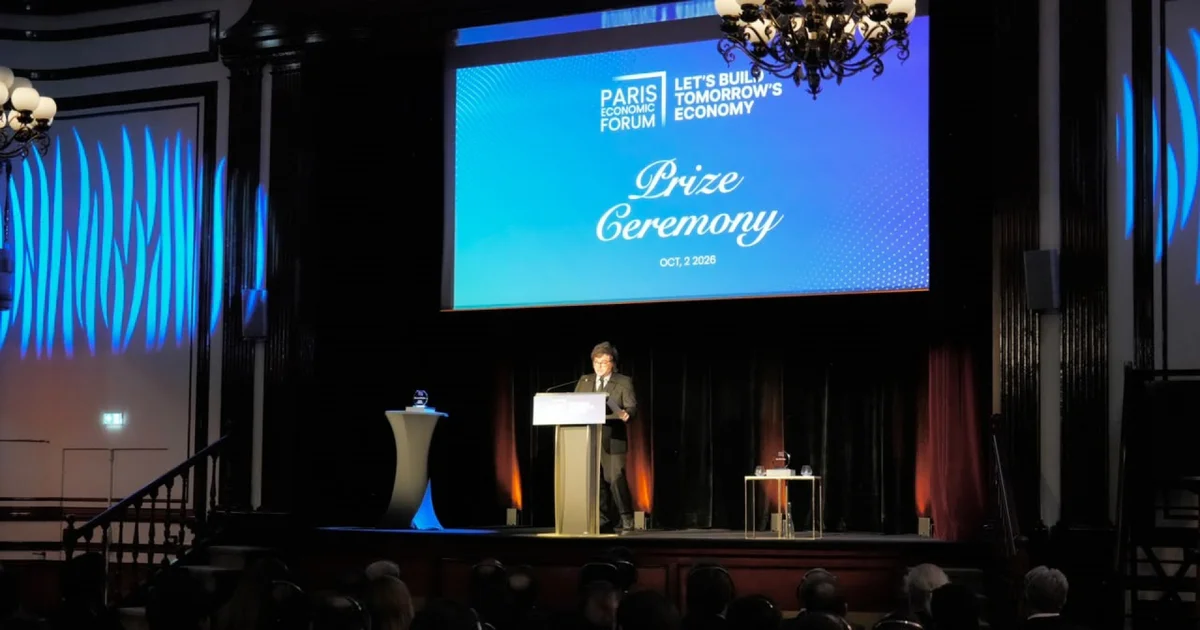
Speech by President Javier Milei after receiving the Economic Forum of Paris Award as "the most influential economist in the world."
Good afternoon everyone. First of all, I would like to thank you for this award, and I also want to thank you for the privilege of what has been the meeting prior to this ceremony. Truly, having the opportunity to speak with an intellectual giant, a great master, such as Philippe Aghion, is an enormous privilege, but it is an additional reason for joy when that person also belongs to the field in which one, from a much humbler place, has worked and specialized in. In my case, I decided to study economics, and over the years I decided to specialize in economic growth.
One of the most wonderful things that happened to me when I was talking with Professor Aghion was that the reason he dedicated himself to economic growth was that he was genuinely concerned about poverty and how to lift people out of poverty. And at that very moment, the phrase came to mind that is found in many economic growth books, a phrase by Robert Lucas Junior that says, because it is very impressive, it says, 'the consequences for human well-being of these kinds of issues are truly staggering to the point that when one starts to think about them, one can never think about anything else.'
When one reads that phrase, that phrase is truly impactful. But when one starts to study economic growth, one cannot stop thinking in those terms, and when I was talking with Professor Aghion, so to speak, that floated in the meeting the whole time. Furthermore, the explanation of economic growth has different versions. In my case, as someone who has only studied it, I faced a menu of options, and there is, so to speak, a train of thought that seemed most attractive to me, which is precisely the Schumpeterian or Neo-Schumpeterian line, propelled by Professor Aghion. Additionally, I mentioned to him the wonderful experience of reading his books with Howitt.
Therefore, this first part of my speech was to thank you for the award, thank you for allowing me to be here, thank you for the privilege of sharing the conversation with Professor Aghion. It seems I am on a roll these weeks because days ago I also had the privilege of meeting Xavier Sala i Martín. So the first thing I want to express is my deep gratitude for all this beautiful moment you are giving me in a task that is quite thankless, which involves facing all kinds of circumstances, dealing with lots of costs, enduring lies, slander, and insults that tarnish one’s good name and honor, as well as that of one’s family, but there is also an element for which it is worth doing it, which is that one is writing a page of history.
So, when these moments appear, so to speak, the utility increases substantially.
That said, one of the things I want to share is how this approach to economic growth is the determining element for which we design public policies, particularly economic policy. We essentially have to face two situations. One is the situation and how to link the situation to the long term, which is what makes up economic growth. At the time we received the Argentine economy, we had the worst of the three major crises in Argentina; we had a monetary imbalance that was double that of what we experienced in ‘75, which was an inflationary explosion with six times the inflation rate. Imagine that it was double, the best manifestation is that the exchange rate gap, that is, between the official exchange rate and the parallel one, had a difference of three times, that is 200%; the other thing we were facing was the situation of a bankrupt Central Bank and a large fiscal imbalance with social indicators worse than those we had prior to the 2001 crisis.
At the same time, inflation was traveling at one and a half, one point five percent daily, we had four monetary bases due each day in the Central Bank, interest-bearing liabilities, which generated a quasi-fiscal deficit of ten percentage points of GDP; and we had 10, equivalent to 10 monetary bases due day by day of the national Treasury debt. That is to say that in one day we could multiply the amount of money by 15 times. In other words, we were literally in hyperinflation.
Therefore, we had to confront the fiscal imbalance of the Treasury of five percentage points of GDP, ten from the Central Bank; we had to tackle 15 points of GDP, and in this context, during the campaign, I carried a chainsaw and said I would close the fiscal deficit in the first year, and they said it was impossible to do it in four. Well, thanks to the talent, bravery, and courage of my Minister of the Economy, the architect of the miracle, Luis ‘Toto’ Caputo, we achieved fiscal balance in the first month of management.
In other words, in the first month of management, we made a 30% reduction in public spending and put the accounts in order from day one.
However, in light of what I’ve told you, that was only one third of the problem, and we had to fix the issue of the Central Bank and the debt in general. The solution that Argentina has used throughout history has always been expropriation. We as libertarian liberals could not afford the heresy of violating private property, of breaking contracts, and along with the great work of Minister Caputo, the President of the Central Bank, whom I am honored to have here, Santiago Bausili, and today Chancellor Pablo Quirno, at that time Secretary of Finance, accomplished the incredible task of closing the quasi-fiscal deficit, that is to say, ten percentage points of GDP, in six months.
So, at the end of the day, I am nothing more than a privileged person lucky enough to guide a group of giants. The other day I was with one of Macron's Ministers, and then I was introducing my ministers, so I introduced Minister Caputo as the architect of the miracle; then when I introduced Federico Sturzenegger, our Minister of Deregulation, who has undertaken about eighteen thousand deregulations, something like seventeen or eighteen per day.
Then he said to me, 'Well, but you don't only have a genius, you have two geniuses.' I replied, 'No, don’t get it wrong; in reality, my entire team consists of geniuses.' That is to say, if I have any talent, it is that I clearly chose truly extraordinary people who allow us to have the best government in history.
Now, how do all these pieces of macro architecture fit together for economic growth, and what is our economic growth strategy? The first point is that inflation, which was traveling at one and a half daily, which could have ended up at levels between 15,000 and 17,000 percent annually, and which as we cut the fiscal deficit and monetary emission drastically, inflation in 2023 for consumers ended up around 200% and for wholesale prices around 300%; today it travels in consumers around 30 and in wholesalers around twenty.
Basically eliminating inflation eliminates the distortion of relative prices, extends the planning horizon for the private sector; consequently, no misallocation of resources takes place due to distorted prices, and consequently, that produces a macro reordering and generates more efficient allocations, and there that generates a gain in well-being, which is once and for all because basically the day one has finished with inflation, that gain evaporates.
The second extremely important point is that, basically, recovering fiscal equilibrium involved restoring savings, and savings become a fundamental piece to finance investment. At the same time, this is where private property plays a fundamental role because all the engineering of growth, I will be going into each of the parts later, but essentially addresses how I generate savings and that savings are transformed into investment.
That is why it was so important from the very beginning to respect the right to property, especially in a country that had come from massive expropriations over the last 50 years. Therefore, it was essential to respect property rights to protect savings, which we also promoted by lowering the fiscal imbalance, thereby freeing resources for the private sector to invest. Additionally, there is a positive collateral effect: when we arrived, the debt-to-GDP ratio in Argentina was one hundred percent of GDP, consolidated, and the Country Risk was at 3000 basis points.
Having achieved fiscal balance and persisted in that policy throughout our mandate, I give you my word that while I occupy the electric chair that is the presidency of Argentina, fiscal balance will continue to exist.
And the counterpart to this is that the debt-to-GDP ratio today is already at 39%. In other words, Argentina is one of the five countries in the world that has fiscal balance in the financial line and has a debt-to-GDP ratio of 39%. The flip side of this is that the country risk fell, reaching levels below 500%. Excuse me: five hundred basis points. However, recent events in the world, considering that Argentina is an aggressive beta asset, led to an increase in country risk.
But more so, so to speak, once all these international convulsions end, country risk will start to fall again, and our idea is that indeed the risk of our administration, and we are down to 27, is below 100 basis points, thus, if we achieve reelection, it will mean that the Argentine economy. Therefore, country risk will collapse, and we will likely accelerate our growth rate to levels of 7 or 8% per capita, without a doubt.
So, that being said, what are the true engines of growth with which we work? One could say that there are basically three blocks: there is an issue related to respect for private property, the fundamental role that private property has, and this, so to speak, private property can be attacked in two ways. One way is taxes. Well, we also have things to discuss in this regard.
Yesterday, in an extraordinary talk given by Minister Sturzenegger, one of the things he said is, under no circumstances should you consider presenting a project to the president that involves generating a fiscal deficit; that is wonderful; and furthermore, in no way should you consider presenting the idea to raise taxes, and in fact, we made the fiscal adjustment by lowering public spending, and we have lowered public spending so much that it has also allowed us to reduce fiscal pressure by three percentage points of GDP.
In other words, we started to return money to the Argentinians. And in fact, and this is simulated by Minister Caputo's team, if Argentina maintained a growth rate around 5%, we could return to Argentinians close to 500 billion dollars from now until 2031, which is an amount equivalent to what we have in debt, therefore, a lot of resources would be returned to Argentinians. Moreover, in fact, having eliminated the inflation tax, which in essence accounted for up to 13 percentage points of GDP in the year prior to our assumption of power, meant returning 100 billion dollars to Argentinians.
That is why when one looks at the drop in poverty, it is so impressive.
And the other part of the regulation or the way to address private property is regulation, and there are two types of regulation. There is a regulation that generates a lot of discomfort when one wants to eliminate it, which is why they often attack Minister Sturzenegger, and not only do they tend to attack him, but they do so in a cowardly manner by writing to me and sending messages to me rather than confronting him directly. Because a talented person like Federico could dismantle them instantly, yet they resort to cowardice.
At one point, Federico had sent some things; you can imagine that I set the guidelines, but I cannot be involved in all the details. Suddenly, my phone started blowing up with complaints about Federico, and I thought, ‘What a wonderful job Federico is doing!’ In other words, he was putting an end to a lot of corrupt practices. So, Federico, please keep it up, I love it when that happens.
Not that it would be more honest for them to attack him directly, but they cannot do so because he is eliminating corruption. So, there is a part of regulation aimed at creating hunting grounds, is it correct to say hunting grounds? Where businesspeople hunt in a zoo, so these are regulations meant to confine Argentines. The other regulation that you have regarding taxes affects property rights, but it does not affect the growth rate, unless they are very violent.
What they do is change the level of the rate; it can be either higher or lower, and they can achieve a higher or lower per capita GDP, but it does not substantially affect the trajectory. However, there is something more complex, which is when regulation is used to make a concentrated market resemble a competitive market. This case is indeed much more serious; it is very typical of the neoclassical approach, which gives the idea of a market failure. So, when you see a structured market with a concentrated framework whose counterpart is the existence of increasing returns, there is a temptation on the part of policymakers to regulate it and make it appear like a competitive company.
At that very moment that you assimilate it to a competitive company, that is equivalent to generating constant returns to scale. And when you have constant returns to scale, there is no growth. In other words, that regulation kills growth.
As I had pointed out: since we took office, Federico has carried out 18,000 deregulations, many of which have concluded, and he has swept away the corrupt, while others have stimulated increasing returns. This means something that generates economic growth. Our second block of economic growth is the idea of our Ministry of Human Capital. Basically, the idea of social containment, of social assistance has always been linked to giving fish to people, and the reality—there is a beautiful phrase from Milton Friedman inspired by the Torah, in the book of Shemot, which describes the departure of the Hebrew people from Egypt—that says, ‘There’s no such thing as a free lunch.’
The Hebrew people who left Egypt were clear about that. The free fish was Egypt; the free fish was slavery. Well, we do not want slaves; we want free Argentines, and that is why we changed social policy to the point that we changed the name of the ministry, and it is no longer called social development or anything like that; it is called the Ministry of Human Capital, and if I could, I would put a huge poster of Gary Becker in the Ministry.
Days ago, I also had the enormous privilege of speaking with James Heckman, and it was wonderful because our construction of the Ministry of Human Capital was perfectly aligned with Heckman’s results. We focus initially on what relates to childhood and family. In other words, we do not want to give fish; we want them to learn how to fish and, if possible, start a business. Now, in this concept, the first link is childhood and family.
When we arrived, the Universal Child Allowance and what was the Food Plan or the 1,000 Days Plan only covered 40% of the basic basket.
Today, the heartless liberals find that these two benefits cover 100% of the basket. Moreover, it is interesting how we managed to double the benefit that reaches people without increasing a single peso. Well, the sensitive Peronists, so sentimental and so committed to the vulnerable, had some gentlemen called poverty managers who took half of the money that was destined for the vulnerable.
When we eliminated mandatory benefits, they no longer had to pass through the toll booth automatically, the vulnerable people doubled the amount of resources they received because they no longer had to pay the poverty managers. Not only that, but the other block is related to Health. Although it was originally part of the Ministry of Human Capital, the difficulties it faced required it to become a Ministry in itself, yet it works integratively with the Ministry of Human Capital because if you have well-fed, well-educated people in good health, this allows them to enter education and develop.
And there, the next link is the labor market, whether for young people to enter or for those who have fallen out of the system to reintegrate. And this, too, has been addressed in various ways in the labor market. The first relates to retraining those who have fallen out of the system so they can return, and our Minister of Human Capital regularly discusses this: before, people asked for social plans; now they ask for work; that is a significant advance.
But not only that, but also thanks to the enormous work of the political table, and especially with our political allies who are not from our party, and who many of them are present and have been part of Argentina Week, we were able to push through many reforms, including labor modernization, so that people could enter the labor market, have a more flexible labor market, and as long as we can continue advancing in the reforms and consolidating them at the polls, meaning that Argentines decide to continue down this path, what will happen is that it will allow for increased formality, and with this, we will be able to resolve the last link in the chain, which is the pension situation.
Therefore, let’s say we are generating increasing returns on the one hand. On the other, we are promoting human capital accumulation and labor insertion. The third block is to open the economy. Increasing returns is what Adam Smith called ‘the pin factory,’ and that division of labor had a limit, and that limit was basically the size of the market. Well, if we are targeting a market of 48 million people, it is a small market.
Therefore, what we decided to do is start opening the economy. Argentina, according to its per capita GDP, should have an openness coefficient of 90 percent, and it currently has one of 30%. In other words, Argentina needs to triple the level of openness of its economy. Naturally, we are doing a lot about that: we have achieved an agreement with the European Union, we have reached an agreement with the United States, we have the EFTA agreement, we are making bilateral agreements with Asian countries, and we are targeting the Trans-Pacific Trade Agreement, so that we can triple Argentina's trade volume, which will generate a tremendous amount of economic growth.
It will still be able to release; it will expand the market size and free up even more increasing returns.
That said, we also have an industrial promotion regime called RIGI, in which we have already harvested about 50 billion dollars in approved investments, and we still have pending approvals of more than 150 billion dollars, something truly impressive because it represents about one-third of GDP. Thus, we are also working on that situation, and obviously, we are calibrating the openness as we can continue lowering the Country Risk because this means that if we want to target a market of 8.
000 billion dollars, this is called enormous economies of scale, and the counterpart of that is tremendous investments. So we have to be quite careful because a lot of capital means very low interest rates, while we have a very high Country Risk, and this transition must be managed wisely, but we have sectors that are indeed very, very dynamic and are pushing growth at this moment, such as, for example, the oil sector, the gas sector, the mining sector, and our agriculture, and we add to this what we are achieving in the knowledge economy and the opening we are doing to make Argentina a hub for artificial intelligence because Argentina is very suited to have data centers in vast, inhospitable, cold lands.
Thus, we are also looking at artificial intelligence as a mechanism for accelerating economic growth. Therefore, that is our growth strategy, so the question is: does it work? Well, the answer is yes.
Another phrase I loved from Friedman, not as much as the first one but still one that I like a lot, is that he used to irritate his students by asking them about their countries, and the point was always first the data. Argentina, when we arrived, had 12 years of stagnated GDP. Furthermore, after Argentina's glorious moment at the beginning of the 20th century, Argentina decided to abandon the liberal model and decided to take a fascist line, that is to say, a socialist line, which then led to a catastrophe.
Because the truth is being the President, the first liberal libertarian President, not only of Argentina but of the world, is not something normal. Well, there were no natural conditions of pressure and temperature. It was chaos. That is why I was chosen, otherwise, under normal conditions, that would never have happened. So in that context, in addition, the one hundred years before we arrived, Argentina's average growth rate was 1%, meaning something truly impoverished, and the worst of all this happened with the demographic transition in our favor.
That said, in the first year of government in an estimator called Monthly Estimator of Economic Activity, so as not to have to bear the consequences of looking at the results of the heritage that was left due to the statistical carryover effect, in our first year, GDP expanded by more than 6.5 percent. In the second year, it grew around four, and if we take the estimates from market analysts, that number can fluctuate between 18 and 20%.
Saying that in four years the number is important, yes, because in the second government of Cristina Fernández de Kirchner, growth was one and a half percent in those four years while the OECD grew around 6%. In Mauricio Macri's government, the economy fell by 3.8% while the OECD also did around 7%. In the case of my predecessor, the economy basically recovered what it had lost during Macri’s government in a world that did it at five.
Well, if we were to position ourselves in a medium scenario of 18%, that would mean we would be tripling OECD growth, and not only that, but the growth would be four and a half times higher than what history has brought to Argentina in the last 100 years, and it is working, and not just because the growth rate is an interesting growth rate, but what is also interesting is the counterpart of what motivated Professor Aghion to dedicate himself to economic growth and in that chilling phrase by Robert Lucas Junior.
And the fact is that poverty, when it was sincere, was at 57%; today it is around 30, 32%. That is to say, we have lifted a quarter of the Argentine population out of poverty, we have lifted 12 million human beings out of poverty; there was 20% of Argentines who were indigent, as you hear it, in a country with food that can nourish 500 million human beings, the political system had left 20% of Argentines without food. That number of 20%, we have brought down to 6%, and children, and children, who are our future, when we arrived had a poverty level of 70%; today it is 42.
I am not saying that the picture is good; the picture remains a horror, the picture remains terrible, but without a doubt it is the best movie in Argentine history. And for that, I need to close by giving thanks. Thanking my teachers, teachers like Philippe Aghion, like Xavier Sala i Martin, or like Robert Lucas Junior, who educated me in economic growth, or the Austrians who inspire me day by day such as Mises, Rothbard, and Hayek, who are the ones that have inspired the construction of this vision, of this vision that I have for Argentina to be great again. Now, having a vision is not enough; just having the vision is not enough, and that is why my greatest gratitude is also to those giants that I have as Ministers, that I have as a cabinet, who are the ones that are making it possible for that idea to become a reality.
And finally, the greatest gratitude is for my loved ones, because they are the ones who bear the collateral effects of one having had the courage to decide to change the declining history of a country to make it great again. Thank you very much.
Discurso del Presidente Javier Milei tras recibir el Premio del Foro Económico de París como "economista más influyente del mundo".
Buenas tardes a todos. En primer lugar, deseo dar las gracias por este premio y también deseo dar las gracias por el privilegio de lo que ha sido la reunión previa a esta ceremonia. Verdaderamente, tener la posibilidad de hablar con un gigante intelectual, un gran maestro, como el caso de Philippe Aghion, es un privilegio enorme pero es un motivo de alegría adicional cuando uno además, esa persona pertenece al campo al que uno, desde un lugar mucho más humilde, ha trabajado y además se ha especializado en ese campo. Es decir, en mi caso decidí estudiar economía y con el correr de los años decidí especializarme en crecimiento económico.
Una de las cosas más maravillosas que me pasó recién cuando hablaba con el profesor Aghion era que él el motivo por el cual se dedicó al crecimiento económico fue porque justamente le preocupaba la pobreza y cómo hacer para sacar a la gente, a la población de la pobreza. Y en ese mismo momento me vino a la cabeza la frase que está en mucho de los libros de crecimiento económico una frase de Robert Lucas Junior que dice, porque es muy impresionante, dice “las consecuencias sobre el bienestar humano, de este tipo de cuestiones son verdaderamente estremecedoras a punto tal que cuando uno empieza a pensar en ellas nunca más puede volver a pensar en algo más”.
Cuando uno lee esa frase, esa frase verdaderamente es muy impactante. Pero cuando uno se pone a estudiar crecimiento económico ya no puede dejar de pensar en esos términos y cuando hablaba con el profesor Aghion, digamos, eso fue lo que flotó en la reunión todo el tiempo. Además, la explicación del crecimiento económico tiene distintas versiones. En mi caso, como alguien que sólo ha sido, alguien que lo ha estudiado, me enfrenté al menú de opciones y hay digamos una línea de pensamiento que me resultó más atractiva y que es justamente la línea schumpeteriana o Neo schumpeteriana, impulsada por el profesor Aghion. Además, le comenté de la hermosa experiencia de leer sus libros con Howitt.
Por lo tanto, esta primera parte de mi charla era dar las gracias por el premio, dar las gracias por permitirme estar aquí, dar las gracias por el privilegio de poder compartir la charla con el profesor Aghion, es más parece que estoy de racha en estas semanas porque días atrás además tuve el privilegio de conocer a Xavier Sala i Martín. Así es que lo primero que quiero manifestar es mi profundo agradecimiento por todo este hermoso momento que me están brindando en una tarea que es bastante ingrata, la cual uno debe enfrentar todo tipo de circunstancias, tiene que tomar un montón de costos, tiene que soportar mentiras, calumnias, injurias que manchen el buen nombre y honor el propio y el de la propia familia, pero también hay un elemento por el cual vale la pena hacerlo que es que uno está escribiendo una página de la historia.
Así es que, pero cuando aparecen estos momentos, digamos, la utilidad se incrementa sustancialmente.
Dicho esto, una de las cosas que quiero contar es cómo este enfoque del crecimiento económico es el elemento determinante por el cual nosotros diseñamos las políticas públicas, la política económica en particular. Nosotros, básicamente, tenemos que enfrentar dos situaciones. Una es la coyuntura y cómo enlazar la coyuntura hacia el largo plazo, que es lo que hace al crecimiento económico. Nosotros al momento de recibir la economía argentina teníamos lo peor de las tres grandes crisis de Argentina, teníamos un desequilibrio monetario que duplicaba al que tuvimos en el año ‘75, que fue una explosión inflacionaria de seis veces la tasa de inflación, imagínense que era el doble, la mejor manifestación es que la brecha cambiaria, o sea entre el tipo de cambio oficial y el paralelo había una diferencia de tres veces, es decir 200%; lo otro que enfrentábamos era la situación de un Banco Central quebrado y teníamos un desequilibrio fiscal muy grande e indicadores sociales peores a los que teníamos en la previa de la crisis del 2001.
Al mismo tiempo, la inflación viajaba al uno y medio, al uno coma cinco por ciento diario, teníamos cuatro bases monetarias venciendo día a día en el Banco Central, pasivos remunerados, que nos generaba un déficit cuasifiscal de diez puntos del PBI; y teníamos 10, el equivalente a 10 bases monetarias venciendo día a día de deuda del Tesoro nacional. Es decir que en un día podíamos multiplicar la cantidad de dinero por 15 veces. Es decir, estábamos literalmente en una hiperinflación.
Por lo tanto, nos teníamos que enfrentar al desequilibrio fiscal del Tesoro de cinco puntos del PBI, diez del Banco Central, había que enfrentar 15 puntos del PBI, y en ese contexto, nosotros, en campaña, yo llevaba una motosierra y decía que iba a cerrar el desequilibrio fiscal en el primer año, y decían que eso era imposible que lo hiciera en cuatro. Bueno, gracias al talento y a la valentía y el coraje de mi Ministro de Economía, el arquitecto del milagro, Luis ‘Toto’ Caputo, el equilibrio fiscal lo logramos en el primer mes de gestión.
Es decir, en el primer mes de gestión hicimos una reducción del gasto público de 30% y pusimos las cuentas en orden desde el primer día.
Sin embargo, a la luz de lo que les conté ese era solamente un tercio del problema y había que arreglar el problema del Banco Central y de la deuda en general. La solución que ha utilizado Argentina a lo largo de la historia siempre fue la expropiación. Nosotros como liberales libertarios no nos podíamos permitir la herejía de violentar la propiedad privada, de violar los contratos y junto al enorme trabajo del Ministro Caputo, el Presidente del Banco Central que tengo el honor que también esté aquí, Santiago Bausili, y hoy Canciller Pablo Quirno, en aquel momento secretario de Finanzas, lograron la tarea increíble de cerrar el déficit cuasifical, es decir diez puntos del PBI, en seis meses.
Así es que en el fondo no soy más que un privilegiado de tener la suerte de poder guiar a un conjunto de gigantes. El otro día estaba con uno de los Ministros de Macron entonces le digamos le fui presentando a mis ministros entonces lo presenté al Ministro Caputo como digamos, el arquitecto del milagro, después cuando lo presente a Federico Sturzenegger, nuestro Ministro de Desregulación y que llevamos hechas dieciocho mil desregulaciones, algo así como diecisiete, dieciocho por día.
Entonces me dice “bueno, pero usted no tiene solamente un genio tiene dos genios”. Le dije “no, no se equivoque, en realidad todo mi equipo son todos genios”, es decir, si algún talento tuve es que elegí claramente a tipos verdaderamente extraordinarios que permiten que estemos haciendo el mejor gobierno de la historia.
Ahora, ¿cómo encajan todas estas piezas de arquitectura macro para el crecimiento económico y cuál es nuestra estrategia de crecimiento económico? El primer punto es que la inflación, que viajaba al uno y medio diario, que podría haber terminado en niveles entre 15 mil y el 17 mil por ciento anual, y que como cortamos de cuajo el déficit fiscal y la emisión monetaria, la inflación del 2023 en el consumidor terminó en torno al 200% y en mayoristas al 300%; hoy viaja en consumidor en torno al 30 y en mayoristas en torno al veinte.
Básicamente eliminar la inflación, elimina la distorsión de precios relativos, estira el horizonte de planeación para el sector privado, consecuentemente no se hacen mala asignación de recursos por tener distorsionados los precios y consecuentemente eso produce un reordenamiento macro y genera asignaciones más eficientes y ahí eso genera una ganancia de bienestar, que esa es de una vez para siempre porque básicamente el día que uno ya terminó con la inflación, esa ganancia se evapora.
El segundo punto extremadamente importante es que, básicamente, recuperar el equilibrio fiscal implicó recomponer el ahorro, y el ahorro se vuelve una pieza fundamental para financiar la inversión. Al mismo tiempo, ahí es donde juega un rol fundamental la propiedad privada porque toda la ingeniería del crecimiento, después voy a estar yendo a cada una de las partes, pero en el fondo trata de cómo yo genero ahorro y ese ahorro lo transformo en inversión.
Por eso era tan importante desde el primer momento el respeto al derecho de propiedad, en especial un país que venía de expropiaciones masivas durante los últimos 50 años. Por lo tanto, resultaba fundamental respetar el derecho propiedad para respetar el ahorro al cual, además, lo impulsamos bajando el desequilibrio fiscal, y de esa manera liberar recursos para que el sector privado pudiera invertir. Además, hay un efecto colateral positivo: cuando nosotros llegamos la relación deuda/producto en Argentina era del cien por ciento del PBI, la consolidada, y el Riesgo País estaba en 3000 puntos básicos.
Haber logrado el equilibrio fiscal y haber persistido en esa política a lo largo de lo que llevamos de mandato y que les doy mi palabra digamos que mientras que yo ocupe la silla eléctrica que es la presidencia argentina, el equilibrio fiscal seguirá existiendo.
Y la contraparte de esto es que la relación deuda/producto hoy ya está en el 39%. Es decir, Argentina es uno de los cinco países del mundo que tiene equilibrio fiscal en la línea financiera y tiene una relación deuda producto del 39%. La contracara de esto es que el riesgo país cayó, llegó a ubicarse en niveles debajo del 500%. Perdón: de quinientos puntos básicos. Sin embargo, los acontecimientos recientes en el mundo, siendo que Argentina es un activo beta agresivo implicó digamos que aumentara el riesgo país.
Pero más bien, digamos, terminen todas estas convulsiones internacionales, el riesgo país volverá digamos a bajar y nuestra idea es que de hecho el propio riesgo de nuestra administración y vamos hasta el 27 está por debajo de los 100 puntos básicos por lo tanto en caso de conseguir la reelección digamos la economía argentina. Por lo tanto, se va a desplomar el riesgo país y vamos a acelerar nuestra tasa de crecimiento seguramente a niveles del 7 u 8% per cápita, sin ninguna duda.
Entonces, dicho esto, ¿cuál es ahora entonces verdaderamente los motores del crecimiento con los que nosotros trabajamos? Uno podría decir que eso básicamente tres bloques: hay una cuestión vinculada al respeto a la propiedad privada, el rol fundamental que tiene la propiedad privada y esto, digamos, la propiedad privada puede ser atacada de dos maneras. Una vía impuestos. Bueno también tenemos cosas para contar en este sentido.
En el día de ayer, en una charla extraordinaria que daba el Ministro Sturzenegger, una de las cosas que decía es, bajo ningún punto de vista se le ocurra llevarle al presidente un proyecto que implica hacer déficit fiscal, eso es maravilloso; y además, de ninguna manera se le ocurra tampoco llevarle la idea de subir los impuestos, y de hecho nosotros el ajuste fiscal lo hicimos bajando el gasto público y, además, hemos bajado tanto el gasto público que eso nos ha permitido además bajar la presión fiscal en tres puntos del PBI.
Es decir, empezamos a devolverle dinero a los argentinos. Y de hecho, y esto está simulado por el equipo del Ministro Caputo, si Argentina mantuviera una tasa de crecimiento en torno al 5%, podríamos estar devolviendo a los argentinos cerca de 500 mil millones de dólares de acá hasta el 2031, lo cual es el monto equivalente a lo que tenemos de deuda, por lo tanto se le estaría devolviendo muchísimos recursos a los argentinos. Es más, de hecho, haber eliminado el impuesto inflacionario, que en el fondo se emitían hasta 13 puntos del PBI en el año previo a que nosotros llegáramos al poder, implicó devolverle a los argentinos cien mil millones de dólares.
Por eso cuando uno ve después la caída de la pobreza es tan impresionante.
Y la otra parte de la regulación o de la forma de atacar la propiedad privada es la regulación, y ahí hay dos tipos de regulación. Hay una regulación que genera mucho malestar cuando uno lo quiere eliminar, motivo por el cual suelen agredir al Ministro Sturzenegger, y que, además, no solo que lo suelen agredir porque si lo agredieran de frente eso no sería un problema porque una persona tan talentosa como Federico podría desarmarlos instantáneamente, sino que lo hacen de manera cobarde escribiéndome y mandándome mensajes a mí.
En un momento, Federico había mandado algunas cosas, yo, digamos, se imaginarán que yo fijo las directrices, pero no puedo estar en todos los detalles, pero de repente mi teléfono empiezan a entrar cosas y estallaba mi teléfono, todos se estaban quejando de Federico, y yo dije «¡Qué trabajo maravilloso está haciendo, Federico». Es decir, estaba terminando con un montón de curros. Así que, Federico, seguía así, por favor, que me encanta cuando pasa eso.
No porque sería más honesto que lo atacaran de manera directa pero no lo pueden hacer porque está eliminando la corrupción. Así que hay una parte de la regulación destinada a generar cotos de caza, ¿está bien decir cotos de caza? donde los empresarios cazan en el zoológico, sea entonces son regulaciones para encerrar a los argentinos. La otra regulación que básicamente ustedes con el tema de los impuestos ustedes afectan el derecho de propiedad, pero no afectan a la tasa de crecimiento, salvo que sean muy violentos.
Lo que hacen es cambiar el nivel de la tasa entonces pueden ir más puede ser más alta o más baja y pueden ir a un PBI per cápita más o menos alto, pero es como que digamos no afecta sustancialmente la trayectoria. Pero hay algo que es más complejo que es cuando se regula para asimilar a un mercado competitivo. Este caso sí es muchísimo más grave es muy propio dios del enfoque neoclásico, da la idea de fallo de mercado entonces ustedes cuando ven una estructura enmarcada de mercado concentrado cuya contraparte es la existencia de rendimientos crecientes existe la tentación por parte de los policy makers de regularlo y hacerlo parecer a una empresa competitiva.
En ese mismo momento que ustedes lo asimilan a una empresa competitiva, eso es equivalente a generar rendimientos constantes a escala. Y cuando ustedes tienen rendimientos constantes a escala, no hay crecimiento. Es decir que esa regulación lo que hace es matar el crecimiento.
Como les había señalado: desde que llegamos al Gobierno, Federico ha llevado a cabo 18.000 desregulaciones, muchas de ellas han terminado y ha barrido con los corruptos y otras han estimulado los rendimientos crecientes. Es decir, algo que genera crecimiento económico. Nuestro segundo bloque de crecimiento económico es la idea de nuestro Ministerio de Capital Humano. Básicamente la idea de la contención social, de la asistencia social siempre estuvo ligada a regalarle el pescado a la gente, y la realidad, hay una frase hermosa de Milton Friedman inspirada en la Torá, en el libro de Shemot, que describe la salida del pueblo hebreo de Egipto, que dice «No existe tal cosa como un almuerzo gratis».
Eso el pueblo hebreo, que salió de Egipto, lo tenía claro. El pescado gratis era Egipto, el pescado gratis era la esclavitud. Bueno, nosotros no queremos esclavos, nosotros queremos argentinos libres, y por eso cambiamos la política social, a punto tal que cambiamos el nombre del Ministerio y no se llama ni desarrollo social ni nada por el estilo, se llama Ministerio de Capital Humano, y si yo pudiera al Ministerio le pondría una gigantografía de Gary Becker.
Días atrás también tuve el privilegio enorme de hablar con James Heckman, y era maravilloso porque nuestra construcción del Ministerio de Capital Humano estaba perfectamente alineada con los resultados de Heckman. Nosotros hacemos un primer foco en lo que tiene que ver con niñez y familia. Es decir, nosotros no queremos regalar el pescado, queremos que aprendan a pescar y si pueden que se hagan una empresa. Ahora, en ese concepto el primer eslabón es niñez y familia.
Nosotros cuando llegamos entre la Asignación Universal por Hijo y lo que era el Plan Alimentar o el Plan Mil Días, eso solamente cubría el 40% de la canasta básica.
Hoy los desalmados liberales sucede que esas dos prestaciones cubren el 100% de la canasta. Es más: es interesante cómo logramos duplicar la prestación que le llegaba a la gente sin aumentar un solo peso. Bueno los sensibles peronistas, tan sensibleros y tan comprometidos con los vulnerables, sucede que tenían unos señores que se llamaban los gerentes de la pobreza y que del dinero que recibían, que estaban destinados los vulnerables, se quedaban con la mitad.
Cuando nosotros eliminamos las prestaciones obligatorias dejaron de tener que pasar por el peaje automáticamente, las personas vulnerables duplicaron la cantidad de recursos que recibían porque no tuvieron que pagar más a los gerentes de la pobreza. No solo eso sino que el otro bloque está vinculado con Salud, si bien originalmente era parte del Ministerio de Capital Humano las dificultades que tenía digamos requirió de que se convierta en un Ministerio en sí mismo pero trabaja integradamente con el Ministerio de Capital Humano porque si usted tiene gente bien alimentada, bien formada y en buenas condiciones de salud eso permite que ingresen a la educación y se formen.
Y ahí, el eslabón siguiente es el mercado de trabajo, ya sea para que puedan ingresar los jóvenes o para que se puedan reinsertar los que se han caído del sistema. Y eso también en el mercado laboral se atacó de distintas maneras, la primera tiene que ver con que aquellos que han caído del sistema, reentrenarlos para que puedan volver y esto nuestra Ministra de Capital Humano lo cuenta regularmente: antes la gente le pedía planes sociales, ahora le pide trabajo; eso es un gran avance.
Pero no solo eso, sino que, además, gracias a la tarea enorme de la mesa política y en especial a nuestros aliados políticos, que no son de nuestro partido y que muchos, y están presentes y han sido parte de Argentina Week, pudimos sacar un montón de reformas, entre ellas la modernización laboral, de modo tal que las personas puedan ingresar al mercado laboral, tener un mercado laboral más flexible y que en la medida que podamos seguir avanzando en las reformas y consolidarlas en las urnas, es decir, que los argentinos decidan seguir por este camino, lo que va a ocurrir es que eso va a permitir incrementar la formalidad y con eso vamos a poder resolver el último eslabón de la cadena que es la situación previsional.
Por lo tanto, digamos por un lado generamos rendimientos crecientes. Por otro lado, favorecemos la acumulación de capital humano y de inserción laboral. El tercer bloque es abrir la economía. Los rendimientos crecientes es lo que Adam Smith llamaba “la fábrica de alfileres” y esa división del trabajo tenía un límite y ese límite era básicamente el tamaño del mercado. Bueno si nosotros estamos apuntando a un mercado de 48 millones de personas es un mercado chiquitito.
Por lo tanto, lo que decidimos es empezar a abrir la economía. Argentina, acorde el PBI per cápita que tiene, debería tener un coeficiente de apertura del 90 por ciento y tiene uno del 30%. Es decir, Argentina tiene que triplicar el nivel de apertura de su economía. Naturalmente estamos haciendo mucho por eso: hemos logrado el acuerdo con la Unión Europea, hemos logrado un acuerdo con Estados Unidos, tenemos el acuerdo EFTA, estamos haciendo acuerdos bilaterales con países asiáticos, estamos apuntando al Tratado Transpacífico, de modo tal que podamos triplicar el volumen comercial de Argentina, lo cual va a generar muchísimo crecimiento económico.
Va a poder todavía liberar, va agrandar el tamaño en el mercado y liberar todavía más rendimientos crecientes.
Dicho esto, también tenemos un régimen de promoción industrial que es el RIGI, en el cual ya hemos cosechado cerca de 50.000 millones de dólares de inversiones que ya están aprobadas, y tenemos todavía pendiente de aprobación más de 150 mil millones de dólares, algo verdaderamente imponente porque representa más o menos un tercio del PBI. Así es que también estamos trabajando en esa situación y obviamente la apertura la vamos calibrando en la medida que podamos seguir bajando el Riesgo País porque esto significa que si nosotros queremos apuntar a un mercado de 8.
000 millones de dólares, eso se llama economías de escalas enormes y la contraparte de eso es tremendas inversiones. Entonces, tenemos que ser bastante cuidadosos porque mucho capital significa tasas de interés muy bajas, mientras que nosotros tenemos el Riesgo País muy alto, esa transición hay que saber manejarla, pero tenemos sectores que sí verdaderamente son muy, muy pujantes y que son los que están empujando el crecimiento en este momento, que son como, por ejemplo, el sector de petróleo, el sector del gas, el sector minero y nuestro campo, y a esto le sumamos lo que estamos logrando en economía del conocimiento y la apertura que estamos haciendo para que Argentina se convierta en un hub de inteligencia artificial porque es muy apto Argentina por tierras extensas, inhóspitas, frías como para poder poner los data centers.
Con lo cual también estamos buscando el tema de la inteligencia artificial como un mecanismo de aceleración del crecimiento económico. Por lo tanto, de eso consta nuestra estrategia de crecimiento, entonces la pregunta es: ¿y funciona? Bueno, la respuesta es sí.
Otra frase que me encantaba de Friedman, no tanto como la primera pero que también me gusta mucho, era que fastidiaba mucho a sus alumnos preguntándole cosas sobre sus países y el punto era siempre primero los datos. Argentina, cuando nosotros llegamos, llevaba 12 años de un PBI estancado. Además, después del momento glorioso de Argentina a inicios del siglo XX, Argentina decidió abandonar el modelo liberal y decidió tomar una línea fascista, es decir una línea socialista, y que después digamos derivó en una catástrofe.
Porque la verdad es que ser el Presidente, el primer Presidente liberal libertario, no sólo de Argentina sino del mundo, no es digamos algo normal. Bueno no había condiciones naturales de presión y temperatura. Era un caos. Por eso me eligieron a mí, sino en condiciones normales eso no hubiera pasado nunca. Entonces en ese en ese contexto, además los cien años previos que nosotros llegáramos la tasa de crecimiento promedio Argentina fue del 1%, es decir algo verdaderamente paupérrimo y lo peor de todo eso ocurrió con la transición demográfica a nuestro favor.
Dicho esto, nosotros en el primer año de gobierno en un estimador que se llama Estimador Mensual de la Actividad Económica, para no tener que estar pagando las consecuencias, digamos al mirar los resultados de la herencia que quedó por el efecto de arrastre estadístico, nosotros el primer año el PBI se expandió más del 6 y medio por ciento. El segundo año lo hizo en torno al cuatro y digamos si nosotros tomamos las estimaciones que tienen los analistas de mercado dio ese número puede fluctuar entre el 18 y el 20%.
Digamos que en cuatro años es importante el número, sí, porque en el segundo gobierno de Cristina Fernández de Kirchner, el crecimiento fue del uno y medio en esos cuatro años mientras que la OCDE lo hizo en torno al 6%. En el gobierno de Mauricio Macri la economía cayó 3,8 % mientras que la OCDE también lo hizo en torno al siete por ciento. En el caso de mi predecesor básicamente la economía recuperó lo que había perdido durante el gobierno de Macri en un mundo que lo hizo al cinco.
Bueno si nosotros nos pusiéramos en el escenario medio de 18% eso significa que estaríamos triplicando el crecimiento de la OCDE y no sólo eso sino que el crecimiento estaría siendo cuatro veces y medio más alto que el que ha traído la historia argentina en los últimos 100 años y está funcionando y no solo porque la tasa de crecimiento es una tasa de crecimiento interesante sino que además lo que es interesante es la contraparte de aquello que fue lo que lo movilizó al profesor Aghion a dedicarse al crecimiento económico y en esa frase tan estremecedora de Robert Lucas Junior.
Y es que la pobreza cuando se sinceró estaba en el 57%, hoy está en torno al 30, 32%. Es decir, sacamos de la pobreza a un cuarto de la población argentina, sacamos de la pobreza a 12 millones de seres humanos, había 20% de argentinos que eran indigentes, así como lo escuchan, en el país de los alimentos que puede alimentar a 500 millones de seres humanos, el sistema político había dejado 20% de los argentinos sin comer. Ese número del 20%, lo hemos llevado al 6%, y los niños, y los niños, que son nuestro futuro, cuando llegamos el nivel de pobreza del 70%; hoy es 42.
No estoy diciendo que la foto sea buena, la foto sigue siendo un espanto, la foto sigue siendo horrible, pero sin lugar a dudas es la mejor película de la historia argentina. Y eso, necesito hacer el cierre dando las gracias. Dar las gracias a mis maestros, maestros como Philippe Aghion, como Xavier Sala i Martin o como Robert Lucas Junior, que me educaron en crecimiento económico, o los austríacos que me inspiran día a día como como Mises, como Rothbard, como Hayek, que son los que han inspirado la construcción de esta visión, de esta visión que tengo para que Argentina sea grande nuevamente. Ahora, con la visión no alcanza, con solo la visión no alcanza, y por eso también mi mayor agradecimiento es a esos gigantes que tengo como Ministros, que tengo como gabinete, que son los que están haciendo posible que esa idea se haga realidad.
Y, finalmente, el mayor agradecimiento es para los seres queridos, porque son los que soportan los efectos colaterales de que uno haya tomado el coraje de haber decidido cambiar la historia decadente de un país para convertirlo en grande nuevamente. Muchísimas gracias.
Full original text in Spanish, published by Casa Rosada.
Copied verbatim from the official speech; translation by MileiHoy.
“When we took office, poverty was at 57%; today it is around 30-32%. We have lifted a quarter of the Argentine population out of poverty, saving 12 million lives.”
— Javier Milei · See it in the speech
“In other words, Argentina is one of five countries in the world that has fiscal balance and a debt-to-GDP ratio of 39%.”
— Javier Milei · See it in the speech
“Thanks to the talent, bravery, and courage of my Minister of Economy, the architect of the miracle, Luis 'Toto' Caputo, we achieved fiscal balance in the first month.”
— Javier Milei · See it in the speech
“We decided to start opening up the economy. Argentina, according to its per capita GDP, should have an openness coefficient of 90%, yet it stands at 30%.”
— Javier Milei · See it in the speech
“Thus, this forms our growth strategy. The question is: does it work? Well, the answer is yes.”
— Javier Milei · See it in the speech