
Three plans: El Resumen Esencial for free, Premium with the full analysis and Intelligence with data and alerts to decide, in English, Spanish or Portuguese.
Three plans: El Resumen Esencial for free, Premium with the full analysis and Intelligence with data and alerts to decide, in English, Spanish or Portuguese.
Three plans: El Resumen Esencial for free, Premium with the full analysis and Intelligence with data and alerts to decide, in English, Spanish or Portuguese.
Perfil5 min read
AI estimate · 90% confidence
Main framing
Left 70%
Left · estimated by AI · 90% confidence
The estimate comes from analyzing the story's text: which sources it quotes, which facts it highlights and what language it uses.
An AI model reads the story and estimates how much of its framing leans left, center or toward a libertarian view. The three percentages add up to 100.
This is an AI-generated estimate, not an objective judgment.
Generated on · 1 min read
AI summaries may contain errors.
The article takes a critical stance towards Milei, emphasizing his opposition to social justice and presenting his comments in a potentially negative context. Language suggests that his proposals for deregulation and criticism of state intervention are problematic.
Quoted from the original Spanish text.
AI summary
Javier Milei received an Honorary Doctorate in Humanities from the University of Belgrano, where he gave a speech on economic growth. He criticized social justice, defended market deregulation, and highlighted the importance of technological advancements.
Additionally, he stated that Argentina could be the best country if it weren't for regulations and advocated for a focus on Judeo-Christian values. During his talk, the president emphasized the importance of work and deregulation to combat poverty.
Generated by AI from the original story in Spanish.
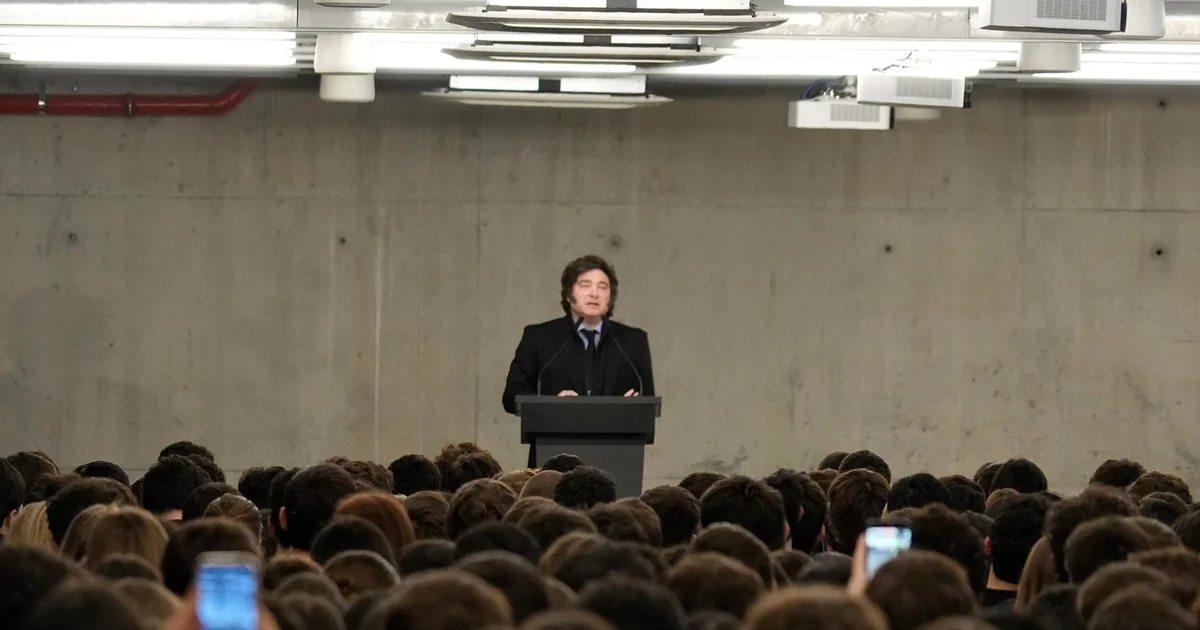
Javier Milei dio un discurso sobre crecimiento económico donde arremetió contra la justicia social y defendió los avances tecnológicos y la desregulación del mercado, al recibir el título de Doctor Honoris Causa en Humanidades, otorgado por la Universidad de Belgrano y el Instituto Universitario Isaac Abarbanel.
Fue en el marco del simposio institucional Los juicios de Nuremberg, con la compañía de la secretaria general de la Presidencia, Karina Milei; el ministro de Economía, Luis Caputo, y el canciller Pablo Quirno, entre otros funcionarios.
Milei comenzó su discurso de aceptación afirmando que estamos en "el mejor momento de la historia, en términos de bienestar". Se remitió a Adam Smith, el más clásico de los economistas, a quien defnió como "un tecnooptimista".
"Adam Smith señala que la división del trabajo, los rendimientos crecientes, están condicionados por el tamaño del mercado", dice. "Si tomáramos conciencia de esto, veríamos que los luditas de los últimos 250 años han estado equivocados". Y describió el movimiento ludita, contrario a la tecnología, como quienes destruyeron un telar para que no redujera el empleo. "Los tecnopesimistas no tienen razón. A lo largo de la historia se han equivocado", aseguró Milei, y trajo como ejemplo a Ford. "Si vamos a seguir así, entonces cuando el hombre inventó el fuego, alguien le habría dicho 'no hagamos fuego que va a haber incendios'".
Encuesta: Javier Milei cae en aprobación, pero ningún dirigente opositor logra una imagen mayoritariamente positiva
Luego volvió a criticar la noción de justicia social, a contramano de las palabras del papa León XIV, que citó textualmente este concepto en su visita a la Universidad Católica Argentina y lo refirió al papa Francisco: "La justicia social tiene varios problemas: un trato desigual ante la ley y el robo; se penaliza el ahorro y la inversión porque no se pueden apropiar de los resultados", dijo Milei.


Politics · iProfesional
Original excerpt in Spanish. The content belongs to Perfil.