Full speech · Institutional
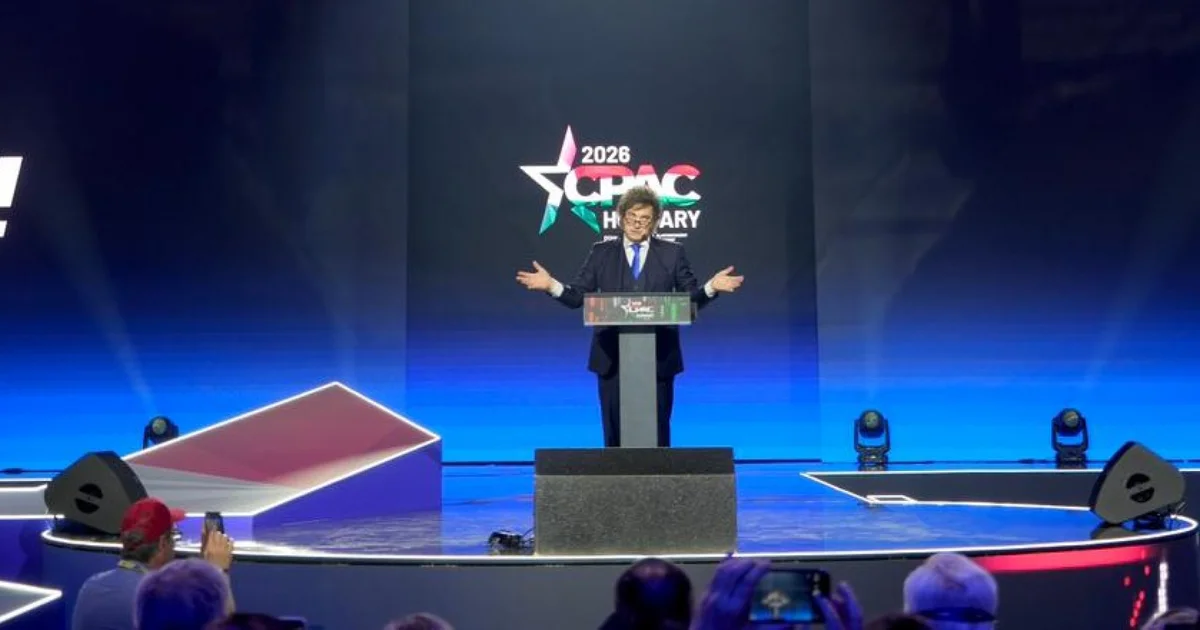
Javier Milei's Words at the Conservative Political Action Conference in Budapest
Casa Rosada19 min read
One topic in one place: the official text, the video, what happened on X, how each outlet told it and the full speech.
Framing breakdown
AI estimate · 80% confidence
Full speech (translation by MileiHoy)
Source: Casa Rosada (CC BY 2.5 AR). Translation by MileiHoy
Words from the President of the Argentine Nation, Javier Milei, at the Conservative Political Action Conference (CPAC) in Budapest, Hungary.
Javier Milei: Good afternoon to everyone, it is truly a pleasure for me to be here in Hungary, being the first President of Argentina to come to this beautiful country for the first time.
A country that I admire for so many brilliant minds, especially for one of the greatest geniuses of humanity, such as John von Neumann, and a whole tradition of great mathematicians. Furthermore, it is a country with an enormous history, a great tradition, and above all, an emblematic country of what the struggle against collectivists is, whether in the murderous versions of collectivists or in the well-mannered globalist, woke, socialist or leftist versions.
A Nation with which we share a love for the ideas of freedom and with whose Prime Minister, Viktor Orbán, we are united by a personal fraternity and a feeling of mutual admiration. It is also a pleasure to be a part of a new edition of CPAC, endless thanks to its organizers for the invitations and for the privilege of once again addressing an audience eager to take the cultural battle throughout the world. I consider it of vital importance to keep this flame alive; I refer to the ideas of freedom, which at all times there are those who are trying to extinguish, events like this contribute to keep this fire burning and serve as a guide for all men in the world.
Today I come to talk to you about a core concept of our government management which, although we have put into action from the very first moment, we have only recently put into words. I am talking about nothing less than morality as a State policy. This is, in brief, a decision-making methodology based on an inflexible order of priorities, which I will proceed to explain.
As you know, every decision made from a government role has three variables to consider. The first is the moral variable, that is, whether it is ethically correct, as Marcus Aurelius said, who perfectly summarized it in his Meditations: if it is not right, do not do it; if it is not true, do not say it.
The second variable to consider is whether the measure is economically efficient, that is, whether it generates prosperity. And finally, in third place, there is the variable of political utility, which is the
last in the line of priorities, that is to say, if it serves the politician who makes the decision on a personal level or not.
For us, who think in terms of generations rather than political cycles, this order is clear and self-evident. Morality, what is morally right—that is to say, the defense of the right to life, to liberty, and to property—always, without exception, comes first, and political calculation, always without exception, comes last.
This moral framework functions as a platform, I would say the only moral platform created to date, upon which free enterprise capitalism, the most efficient economic system in generating prosperity and wealth and lifting billions out of poverty, can naturally arise. And ultimately, it is economic growth that ends up generating political utility, because any politician under whose mandate their people thrive will extract some form of political gain.
In Argentina, for 100 years, the diametrically opposite was done. Politicians doubted private property, issued money without backing, indebted entire generations that have yet to be born, and engaged in countless economic and moral aberrations of all kinds, all with the primary objective of favoring their political trajectories in the short term leading up to each election, to the detriment not only of the material well-being of their people but also of their moral integrity.
And by this, I mean that the politician transmits their obsession with the short term to the market and the population, forcing them to adapt to increasingly narrow timeframes. That is to say, the State, which should, more than any other actor in society, safeguard the long-term interests of a nation, ends up unable to even think three years ahead.
In this way, the process of civilization is reversed, pushing people into a state of barbaric immediacy, where day-to-day priorities prevail over future projects, and this becomes most apparent during inflationary processes, where the uncertainty about tomorrow's prices leads to the destruction of today's savings and production. Thus, we inherited a country that had spent years repeating this harmful behavior, which left us by the end of 2023 on the brink of the worst crisis in our history, with inflation exceeding 200% and heading directly towards hyperinflation, as we had a daily inflation rate of 1.5%.
It was thanks to applying our heuristics with conviction that we managed to keep the country afloat. That is to say, from an inflation that had been hovering around 15,000% annually, we moved to an inflation rate around 30%, and probably by the end of our term, in this first term, we will finish exterminating it.
In the economic sphere, the pursuit of political convenience led our politicians to constantly incur debt to finance themselves and their friends. At the time of payment, since adjusting spending and fulfilling contracts seemed politically unacceptable to them, they chose to default again and again on our debts, undermining trust in our country around the world and its capacity for economic growth. As that was not enough to stop their compulsive spending, they continued to do so, but financed it with monetary emission, eroding the salaries of all Argentinians and destroying our currency, which...
We removed 13 zeros in successive inflationary processes that include two hyperinflations without war and a third one that we managed to avoid in time upon assuming our mandate.
And all of this, always in a context of high fiscal pressure and regulatory madness that made commerce unviable. Without a doubt, the public spending spree, reflected in chronic fiscal deficit, always responded to the most frivolous of political needs of the leaders. For 100 years, our politicians, whether out of malice or ignorance, believed that the optimal path to economic efficiency was centralized planning. This was a colossal mistake that led us to the most terrible of failures: we were heading directly to Cuba with a stopover in Venezuela.
But this choice does not apply only to Argentina; it can be observed as a constant throughout the history of humanity: all Western countries have suffered, to a greater or lesser extent, from the fatal arrogance of politicians.
Not to mention, the Soviet Union, which promised paradise on Earth, ended up causing the death of 100 million people and the return of cannibalism at a time when the global trend was prosperity. The great experiment, as some Western socialist intellectuals called it from the comfort of their prosperous countries, imposed long prison sentences on those who, desperate from the hunger generated by their failed system, stole a handful of flour or an ear of corn.
Or what about Cuba? After almost 70 years of a so-called childish revolution that only mattered to the Castro family, they left a population steeped in the most abject misery, and this week they had to announce a change in economic model; that is to say, they are having their own perestroika and that, surely before the middle of the year, with the leadership of that great man who is Donald Trump, we will probably see a free Cuba.
In each of these cases, we can see that the making of these terrible decisions, which sacrificed freedom at the altar of supposed efficiency, was guided by political utility. Planning gives infinitely resources to the current communist to do whatever he wants, and all these errors or evils occurred because they abandoned the thought of first considering the moral order, or better said, they did so obeying their own twisted moral order.
That is why we call communists those who want to follow the same path in Western countries that managed to accumulate wealth by doing exactly the opposite, and this also applies to those who are well-mannered: the well-mannered socialists who wrap themselves in good people and who, deep down, dictate policies that exterminate nations.
Because, although they always renounce the successive failed experiments and seek to distance themselves by calling themselves socialists or social democrats, they share the same principles. For all this, we, as I already explained, took the opposite path. Although everyone said it was impossible, in our first month in office we made the largest adjustment in the history of humanity on public spending to meet our debt payments and thus begin to restore our country's credibility. More or less, to make sure that
In order to have a frame of reference, we reduced public spending in real terms by 30%, which is to say an adjustment of 5 points of GDP, something that was claimed to be impossible to achieve over a term, and we did it in one month. Because in a gigantic State that exploits its citizens, it is only right, above all, to reduce the weight of the State. Although everyone said it was impossible, six months into our mandate we eliminated all sources of monetary issuance to stop deceiving Argentinians with seigniorage and thus restore confidence in our currency, a fundamental condition for being able to grow economically.
Specifically, this refers to the quasi-fiscal deficit, that is, the deficit of the Central Bank, which was around 10 points of GDP, and we were able to fix it in six months, meaning that in the span of six months, under our government we made an adjustment of 15 points of GDP, that is, we returned to the good Argentinians nearly 90 billion dollars. Although everyone said it was impossible, we began to gradually open up our economy so that our truly competitive sectors could compete globally and thrive, and so that Argentinians could access high-quality goods at the best price; and we will not rest until we become the freest and most open Nation in the world.
As a result of adopting these measures, thanks to our moral filter, we have managed to reduce poverty from 57% to 30%, which means we have lifted more than 15 million Argentinians out of poverty, representing, obviously, millions of Argentinians being lifted from poverty. We have also managed to lower the country risk from around 3000 basis points to about 600 points, and we have begun to receive investments in our territory amounting to approximately 100 billion dollars.
Here, in Europe, on the contrary, they have been taking the opposite decision-making matrix for decades, just as it happened in Argentina, albeit at a different pace: first they analyze what is convenient for the politician or the bureaucrat, then what is economically efficient, and finally, they analyze what is morally correct, if they even do that, and they always disguise it as virtue. In the name of compassion, they attacked property, in the name of equality, they destroyed merit, in the name of a hollow universalism, they ceded the sovereignty of their nations to bureaucrats that no one elected.
Every time European politics made a bad decision, they did so with a noble cause in hand, and that is the trick, that is the trap, because behind every noble cause there is a very concrete political equation: creating dependents is creating voters, each subsidy is a bought vote, each regulation is a favor collected, each open border is an expanded electoral roll, they do not do it out of compassion, they do it because it suits them, and they put a humanitarian flag on top so that no one dares to question them.
Let us take as an example economic policy and immigration policy. As we all know, in Europe they pride themselves on being a nanny state, that is, taking proportionally from those who generate the most wealth, violating the principle of property and equality before the law in the process, to redistribute it with the rest of society in the form of services. In other words, they consider that the economy is like a cake: they are focused on managing and deciding what
the slice belongs to whom, instead of focusing on how to make the cake keep growing. This generates the economic stagnation that has been observed for some time in the region.
And the further away from the individual the pinnacle of power is, the worse the consequences of this attempt at planning are. National subjugation to unilateral decrees and supranational organizations replaces sovereignty and individual freedoms with the whims of the current bureaucrats. When power is separated from the responsibility that comes with representation, it can quickly turn into tyranny.
In fact, in the speech just mentioned, my dear friend Santiago Abascal referred to the fledgling tyrant that they have in Spain. If we add to this the migratory issue, which indiscriminately increases the number of recipients of pieces of the pie without any requirement for contribution of any kind, it ends up defrauding the population that has paid taxes for so many years, returning to them a system headed for collapse.
As a result of this action, Europe has been left without growth, without the rule of law, and it is already becoming evident that its leaders have also lost any political credibility, and none of this can take us by surprise, because as the saying goes, "we can ignore reality, but we can never ignore the consequences of ignoring reality," Ayn Rand said.
And with this, I want to say something that seems obvious but that politics tends to obscure: ideas are not abstract; ideas have real consequences in people's lives. When a society chooses freedom, things improve; we are seeing it in Argentina. When a society chooses socialism, things worsen: we saw it in the Soviet Union, we see it in Cuba, we see it in Venezuela, we experienced it ourselves during 100 years of progressive decline in Argentina.
It is not a matter of luck, it is not a matter of natural resources, it is not a matter of history or geography; it is a matter of decisions. Nations that embrace freedom, private property, and the moral order of Western civilization progress; those that abandon it decline, always, without exception.
That is why what is at stake in every election is not just who governs, it is what direction a people takes, and that direction matters. That is why Prime Minister Orbán and the Hungarian people are very clear: as a country that has experienced the misfortunes of communism firsthand, today they face the same spirit that I am recounting. They have placed their trust in the determination and courage of Prime Minister Orbán to carry it forward, and he is indeed someone worthy of admiration for his enormous task.
Hungary has then become a country that decides to do what is right over what is well-regarded; this relentless action has led it to remain firm with its immigration policy, going against the tide of the entire region that pressured it to open its borders. In contrast, Europe, due to doing what made politicians look good in world newspaper headlines, today finds itself facing a disproportionate crisis in this matter and many others.
In this sense, I feel that my friend Viktor and I have something important in common: we both started to fight these battles long before it was popular to do so. When I said in Argentina that socialism was destroying us, I was an outcast; they didn't invite me to programs, no party called me, journalists looked at me like a crazy person, and yet I continued to say it because it was the right thing to do.
Viktor, in parallel, was the first to stand up to all of polite Europe, to say what no one wanted to hear: that the West was in danger, that Europe was committing suicide, that uncontrolled mass immigration was not an act of generosity but an act of irresponsibility towards its own people. He said it when it still cost him dearly to do so, and that is called courage.
Today, years later, the facts have vindicated those who spoke the truth in time, and this is exactly what distinguishes a statesman from a politician: the statesman speaks the truth before it is convenient to say it. Therefore, my message tonight for all of you is the following: when the bad and the bad people impose themselves as the norm, it is our duty to defend ethics, morality, justice, and truth more bravely than ever. No matter how much they try, how much they invest in media, how much they impose legislation, we must not allow ourselves to be convinced that what is bad is good: what is bad is bad, even if millions of people defend it.
In this sense, I want to add a phrase that is in Virgil's epic poem Aeneid, which Ludwig von Mises used to repeat; first I will say it in Latin, which I will obviously pronounce horribly wrong, but I will attempt it, and it goes: 'Tu ne cede malis, sed contra audentior ito,' which means: never yield to evil, but fight it with even greater strength, and indeed Viktor is doing just that.
Today we are faced with a reconfiguration of the world order, and the way we insert ourselves into this new world that is being born will determine the fate of our nations. The era of global cooperation without a moral compass has come to an end. Too many institutions that were born to mediate conflicts and guarantee peace were captured by bureaucrats who turned them into instruments to impose an ideological agenda on the peoples. What was meant to be an impartial arbitrator became an actor with its own agenda, and the result is evident.
Times of change require a correct diagnosis, a calibrated moral compass, and the courage to act. In this world, increasingly, the waters will be divided between free nations and subjugated nations. Hungary and Argentina are two nations that are very clear about this and are embracing the winds of change. That is why we support initiatives such as the Board of Peace of the President of the United States, Donald Trump.
When countries that share principles act decisively and in coordination, real progress is made without getting trapped in the inertia or ambiguity that often paralyzes certain international organizations. Argentina joined from day one because we believe in diplomacy that takes risks to achieve peace. In our country, this path is already beginning to yield concrete results: macroeconomic order, the unconditional respect for property.
Private defense of life and the recovery of clear rules have returned predictability, investment, and growth.
This process does not go unnoticed in the region and in the world: more and more countries observe this experience as a reference and begin to take a similar path.
For example, Argentina is now in a position to guarantee Europe’s energy security. We are experiencing a gold rush in energy investments; imagine that by 2030 we will export over 30 billion dollars per year. Europe has sought energy independence for years; we offer something better: a reliable partner, with enormous reserves and a government that honors its contracts.
Argentina thus returns to occupy a leading role, not through imposition, but through example and what it has to offer the world, driving a broader movement that seeks to reclaim the greatness of America on the basis of freedom.
This movement already has a name on our continent; it is the decision of the people to make America great again. It is the conviction that only on the basis of liberty, order, and respect for the values that gave rise to our civilization is it possible to build a future of prosperity, and that same conviction is what is beginning to make its way in Europe today. Europe does not need to reinvent itself; it needs to reconnect with itself, return to its roots, regain confidence in its history, and leave behind the logic of permanent guilt. On that path, Hungary occupies a central place, and Víktor Orban has become one of the clearest and bravest voices in the task of returning Europe to its course.
Now Hungary is approaching a new turning point, where two opposing moral models are at stake to lead the country in the coming years. That communism that once appeared under the Soviet flag now shows itself under another guise: it hides behind multiple noble and humanitarian causes, all seemingly independent, but intimately linked by a common agenda of war against tradition and hatred towards everything we consider good, beautiful, and sacred.
In a few weeks, the Hungarian people will speak again, and now more than ever we must be clear about what is truly at stake. What Hungary decides will resonate throughout Europe because when a nation stands firm against the pressures of political correctness, it shows other countries that it is also possible to resist and win.
When a nation decides to defend freedom, its families, its borders, and its traditions, it reminds other countries anesthetized by the engineers of decay that there is still time to react. And when a leader like Viktor Orbán fights that battle without asking for permission, he becomes a beacon for all of us who do not accept that the destiny of the West is a managed twilight.
Dear friend Viktor, you have our respect, our admiration, and our support. Hungary has in you a leader of exceptional courage and an indispensable voice for the future of Europe, and all of us who fight this battle in the name of freedom know that, when a
A statesman stands firm in defense of his people, not only protecting his Nation but also restoring hope to the world. That is why, thank you very much to everyone. May God bless Hungary, may God bless Argentina, may the forces of heaven accompany us, and viva la libertad, carajo (long live freedom, damn it). Thank you very much to everyone.
View the official text in Spanish
Palabras del Presidente de la Nación Argentina, Javier Milei, en la Conferencia de Acción Política Conservadora (CPAC) en Budapest, Hungría
Javier Milei: Buenas tardes a todos, es para mí un verdadero gusto estar aquí en Hungría, siendo el primer Presidente de Argentina en estar por primera vez en este hermoso país.
Un país que admiro por tantas mentes brillantes, en especial por uno de los más grandes genios de la humanidad, como fue, por ejemplo, John von Neumann, y toda una tradición de grandes matemáticos. Además, un país de una enorme historia, una gran tradición y, sobre todas las cosas, un país emblema de lo que es la lucha contra los colectivistas, ya sea en las versiones asesinas de los colectivistas o en las versiones de buenos modales globalistas, woks, socialistas o zurdos.
Una Nación con la que compartimos el amor por las ideas de la libertad y con cuyo Primer Ministro, Víktor Orbán, nos une una fraternidad personal y un sentimiento de admiración mutua. También es un placer ser parte de una nueva edición de CPAC, nunca son suficientes los agradecimientos a sus organizadores por las invitaciones y por el privilegio de dirigirme una vez más ante un público deseoso de llevar la batalla cultural a todo el mundo. Considero de vital importancia mantener viva esta llama, me refiero a las ideas de la libertad, que en todo momento hay quienes están intentando extinguirlas, eventos como este contribuyen a que este fuego siga encendido y sea una guía para todos los hombres del mundo.
Hoy vengo a hablarles de un concepto troncal de nuestra gestión de gobierno que, si bien hemos puesto en acción desde el primer momento, tan solo hemos puesto en palabras recientemente. Hablo, ni más ni menos, de la moral como política de Estado. Esto es, en pocas palabras, una metodología de toma de decisiones basada en un orden inflexible de prioridades, el cual pasaré a explicar.
Como ustedes saben, cada decisión que se toma desde un rol del gobierno tiene tres variables a considerar. La primera es la variable moral, es decir, si es éticamente correcto, tal como dijo Marco Aurelio, que lo resumió perfectamente en sus Meditaciones: si no es correcto, no lo hagas; si no es verdad, no lo digas.
La segunda variable a considerar es si la medida es eficiente económicamente, es decir, si genera prosperidad. Y, por último, en tercer lugar está la variable de la utilidad política, que es la
última en la línea de prioridades, es decir, si al político que toma la decisión le sirve a título personal o no.
Para nosotros, que pensamos en generaciones en lugar de ciclos políticos, este orden es claro y autoevidente. La moral, lo moralmente correcto —es decir, la defensa del derecho a la vida, a la libertad y a la propiedad— siempre, sin excepción, está primero, y el cálculo político, siempre sin excepción, está al final.
Este marco moral funciona como una plataforma, diría la única plataforma moral creada hasta la fecha, sobre la cual puede surgir naturalmente el capitalismo de libre empresa, el sistema económico más eficiente a la hora de generar prosperidad y riqueza y sacar miles de millones de la pobreza. Y por último, es el crecimiento económico lo que termina generando la utilidad política, porque cualquier político bajo cuyo mandato su pueblo prospere sacará alguna forma de rédito político.
En la Argentina, durante 100 años, se hizo diametralmente lo contrario. Los políticos pusieron en duda la propiedad privada, emitieron dinero sin respaldo, endeudaron a generaciones enteras que aún no han nacido y un sinfín de aberraciones económicas y morales de toda índole, todo con el objetivo principal de favorecer sus trayectorias políticas en el corto plazo de cara a cada elección de turno, en detrimento no solo del bienestar material de su pueblo, sino de su integridad moral.
Y con esto me refiero a que el político transmite su obsesión por el corto plazo al mercado y a la población, obligándolos a adaptarse a marcos temporales cada vez más acotados. Es decir, el Estado, que debería, más que ningún otro actor en una sociedad, velar por los intereses a largo plazo de una nación, termina sin poder pensar siquiera a tres años.
De esta manera, se revierte el proceso de civilización, empujando a las personas hacia un estado de inmediatez barbárica, donde el día a día prevalece por sobre el proyecto a futuro, y en ningún momento queda esto más claro que en los procesos inflacionarios, en donde la incertidumbre por los precios del mañana lleva a una destrucción del ahorro y la producción de hoy. Así, nosotros heredamos un país que venía de años y años repitiendo esta conducta nociva que nos dejó hacia finales del 2023 al borde de la peor crisis de nuestra historia, con una inflación de más del 200% y que viajaba directamente a una hiperinflación, ya que teníamos una inflación diaria del 1,5%.
Fue gracias a aplicar con convicción nuestras heurísticas que logramos sacar el país a flote. Es decir, de una inflación que venía viajando en torno al 15.000 % anual, pasamos a una inflación que está en torno al 30, y probablemente sobre el final de nuestro mandato, en este primer mandato, la terminaremos de exterminar.
En el ámbito económico, la búsqueda de la conveniencia política llevó a nuestros políticos a endeudarse constantemente para financiarse a sí mismos y a sus amigos. Al momento de pagar, dado que ajustar el gasto y cumplir los contratos les parecía políticamente inaceptable, optaron por defaultear una y otra vez nuestras deudas, dinamitando la confianza en nuestro país alrededor del mundo y su capacidad de crecimiento económico. Como eso no alcanzó para dejar de gastar compulsivamente, siguieron haciéndolo, pero financiándolo con emisión monetaria, licuando los salarios de todos los argentinos y destruyendo nuestra moneda, a la que le
quitamos 13 ceros en sucesivos procesos inflacionarios que incluyen dos hiperinflaciones sin guerra y una tercera que logramos evitar a tiempo al asumir nuestro mandato.
Y todo esto, siempre en un contexto de alta presión fiscal y locura regulatoria que hacían inviable el comercio. Sin duda, la fiesta del gasto público, traducida en déficit fiscal crónico, obedeció en todo momento a la más frívola de las necesidades políticas de los dirigentes. Durante 100 años, nuestros políticos, sea por malicia o por ignorancia, pensaron que el camino óptimo a la eficiencia económica era la planificación centralizada. Esto fue un error garrafal que nos condujo al más terrible de los fracasos: estábamos yendo con destino directo a Cuba y con parada intermedia en Venezuela.
Pero esta elección no aplica solo a la Argentina, sino que puede observarse como una constante a lo largo de la historia de la humanidad: todos los países occidentales han sufrido, en mayor o menor medida, de la fatal arrogancia de los políticos.
Sin ir más lejos, la Unión Soviética, que prometió el paraíso en la Tierra, terminó causando la muerte de 100 millones de personas y el regreso del canibalismo en una época donde la tendencia global era la prosperidad. El gran experimento, como lo llamaban algunos intelectuales occidentales socialistas desde la comodidad de sus países prósperos, llegó a imponer largas penas de prisión a aquellos que, desesperadamente por el hambre que generaba su sistema fracasado, robaban un puñado de harina o una mazorca de maíz.
O ¿qué decir de Cuba? Que tras casi 70 años de una supuesta revolución infantil que solo le importaba a la familia Castro, dejaron a una población sumida en la más abyecta miseria, y esta semana tuvieron que anunciar un cambio de modelo económico; es decir, están teniendo su propia perestroika y que, seguramente antes de mitad de año, con el liderazgo de ese gran hombre que es Donald Trump, probablemente veamos a Cuba libre.
En cada uno de los casos podemos ver que la toma de estas pésimas decisiones, que sacrificaron la libertad en el altar de la supuesta eficiencia, fue guiada por la utilidad política. La planificación le da infinitos recursos al comunista de turno para hacer lo que le da la gana y todos estos errores o maldades ocurrieron porque abandonaron pensar primero que nada en el orden moral, o mejor dicho, lo hicieron obedeciendo a su propio orden moral retorcido.
Por eso llamamos comunistas a quienes quieren transitar el mismo sendero en los países occidentales que lograron acumular riqueza haciendo exactamente lo contrario, y eso vale también para los que son de buenos modales: los socialistas de buenos modales que se arropan de gente buena y que, en el fondo, dictan políticas que exterminan naciones.
Porque, si bien ellos siempre reniegan de los sucesivos experimentos fallidos y buscan desmarcarse llamándose a sí mismos socialistas o socialdemócratas, comparten los mismos principios. Por todo esto, nosotros, como ya expliqué, tomamos el camino opuesto. Aunque todos dijeron que era imposible, en nuestro primer mes de mandato hicimos el ajuste más grande de la historia de la humanidad sobre el gasto público para afrontar nuestros pagos de deuda y así comenzar a recomponer la credibilidad de nuestro país. Más o menos, para que
tengan un orden de magnitudes, bajamos el gasto público en términos reales un 30%, es decir, un ajuste de 5 puntos del PBI, que decían que era imposible hacerlo a lo largo de un mandato, y lo hicimos en un mes. Porque en un Estado gigante que explota a sus ciudadanos, lo justo es, antes que nada, bajar el peso del Estado. Aunque todos dijeron que era imposible, a los 6 meses de nuestro mandato eliminamos todas las fuentes de emisión monetaria para dejar de estafar a los argentinos con señoreaje y así recomponer la confianza en nuestra moneda, condición fundamental para poder crecer económicamente.
Concretamente, esto hace referencia al déficit cuasifiscal, es decir, el déficit del Banco Central, que era del orden de 10 puntos del PBI, y eso lo pudimos arreglar en 6 meses, quiere decir que en el lapso de 6 meses, en nuestro Gobierno hicimos un ajuste de 15 puntos del PBI, es decir, le devolvimos a los argentinos de bien cerca de 90.000 millones de dólares. Aunque todos dijeron que era imposible, comenzamos a abrir gradualmente nuestra economía para que nuestros sectores verdaderamente competitivos pudieran competir globalmente y proliferar, y para que los argentinos pudieran acceder a bienes de máxima calidad al mejor precio; y no descansaremos hasta convertirnos en la Nación más libre y abierta del mundo.
Fruto de adoptar estas medidas, gracias a nuestro tamiz moral, hemos logrado bajar la pobreza del 57% al 30%, es decir, sacamos de la pobreza a más de 15 millones de argentinos, lo que representa haber sacado, obviamente, millones de argentinos de la pobreza. También hemos logrado bajar el riesgo país del orden de los 3000 puntos básicos en torno a los 600 puntos y hemos comenzado a recibir inversiones en nuestro suelo por aproximadamente 100.000 millones de dólares.
Aquí, en Europa, por el contrario, llevan décadas tomando la matriz decisoria opuesta, tal como sucedía en Argentina, aunque a otro ritmo: primero analizan lo que le conviene al político o al burócrata, después lo que es económicamente eficiente y, por último, analizan lo que es moralmente correcto, si es que siquiera esto lo hacen, y lo hacen siempre disfrazado de virtud. En nombre de la compasión atacaron la propiedad, en nombre de la igualdad destruyeron el mérito, en nombre de un universalismo vacío cedieron la soberanía de sus naciones a burócratas que nadie eligió.
Cada vez que la política europea tomó una mala decisión, lo hizo con una causa noble en la mano, y ese es el truco, esa es la trampa, porque detrás de cada causa noble hay una ecuación política muy concreta: crear dependientes es crear votantes, cada subsidio es un voto comprado, cada regulación es un favor cobrado, cada frontera abierta es un padrón electoral expandido, no lo hacen por compasión, lo hacen porque les conviene y le ponen una bandera humanitaria encima para que nadie se atreva a cuestionarlos.
Tomemos por ejemplo la política económica y la política migratoria. Como todos ya sabemos, en Europa se vanaglorian de ser un Estado niñera, es decir, quitarle proporcionalmente a los que más riqueza generan, violando el principio de propiedad y la igualdad ante la ley en el proceso, para redistribuirlo con el resto de la sociedad en forma de servicios. Dicho de otra manera, ellos consideran que la economía es como una torta: están enfocados en gestionar y decidir qué
pedazo le corresponde a quién, en lugar de enfocarse en que la torta siga creciendo. Eso genera el estancamiento económico que se observa hace tiempo en la región.
Y cuanto más alejado del individuo se encuentra la cumbre del poder, peores son las consecuencias de este intento de planificación. La sujeción nacional a los dictámenes unilaterales y organismos supranacionales reemplaza la soberanía y a las libertades individuales por los caprichos de los burócratas de turno. Cuando el poder se separa de la responsabilidad que trae la representación, se puede convertir en tiranía muy rápidamente.
De hecho, en el discurso de recién mencionó mi querido amigo Santiago Abascal al pichón de tirano que tienen en España. Si a esto le sumamos la cuestión migratoria, que lo que hace es aumentar indiscriminadamente la cantidad de receptores de pedazos de la torta sin ninguna exigencia de aporte de ningún tipo, se termina estafando a la población que pagó impuestos durante tantos años, devolviéndoles un sistema camino al colapso.
Fruto de este accionar, Europa se quedó sin crecimiento, sin imperio de la ley y hoy ya está haciendo evidente que sus dirigentes se quedaron también sin credibilidad política alguna, y nada de esto puede tomarnos por sorpresa, porque tal como reza la frase, “podemos ignorar la realidad, pero nunca podremos ignorar las consecuencias de ignorar la realidad”, Ayn Rand dixit.
Y con esto quiero decir algo que parece obvio, pero que la política se encarga de oscurecer: las ideas no son abstractas, las ideas tienen consecuencias reales en la vida de las personas. Cuando una sociedad elige la libertad, las cosas mejoran; lo estamos viendo en Argentina. Cuando una sociedad elige el socialismo, las cosas empeoran: lo vimos en la Unión Soviética, lo vemos en Cuba, lo vemos en Venezuela, lo vimos nosotros durante 100 años de decadencia progresiva en la Argentina.
No es una cuestión de suerte, no es una cuestión de recursos naturales, no es una cuestión de historia o geografía, es una cuestión de decisiones. Las naciones que abrazan la libertad, la propiedad privada y el orden moral de la civilización occidental progresan; las que la abandonan decaen, siempre, sin ninguna excepción.
Por eso, lo que está en juego en cada elección no es solo quién gobierna, es qué dirección toma un pueblo, y esa dirección importa. Por eso el Primer Ministro Orbán y el pueblo húngaro lo tienen muy claro: siendo un país que vivió en carne propia las desgracias del comunismo, hoy encaran el mismo espíritu que estoy contando. Depositaron su confianza en la determinación y el coraje del Primer Ministro Orbán para llevarlo adelante, y vaya que es alguien digno de admiración por su enorme tarea.
Hungría se ha convertido entonces en un país que decide hacer lo correcto por sobre lo que está bien visto, ese accionar implacable lo llevó a mantenerse firme con la política migratoria, yendo a contramano de toda la región que lo presionaba para abrir sus fronteras. En contrapartida, Europa, por culpa de hacer lo que dejaba bien parados a los políticos en titulares de diarios del mundo, hoy se encuentra ante una crisis desproporcionada en esta materia y tantas otras.
En este sentido, yo siento que con mi amigo Viktor tenemos algo importante en común: ambos empezamos a dar estas batallas mucho antes de que fuera popular darlas. Cuando yo decía en Argentina que el socialismo nos estaba destruyendo, era un paria; no me invitaban a los programas, no me llamaban de ningún partido, los periodistas me miraban como un loco, y sin embargo seguí diciéndolo porque era lo correcto.
Víktor, en paralelo, fue el primero en pararse frente a toda la Europa bien pensante, de decir lo que nadie quería oír: que Occidente estaba en peligro, que Europa se estaba suicidando, que la inmigración masiva sin control no era un acto de generosidad sino un acto de irresponsabilidad con sus propios pueblos. Lo dijo cuando todavía le costaba caro decirlo, eso se llama coraje.
Hoy, años después, los hechos le dieron la razón a los que dijeron la verdad a tiempo, y esto es exactamente lo que distingue a un estadista de un político: el estadista dice lo que es verdad antes de que sea conveniente decirlo. Por eso, mi mensaje esta noche para todos ustedes es el siguiente: cuando lo malo y los malos se imponen como norma, es nuestro deber defender con más valentía que nunca la ética, la moral, la justicia y la verdad. Por mucho que lo intenten, por mucho que inviertan en medios, por mucho que impongan legislaciones, no debemos dejarnos convencer de que lo malo es bueno: lo malo es malo, aunque millones de personas lo defiendan.
En este sentido, quiero adicionar una frase que está en la novela Eneida de Virgilio, que solía repetir a Ludwig von Mises, primero la voy a decir en latín, que obviamente lo voy a pronunciar horriblemente mal, pero lo voy a intentar, y dice: “Tu ne cede malis, sed contra audentior ito”, es: jamás cedas ante el mal, sino combatelo con más fuerza, y vaya que Víktor lo está haciendo.
Hoy estamos ante una reconfiguración del orden mundial, y la forma en que nos insertamos en este nuevo mundo, que está naciendo, determinará el destino de nuestras naciones. La era de la cooperación global sin brújula moral ha terminado. Demasiadas instituciones que nacieron para mediar conflictos y garantizar la paz fueron capturadas por burócratas que las convirtieron en instrumentos para imponerle a los pueblos una agenda ideológica. Lo que debía ser un árbitro imparcial se convirtió en un actor con agenda propia, y el resultado está a la vista.
Tiempos de cambio requieren un diagnóstico correcto, una brújula moral calibrada y el coraje para actuar. En este mundo, cada vez más, se partirán las aguas entre las naciones libres y las naciones sometidas. Hungría y Argentina son dos naciones que lo tienen muy claro y están abrazando los vientos de cambio. Por eso apoyamos iniciativas como la del Board of peace del Presidente de los Estados Unidos, Donald Trump.
Cuando países que comparten principios actúan con decisión y coordinación, se logran avances reales sin quedar atrapados en la inercia o en la ambigüedad que muchas veces paraliza a ciertos organismos internacionales. Argentina se sumó desde el primer día porque creemos en una diplomacia que asume riesgo para alcanzar la paz. En nuestro país, ese camino ya empieza a dar resultados concretos: el orden macroeconómico, el respeto irrestricto a la propiedad
privada, la defensa de la vida y la recuperación de reglas claras han devuelto previsibilidad, inversión y crecimiento.
Ese proceso no pasa desapercibido en la región y en el mundo: cada vez más países observan esta experiencia como una referencia y comienzan a recorrer una senda similar.
Por dar un ejemplo, ahora Argentina está en condiciones de garantizar la seguridad energética de Europa. Estamos viviendo una fiebre del oro en inversiones de energía; imagínense que para 2030 exportaremos arriba de 30.000 millones de dólares por año. Europa buscó durante años la independencia energética; nosotros le ofrecemos algo mejor: un socio confiable, con reservas enormes y un Gobierno que honra sus contratos.
Argentina vuelve así a ocupar un lugar de protagonismo, no desde la imposición, sino desde el ejemplo y desde lo que tiene para ofrecerle al mundo, impulsando un movimiento más amplio que busca recuperar la grandeza de América sobre la base de la libertad.
Ese movimiento ya tiene nombre en nuestro continente, es la decisión de los de hacer grande América nuevamente. Es la convicción de que sólo sobre la base de la libertad, el orden y el respeto por los valores que dieron origen a nuestra civilización es posible construir un futuro de prosperidad, y esa misma convicción es la que hoy empieza a abrirse paso en Europa. Europa no necesita reinventarse, necesita reencontrarse consigo misma, volver a sus raíces, recuperar la confianza en su historia y dejar atrás la lógica de la culpa permanente. En ese camino, Hungría ocupa un lugar central y Víktor Orban se ha convertido en una de las voces más claras y valientes en la tarea de devolverle a Europa su rumbo.
Ahora Hungría se está acercando a un nuevo punto de inflexión, donde se ponen en juego dos modelos morales opuestos para liderar el país por los próximos años. Ese comunismo que antes aparecía bajo la bandera soviética hoy se muestra bajo otra apariencia: se oculta detrás de múltiples causas nobles y humanitarias, todas en apariencia independientes, pero íntimamente ligadas por una agenda común de guerra contra la tradición y odio hacia todo lo que consideramos bueno, bello y sagrado.
Dentro de pocas semanas, el pueblo húngaro volverá a pronunciarse, hoy más que nunca debemos tener en claro qué es lo que está verdaderamente en juego. Lo que Hungría defina tendrá eco en toda Europa porque, cuando una nación se mantiene en pie frente a las presiones de la corrección política, les muestra a otros países que también es posible resistir y vencer.
Cuando una nación decide defender la libertad, a sus familias, a sus fronteras y a sus tradiciones, les recuerda a otros países anestesiados por los ingenieros de la decadencia que todavía hay tiempo para reaccionar. Y cuando un líder como Viktor Orbán da esa pelea sin pedir permiso, se convierte en un faro para todos los que no aceptamos que el destino de Occidente sea un crepúsculo administrado.
Querido amigo Víktor, contás con nuestro respeto, con nuestra admiración y con nuestro apoyo. Hungría tiene en vos un líder de coraje excepcional y una voz indispensable para el futuro de Europa, y todos los que damos esta batalla en nombre de la libertad sabemos que, cuando un
hombre de Estado se planta con firmeza en defensa de su pueblo, no solo protege a su Nación, también le devuelve esperanza al mundo. Por eso, muchísimas gracias a todos. Que Dios bendiga a Hungría, que Dios bendiga a la Argentina, que las fuerzas del cielo nos acompañen y viva la libertad, carajo. Muchas gracias a todos.
Source: Casa Rosada(opens in a new tab)
Full original text in Spanish, published by Casa Rosada.